To understand why AI has become an important topic for FMCG, we need to look back at how the market is changing. As consumers access products through more channels, brands not only need to appear more frequently, but also need to create more relevant content for each behavior, need, and shopping context. This is the foundation that makes content speed and consumer data two major pressures in the new competitive race of FMCG.
1. Market Context: FMCG Enters a New Race for Content Speed and Consumer Data
FMCG needs more content across more touchpoints
In the past, FMCG content often revolved around major campaigns, TVCs, key visuals, POSM, promotions, or seasonal social posts. Today, however, the consumer purchase journey has expanded across more touchpoints: e-commerce, social commerce, livestreaming, retail media, retail apps, review communities, KOCs, and quick-commerce platforms.
This shift is clearly reflected in the growth of e-commerce in Vietnam. According to YouNet ECI data compiled by Cimigo, Vietnam’s e-commerce GMV in the first half of 2025 reached VND 222.1 trillion, equivalent to USD 8.49 billion, up 23.1% year-on-year. Notably, TikTok Shop grew 148% YoY and accounted for 42% of total GMV, showing that shopping behavior is shifting strongly toward platforms with higher levels of content, entertainment, and social commerce.
This has significantly increased the demand for FMCG content, both in terms of volume and flexibility. A product no longer needs only one general message, but multiple content versions tailored to each platform, each user group, each purchase moment, and each conversion objective. In Q1/2025 alone, Shopee, TikTok Shop, Lazada, and Tiki recorded total revenue of VND 101.4 trillion, up 42% year-on-year; TikTok Shop alone grew nearly 113.8%, increasing its market share from 23% to 35%. This signals that content-commerce is becoming an important part of the shopping journey, not merely a supporting communication channel.
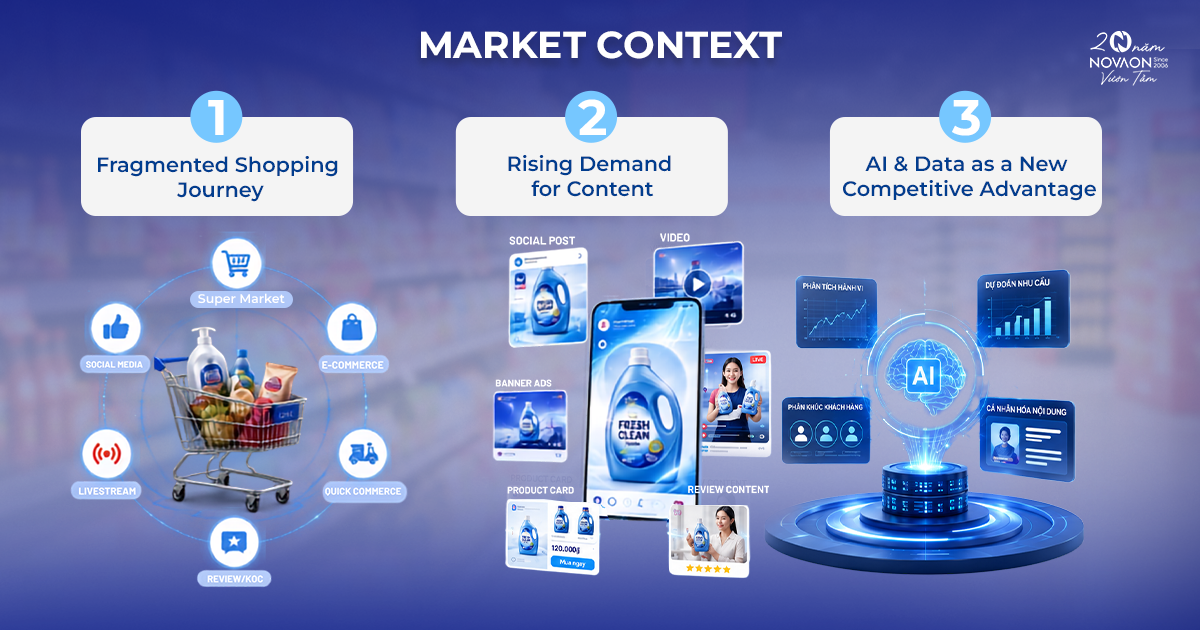
Market context: FMCG enters a new race for content and data.
Image source: Novaon Digital
AI unlocks personalization at scale
With data from search, social interactions, purchase history, shopping carts, livestream feedback, or in-app behavior, FMCG brands can understand consumers across more contextual layers. AI helps process these signals faster, thereby supporting brands in identifying demand clusters, predicting purchase likelihood, and delivering more relevant messages.
McKinsey reported that in its 2024 survey of CPG leaders, 71% said their companies had adopted AI in at least one function, up from 42% in 2023; at the same time, 56% said they were using GenAI regularly. McKinsey also pointed out that AI can participate in multiple points across the CPG value chain, from social listening and feedback mining to predictive trend sourcing. This shows that AI is no longer only an experimental tool, but is becoming a new competitive capability in the CPG/FMCG industry.
At the shopping experience level, NielsenIQ noted that AI is reshaping e-commerce by supporting dynamic product content, personalized journeys, and scalable content operations. AI can help create product descriptions, FAQs, promotional content, while also providing product recommendations based on each user’s preferences, browsing history, behavior, and context. For FMCG, this is the foundation for brands to shift from mass communication to experiences that are more relevant to the right person, the right need, and the right moment.
But speed cannot replace authenticity
As AI-generated content becomes more common, the market also faces a new risk: content is increasing in volume but can easily become repetitive, emotionally flat, or lacking in brand distinctiveness. For FMCG, this is especially important because products are directly connected to consumers’ everyday lives: food and beverages, personal care, family, health, hygiene, and daily convenience.
In reality, many major CPG brands have started using GenAI to accelerate marketing content production, but still place humans in a supervisory role. Reuters reported that Mondelez is deploying a GenAI tool with the goal of reducing marketing content production costs by 30–50%, having invested more than USD 40 million in the tool; however, the company still requires human review of outputs to avoid risks related to content, bias, or inappropriate messaging.
Therefore, the challenge for FMCG is not to let AI replace creativity entirely, but to use AI to support humans in understanding more deeply, working faster, and creating more precisely. AI can help brands accelerate production and optimize content, but authenticity, emotion, and brand identity still need to be guided by humans.
2. AI Trends Changing FMCG Marketing
Trend 1: AI Personalization – Personalizing experiences for each user
AI Personalization helps brands personalize content, offers, and messaging based on consumer behavior, needs, timing, and context. In FMCG, personalization does not only exist in advertising, but also appears in personalized vouchers, combo recommendations, seasonal content, or reminders for recurring product repurchases.
The key difference of AI lies in its ability to process data at scale. Instead of using one common message for the entire market, brands can design multiple layers of experience: new users need content that sparks demand, users in the consideration stage need reviews and validation, while existing buyers need repurchase offers or complementary products.
For FMCG, this trend helps brands appear at the right moments when consumers are more likely to buy. If FMCG brands once competed through shelf visibility, in the AI era, they need to compete through the ability to understand consumer context accurately.
Trend 2: AI-generated Commerce Content – Accelerating commerce content production
AI-generated Commerce Content is becoming an important trend as FMCG brands need to produce more content for more platforms. A product no longer needs only a hero image or seasonal social post, but also marketplace product descriptions, product cards, captions, livestream content, chatbot scripts, banners, short videos, and multiple creative variations for different customer groups.
This trend is most effective in always-on commerce campaigns, mega sales, product launches, or multi-SKU campaigns, where brands need to deploy a large volume of content within a short period of time. For brands with multiple product lines, SKUs, or sales seasons, AI can help shorten the process of creating content variations, optimize messaging for each channel, and support the testing of multiple creative directions.
However, AI-generated content should not be seen as the starting point of creative strategy. AI can help brands scale content, but insight, Big Idea, tone of voice, and the brand identity system still need to be led by humans. If AI is used only to produce faster, brands can easily fall into a race for quantity; but if AI is used to expand a clearly defined creative direction, content can become both faster and more consistent.
Trend 3: AI Shopper Recommendation – Recommending products based on purchase behavior
AI Shopper Recommendation in FMCG does not stop at suggesting “similar products” on e-commerce platforms. Its greater value lies in the ability to turn shopping data into contextual recommendations: whether consumers are buying for breakfast, preparing items for the family, looking for personal care products, stocking up for the month, or hunting for deals during peak seasons. When brands understand the “shopping mission” behind each basket, they can recommend products with a more relevant role instead of appearing as a random option.
This trend is especially suitable for campaigns that drive conversion at digital points of sale, such as e-commerce activation, quick-commerce, retail apps, D2C, or seasonal campaigns. For example, in personal care, AI can suggest combos based on usage routines; in food and beverages, AI can recommend products that pair with meals, holidays, or weather conditions; in household care, AI can remind consumers to repurchase based on household consumption cycles. At this point, recommendation does not only help sell more products, but also helps brands enter the exact moment when shoppers are making decisions.
From a strategic perspective, AI Shopper Recommendation helps FMCG shift from a “product-push” mindset to a “basket-building” mindset. Brands do not only compete to be seen on digital shelves, but compete to become the most relevant choice for each specific consumption need. When well connected with commerce data, CRM, and purchase behavior, recommendation can support basket size growth, drive cross-sell and upsell, activate repurchase, and provide reverse insights to brands on how consumers actually combine products in everyday life.
Trend 4: Predictive Marketing – Predicting demand before consumers make decisions
Predictive Marketing uses data and AI to forecast behavior, demand, or conversion likelihood before consumers make purchase decisions. For FMCG, this capability is especially important because market demand often fluctuates quickly according to seasonality, holidays, weather, geography, promotions, social trends, and shopping signals across digital platforms.
This trend is suitable for campaigns that require early decision-making, such as new product launches, Tet campaigns, summer campaigns, back-to-school campaigns, mega sales, regional campaigns, or demand generation activities. AI can help brands identify customer groups with high purchase likelihood, SKUs showing rising demand signals, the right timing to launch offers, content that should be prioritized, or media channels that deserve more budget allocation.
Unlike traditional performance marketing, which often optimizes after a campaign has already started running, Predictive Marketing helps brands become more proactive from the planning stage. However, this trend only creates value when data is sufficiently strong and connected. If data from media, commerce, CRM, and retail remains fragmented, forecasts will be difficult to translate into real actions. Therefore, for FMCG, predictive marketing is not only an AI challenge, but also a challenge of building a data foundation and a decision-making process based on market signals.
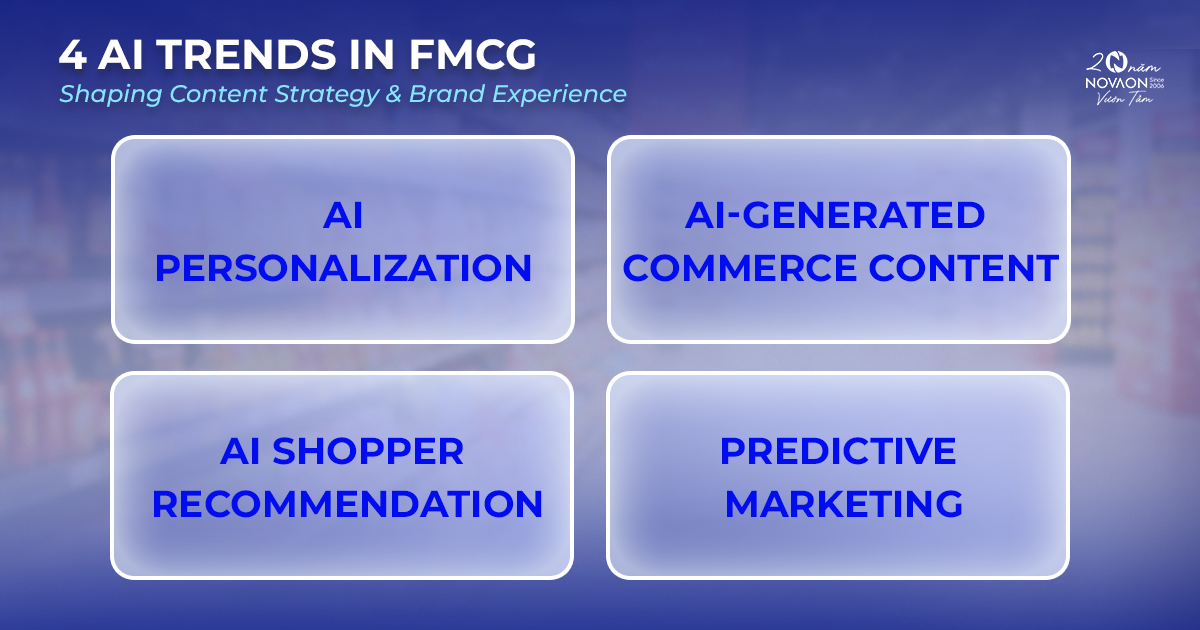
4 AI trends are shaping FMCG brand experience.
Image source: Novaon Digital
3. New Challenges and Opportunities: As Content Increases, Authenticity Becomes a Stronger Competitive Advantage
AI is helping FMCG create more content, faster and more flexibly. But this also puts the market at risk of a new form of saturation: content optimized by formula, images that are too perfect, messages that look increasingly similar, and experiences that lack a sense of reality.
For FMCG, authenticity is not a secondary factor. Consumers buy products that are directly connected to everyday life, so they need a sense of trust, familiarity, and verifiability. An honest review, a KOC with real experience, a clear livestream consultation, or a piece of content that reflects the right usage context can sometimes be more persuasive than a highly polished image that lacks emotion.
However, this is also an opportunity for FMCG brands to use AI more strategically. When AI can support content production, analysis, and optimization, humans have more room to focus on the elements that create differentiation: insights, ideas, brand storytelling, cultural perspectives, and real consumer emotions. Instead of using AI to create more similar content, brands can use AI to understand more deeply what content is worth creating, who to speak to, in which context, and how to optimize across each touchpoint.
This creates a new requirement for FMCG: AI cannot fully replace the role of humans in brand creativity, but it can amplify human capability when placed in the right role. If AI is used only to do more, brands can easily fall into a race for quantity. But if AI is used to support strategy, accelerate production, validate user responses, and optimize experiences, brands can create content that is faster, more relevant to consumer needs, and still consistent with their own identity.
Authenticity in the AI era, therefore, is not opposed to technology. On the contrary, it is the standard that ensures technology is used properly. AI needs to be guided by strategy, controlled by humans, and translated into meaningful experiences for consumers. When that happens, the challenge of content saturation also becomes an opportunity for FMCG to redefine the role of creativity: not only to create more content, but to create more trustworthy brand experiences.
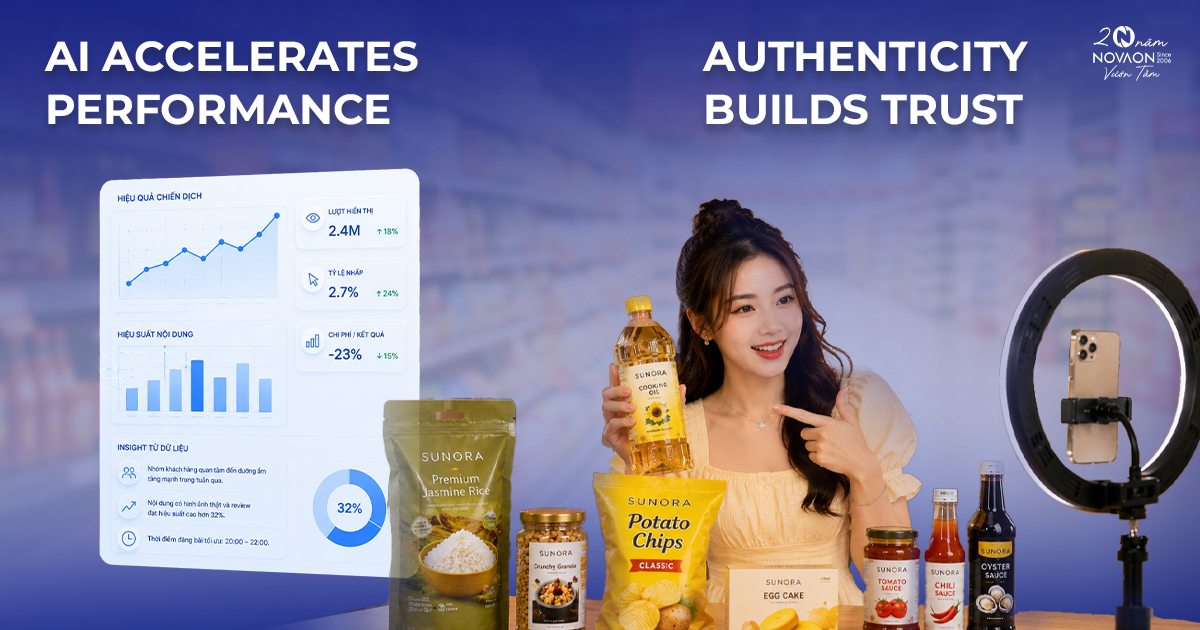
New challenges and opportunities in the AI era.
Image source: Novaon Digital
4. Conclusion: AI Is an Accelerator, but Humans Remain at the Center of Brand Experience
AI is becoming an important capability in FMCG marketing, helping brands create content faster, understand consumers more deeply, and personalize experiences across multiple touchpoints. From AI personalization, AI-generated commerce content, shopper recommendation to predictive marketing, technology is opening up a new approach for an industry that has always required speed, coverage, and high conversion capability.
However, in a market where more and more content is created by technology, competitive advantage does not lie only in production speed. The winning brand is not the one that creates the most content, but the one that knows how to use data and AI to create experiences that are more relevant, more trustworthy, and more emotional.
FMCG in the AI era therefore needs a balanced approach: technology to accelerate, data to deepen understanding, creativity to create differentiation, and humans to preserve brand authenticity.
Accompanying this shift, Novaon Digital provides a Brand Experience solution ecosystem for the FMCG industry, combining Strategy, Creative, and Technology to help brands apply AI effectively in content creation, experience personalization, and conversion optimization, while still preserving authenticity and the guiding role of humans across every brand touchpoint.