The automotive purchase journey is becoming longer and increasingly fragmented across touchpoints, from OOH exposure and online search to reviews, showrooms and test drives. In this environment, OOH, Digital and Activation can no longer operate as isolated workstreams. Effective IMC requires these channels to work as one connected Brand Experience, guided by Strategy, powered by Creative and optimized through Technology.
A prospective buyer may first encounter a new model on a DOOH screen, search for it on Google, watch reviews on YouTube, explore an online configurator and eventually register for a test drive. Purchase decisions are therefore not made at a single touchpoint. They are built progressively through repeated exposure, information gathering, comparison and real – world validation.
Yet many automotive campaigns remain structurally fragmented. OOH is tasked with reach, Digital with lead generation, and Activation with events. When messaging, data and KPIs are disconnected, brands struggle to understand which touchpoints actually contribute to test drives, bookings and sales.
The challenge for Automotive IMC is therefore not to add more channels, but to orchestrate them into a connected journey from awareness to conversion.
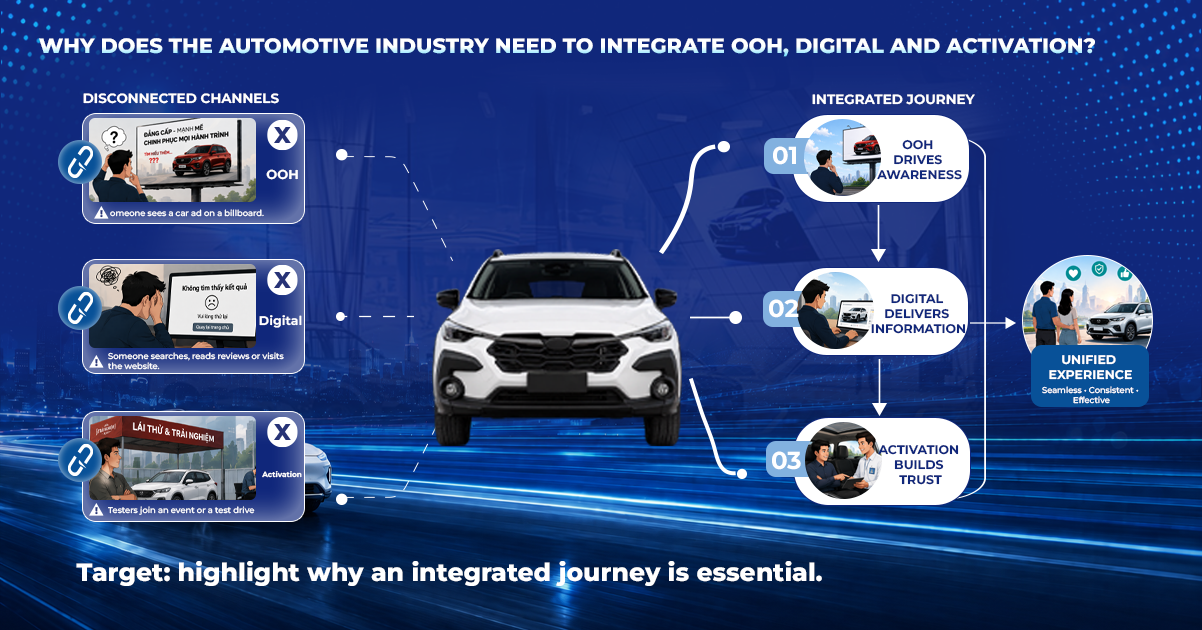
1. Why Automotive Needs OOH, Digital and Activation to Work Together
Source: Novaon Digital
Automotive competition is becoming more complex as new models, powertrain technologies, connected features and pricing strategies continuously reshape the category. Consumers are no longer comparing vehicles based solely on design or price. Safety, total cost of ownership, after-sales service, technology and long-term value increasingly influence consideration.
Deloitte’s 2026 Automotive Consumer Study surveyed more than 28,500 consumers across 27 markets. In Southeast Asia alone, 6,013 respondents across six countries, including Vietnam, participated. The findings reinforce the importance of multiple information sources throughout the purchase journey, including social media, influencer reviews, manufacturer websites and dealer visits. Product value, pricing transparency and physical experience continue to play significant roles in purchase decisions.
This creates three simultaneous requirements for automotive marketing: establish brand perception, provide sufficient information for consideration, and deliver credible product proof before purchase.
Each channel has limitations when deployed independently. OOH generates scale, physical presence and frequency, but its impact can weaken if exposure is not followed by Search, Social or a digital destination. Digital can identify intent and generate leads, but it cannot fully communicate a high-value product that consumers often need to experience physically. Activation provides that experience, yet its value declines if attendee data never returns to CRM or Sales for further nurturing.
The roles are therefore distinct but interconnected: OOH builds presence and salience; Digital captures and nurtures intent; Activation validates product value and strengthens purchase confidence.
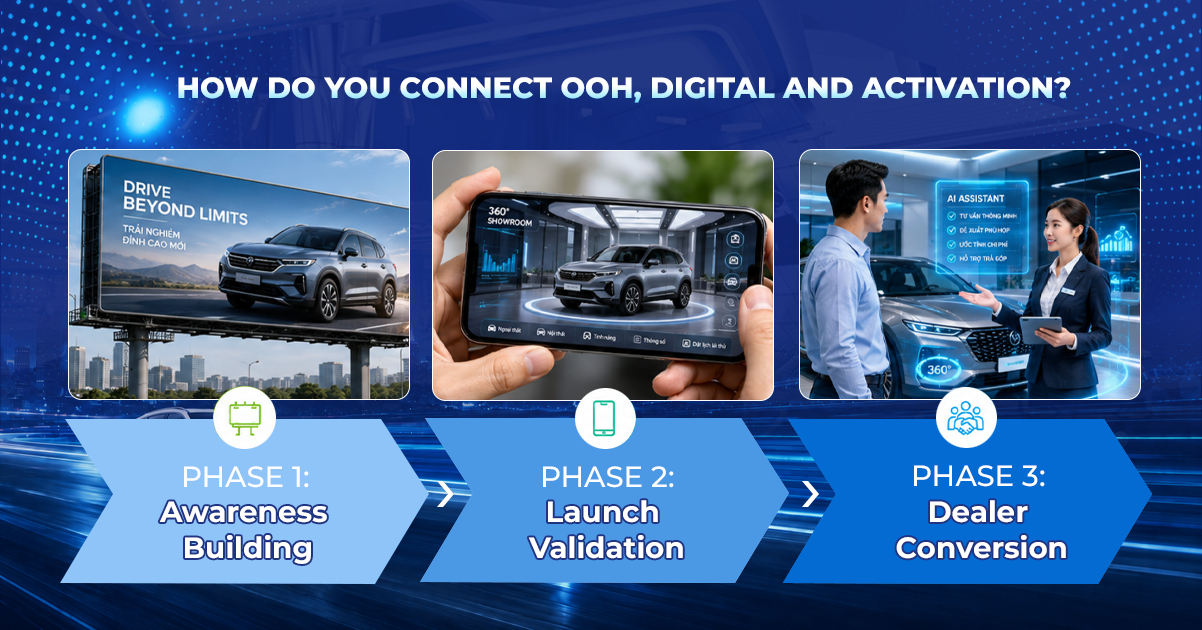
2. Connecting OOH, Digital and Activation Across the Automotive Journey
Source: Novaon Digital
Awareness Building – Capturing Attention and Stimulating Demand
At the top of the journey, OOH establishes physical visibility for a new vehicle. Billboards, DOOH, shopping-mall media, metro inventory and placements around high-value urban corridors or showroom catchment areas can be used to introduce teasers, key visuals and distinctive product propositions.
OOH should also be considered as an activation trigger rather than solely an awareness medium. A 2026 OAAA and Kochava study analysing hundreds of campaigns across seven industries found that the conversion rate from OOH exposure to digital action increased 5.3 times as exposure frequency rose from one to ten.
Digital then captures the interest generated by physical media. Search, Social, teaser videos and landing pages identify users who search for the model, consume product content or visit owned platforms. These behavioural signals can be used to build audience pools according to intent and engagement.
Activation may begin on a smaller scale at this stage through private previews, media previews or exclusive experiences for loyal customers.
The connection is straightforward:
OOH creates attention > Digital captures intent > Activation introduces product experience.
Launch Validation – Turning Product Claims into Experience
Once the product officially launches, OOH moves from teaser to reveal. Product imagery, core propositions and launch communication need to be synchronized with Digital, while programmatic DOOH can potentially adapt delivery based on location, time of day and proximity to showrooms.
Digital provides depth. TVCs, livestreams, expert reviews, creator content, configurators, AR/VR experiences and variant comparisons allow consumers to investigate the product beyond the initial impression. Lead Ads, chatbots and landing pages then translate consideration into test-drive registrations or consultation requests.
Activation provides the evidence layer. Launch events establish the product moment; Media Road Trips generate earned credibility; test drives validate driving performance; and technology demonstrations translate technical specifications into tangible customer benefits.
Crucially, Activation should not be treated as the end of the campaign. Reviews, user reactions, event footage and test-drive experiences become new social proof that can be redistributed through Digital and, where appropriate, OOH.
This creates a continuous feedback loop:
Digital drives participation > Activation generates experience, content and data > Digital amplifies proof > OOH continues directing demand toward showrooms.
Conversion Acceleration – Shortening the Path from Test Drive to Purchase
After launch, communication needs to shift from product introduction to conversion.
OOH can concentrate around high – intent locations and showroom catchment areas, using test – drive messaging, awards, expert endorsements and differentiated product benefits. Digital shifts toward retargeting, Search Ads, CRM nurturing and personalized messaging based on previous behaviour.
Activation becomes increasingly conversion-led, with test-drive weekends, product clinics, one-to-one consultations and showroom-based engagement designed to move high-intent prospects closer to purchase.
At this stage, Sales data becomes critical. Lead source, response status, test-drive participation and conversion outcomes must be returned to the marketing system. The KPI framework therefore needs to evolve into a connected funnel:
Reach > Search > Qualified Lead > Test Drive > Booking
The Subaru Forester DA9 campaign implemented by Novaon Digital illustrates this Digital – to – Activation mechanism. Teaser content created Warm Audiences; communication was differentiated between loyal Subaru customers and new prospects; livestreaming, a Media Road Trip in Sa Pa and SATD provided product validation; while Lead Ads continued driving test – drive and booking opportunities.
The campaign generated 88 bookings, reaching 126% of target, while test – drive registrations increased 148% and brand – related search grew 160%.
The available campaign materials do not record OOH deployment in this case. Its relevance therefore lies in demonstrating an important principle: Digital should not stop at the lead form. It needs to connect with product experience, showroom engagement and measurable commercial outcomes.
Brand Experience Powered by Strategy, Creative and Technology
For OOH, Digital and Activation to contribute to one consistent Brand Experience, campaigns need three interconnected capabilities: Strategy, Creative and Technology.
Strategy defines the business challenge, customer barriers, audience architecture, role of each touchpoint and full-funnel measurement framework. Media investment should be allocated according to contribution to the broader business objective rather than divided into isolated channel budgets.
Creative converts one strategic platform into multiple expressions across OOH key visuals, video, social content, creator partnerships, event concepts and test – drive experiences. Execution may vary by audience and context, but the underlying brand proposition must remain consistent.
Technology connects media exposure, lead forms, CRM, Call Center and dealer networks. Lead scoring, Marketing Automation, AI and Data Analytics help identify qualified prospects, prioritize follow – up and optimize campaigns against downstream outcomes rather than media metrics alone.
This is also how Novaon Digital approaches Automotive Brand Experience: Strategy architects the journey, Creative builds relevance across touchpoints, and Technology connects online behaviour with showroom and Sales data. Together, they create a full-funnel system that can be measured from awareness through test drive, booking and commercial impact.
3. An Automotive Marketing Perspective from Novaon Digital
Source: Novaon Digital
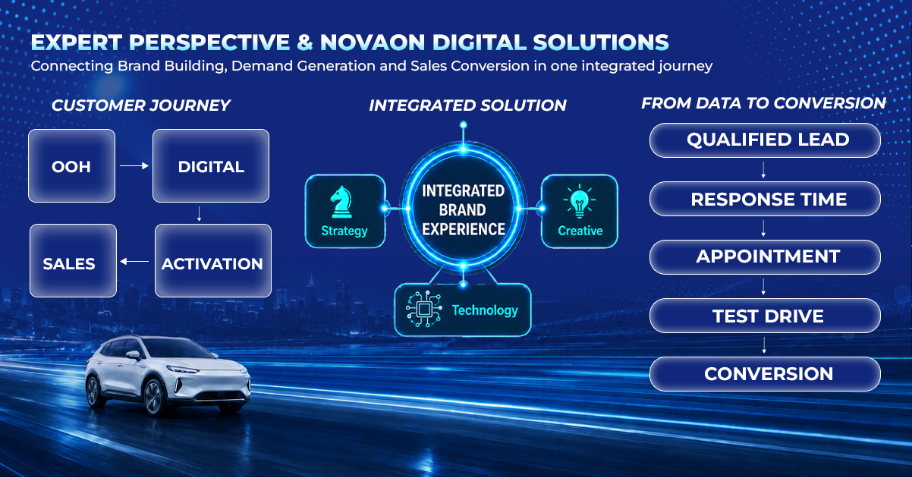
The real advantage of integrated Automotive IMC is not simply broader channel coverage. It is the ability to connect Brand Building, Demand Generation and Sales Conversion within the same customer journey.
OOH establishes physical presence and shapes perception. Digital captures demand through Search, Social, websites and lead-generation environments. Activation validates attributes that are difficult to communicate through content alone, including driving dynamics, safety technology and overall product quality. When these components work together, brands can move consumers more effectively from awareness to consideration, test drive and purchase.
The most common friction, however, often occurs during the handover between Marketing, Activation, dealers and Sales. A campaign may generate strong reach and large volumes of leads without producing equivalent business impact if prospects are poorly qualified, contacted too slowly or not nurtured after the first interaction.
Automotive marketers should therefore look beyond reach, views and engagement and track operational indicators such as qualified lead rate, lead response time, appointment show-up rate and test – drive – to – conversion rate.
Within this system, Novaon Digital brings three core capabilities. Strategy covers Customer Journey design, IMC Architecture, audience segmentation and measurement frameworks. Creative translates product advantages into a consistent communication platform across Social, video, creator content, livestreaming and Activation. Technology connects lead forms, CRM, Call Center and dealer networks while enabling lead scoring, automated nurturing, retargeting and closed – loop measurement.
Within the wider Novaon ecosystem, Novaon Media extends this capability into OOH, strengthening brand presence across physical touchpoints. Combined with Novaon Digital’s Strategy, Creative and Technology capabilities, this creates a more connected journey from awareness and engagement to data capture and conversion opportunities.
Looking ahead, programmatic DOOH, first-party data and AI will continue to improve contextual targeting, personalization and measurement. But technology alone will not solve a fragmented customer journey. Brands first need connected data architecture, clear lead handover protocols and full-funnel KPIs. Those foundations will ultimately determine whether an integrated automotive ecosystem delivers media efficiency or genuine business growth.
Conclusion
Consumers do not buy vehicles at a single touchpoint. OOH, Digital and Activation therefore should not be planned as three separate workstreams.
Effective Automotive IMC requires a clear connection between them: OOH captures attention, Digital nurtures demand, and Activation builds confidence and accelerates conversion.
When Strategy defines the journey, Creative creates relevance and Technology connects the underlying data, every touchpoint can contribute not only to awareness, but also to test drives, bookings and sustainable business growth.
Cre: BrandsVietnam