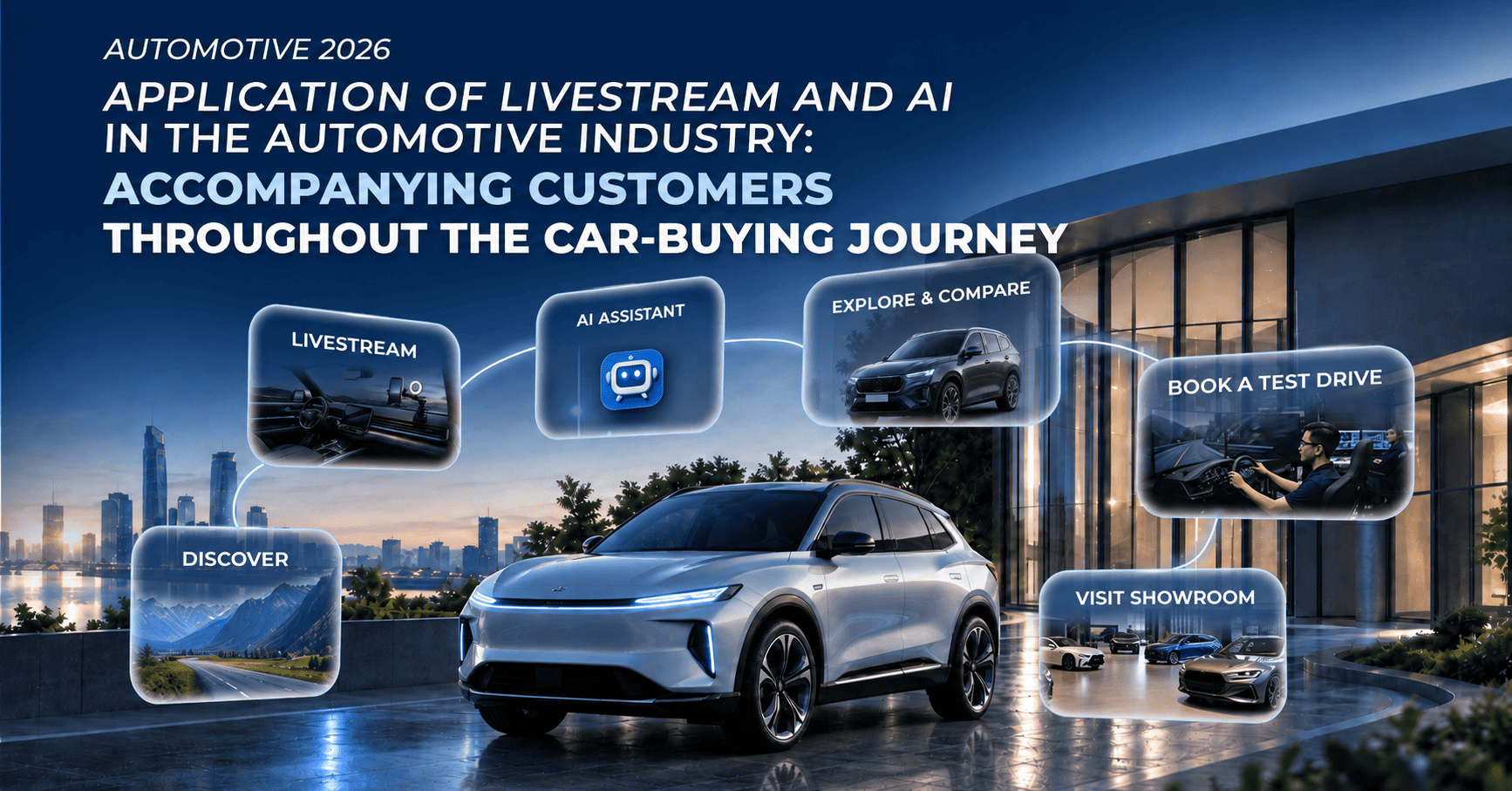
Behind this shift is more than the emergence of a new communication channel. It reflects a fundamental change in how car buyers discover, evaluate, and build trust in automotive brands. As the earliest stages of consideration increasingly take place in digital environments, businesses need to rethink how they present products, manage interactions, and connect data throughout the customer journey. To begin, it is important to understand the changes driving this transformation across the Automotive industry.
1. When the car-buying journey no longer begins at the showroom
Showrooms remain the place where customers test-drive vehicles and complete transactions, but they are no longer where the conversation begins. Before meeting a sales consultant, customers have already discovered vehicles on social feeds, watched livestreams, compared different variants, and asked chatbots for information. By the time they arrive at the showroom, many of their preferences have already been shaped by digital interactions.
According to Google data cited by Novaon Digital, 97% of car buyers in Vietnam search for information online before making a decision. Meanwhile, EY research shows that around two-thirds of car buyers use digital channels such as websites, applications, and social media to gather information. However, more than 60% still prefer interacting with dealerships during the stages of in-depth research, physical product experience, and purchase. This indicates that digital environments are not replacing the showroom. Instead, they are changing its role from the starting point of the journey into a place where customers validate information, test-drive vehicles, and finalize decisions that have already been shaped through multiple previous touchpoints.
This shift becomes even more significant during peak sales periods. According to VAMA, industry-wide sales reached 47,067 vehicles in December 2025, increasing by 20% compared with the previous month and 49% year-on-year. When demand is concentrated within a short period, competition is no longer driven solely by pricing, promotions, or dealership coverage. It also depends on a brand’s ability to appear at the right moment and influence customers early enough in their consideration journey.

The car-buying journey begins before the showroom.
Source: Novaon Digital
The challenge goes beyond going live
Livestream is increasingly becoming a bridge between digital experiences and physical showrooms, allowing customers to explore products, ask questions, and receive consultations directly on familiar platforms. In the automotive sector, the objective of livestreaming is not necessarily to complete a transaction immediately, but to shorten the research process and convert interest into consultation requests, quotation requests, or test-drive bookings.
However, every traditional livestream depends on hosts, product experts, and an operations team, while broadcasting time is limited and not every customer question can be answered immediately. Customer data generated after a livestream can also become fragmented across TikTok, Facebook, websites, and dealership systems. Studies on customer management in the automotive industry indicate that many businesses still lack a unified lead management process, creating the risk that a significant portion of potential customers may be overlooked after interacting with the brand.
Therefore, the challenge for businesses is no longer simply to organize another livestream. It is to build a system capable of maintaining continuous content operations, personalizing customer experiences, and connecting viewers directly with the sales process.
From Livestream to an AI-powered experience ecosystem
AI can support the livestream process from end to end. Before going live, technology can analyze customer interests, consolidate frequently asked questions, and help develop scripts tailored to specific vehicle models. During the livestream, AI Influencers can work alongside KOLs or experts to introduce products, respond to questions, and adjust content based on audience interactions. After the broadcast, AI can continue analyzing data, categorizing customer needs, and transforming livestream content into short-form videos for social media.

AI supports the entire livestream process.
Source: Novaon Digital
When combined with AR and 3D models, livestream can also evolve into a digital showroom. Viewers can explore vehicle interiors, examine exteriors from different angles, change body colors, or compare variants directly on their screens. This experience does not replace a physical test drive, but it helps customers understand the product more clearly and arrive at the showroom with more specific needs.
Building on its role as an information touchpoint, Xchatbot AI can instantly respond to questions about pricing, promotions, or test-drive schedules while continuing to nurture customers after the livestream. Within Novaon Digital’s ecosystem, OnLead collects data from social media, chatbots, websites, and hotlines; removes duplicates, categorizes customer needs, and then distributes leads to the appropriate sales teams.

Connecting digital experiences with the conversion journey.
Source: Novaon Digital
When Livestream, AI, AR, Xchatbot, and OnLead are connected, brands are not simply bringing vehicles onto social media. They are effectively extending the showroom to the very place where the car-buying journey begins. From the first moment a customer encounters the brand to the point of booking a test drive, every interaction can become a connected step in the overall experience and conversion journey.
2. The process of connecting Livestream, AI, and the car-buying journey
To convert customer interest on social media into sales opportunities, businesses need to clearly define the roles of three components: Livestream creates interactive touchpoints; AI supports analysis, personalization, and customer nurturing; while the purchase journey connects customers from social media to consultation, test drives, and the showroom.
Based on the foundation for Brand Experience in the Automotive industry, Novaon Digital has developed and applied the SCT model, combining Strategy, Creative, and Technology. The process can be implemented across five stages.

Five-stage process connecting Livestream, AI, and the car-buying journey.
Source: Novaon Digital
Stage 1: Design the customer journey
Before selecting platforms or developing content, businesses need to identify target customers, barriers to purchase, and the role of each touchpoint. Social media creates initial interest; livestream addresses customer concerns; chatbots receive questions; while sales consultants and showrooms complete the experience.
Digital Audit helps assess existing channels and available data, while Brand Strategy, Communication Strategy, and Media Strategy support the development of messaging, KPIs, and lead qualification criteria. Beyond views, campaigns should measure lead quality, response time, test-drive bookings, and showroom visit rates.
Stage 2: Build a Livestream content system
Livestream should be positioned within a broader content ecosystem that includes teasers, review videos, the main broadcast, Q&A content, and short-form post-event content. Each format serves a different purpose, from generating attention and explaining features to strengthening trust and encouraging test-drive registrations.
Creative Concept Live defines the theme, script, setting, and interaction flow; Digital Production develops visual and video assets; while Social Media Marketing and Onfluencer support platform selection and the identification of suitable KOLs, KOCs, or experts. This allows livestream to become a key moment within a unified content journey rather than an isolated activity.
Stage 3: Integrate AI and experience technologies
AI is introduced as a supporting layer once the livestream content strategy has been established. Before the livestream, AI helps consolidate questions and develop content. During the broadcast, technology supports comment filtering, responses to basic inquiries, and the identification of signals of customer interest. After the livestream, AI analyzes data and transforms content into short-form videos for redistribution.
AI does not replace hosts, experts, or KOLs. Instead, it makes preparation faster and improves the efficiency of customer responses. At the same time, Createch and AR/VR/XR Production enable customers to explore vehicle exteriors, experience interiors, change colors, or compare variants directly within digital environments.
Conversational Marketing Solution, chatbots, and OnLead should also be connected in advance to capture questions, forms, and interaction data, preventing situations where customer interest is high but the sales team cannot respond quickly enough.
Stage 4: Launch and operate the Livestream
Before the broadcast, social content, short-form videos, KOL/KOC activities, and Performance Media are deployed to attract the right customer segments. At the same time, the operations team needs to test connectivity, scripts, 3D visuals, Xchatbot, forms, and the lead transfer process.
During the livestream, hosts and experts focus on presenting products, answering customer questions, and building trust. AI works in the background to process questions, analyze interactions, and identify high-intent signals such as quotation requests or test-drive registrations.
Stage 5: Guide customers from social media to the showroom
After the livestream, content is edited into short-form videos for remarketing, while chatbots and Marketing Automation Solution continue nurturing customers based on their preferred vehicle models and level of interest.
For customers demonstrating clear purchase intent, OnLead collects data from social media, chatbots, websites, and forms, then removes duplicates, scores and categorizes leads, and transfers them to the appropriate sales consultant or dealership. Sales data is subsequently fed back into the campaign to optimize content, media performance, and lead quality.
Ultimately, effectiveness should not be measured solely through livestream views, but also through response speed, test-drive registrations, showroom visit rates, and conversion potential. Livestream builds trust, AI enhances processing capabilities, while the Strategy – Creative – Technology (SCT) ecosystem connects the entire journey from social media to sales.
3. OMODA & JAECOO: Building trust and driving conversion through TikTok Livestream
When entering the Vietnamese market, OMODA & JAECOO faced competition from numerous established brands with long-standing dealership networks. Beyond the challenge of building awareness, the brand also needed to address customer concerns regarding origin, quality, technology, warranty policies, and its long-term commitment to the Vietnamese market. Therefore, the communication objective was not simply to increase product awareness, but to provide customers with sufficient reasons to trust the brand, actively seek more information, and move closer to experiencing the vehicles themselves.
Instead of continuing to rely on one-way advertising, Novaon Digital and the brand adopted a Brandformance strategy combining brand-building objectives with conversion performance. Livestream was positioned at the center of the content ecosystem, while TikTok, Facebook, and Zalo expanded reach, maintained engagement, and continued connecting with audiences after each broadcast.

Omada Jaecoo x Novaon Digital
Source: Novaon Digital
One notable aspect of the execution was that the brand did not rely solely on KOLs or hosts to introduce its products. It also built personal brands for senior executives. By having leaders appear directly and answer technical questions about engines, technology, and long-term development strategies, corporate commitments were transformed into conversations represented by real people who could personally address customer concerns.
Around this central touchpoint, review videos, Q&A content, and real-world experiences provided additional evidence for viewers. Each content layer addressed a different concern: executives reinforced the brand’s commitments; experts clarified technologies; while reviewers and real-life experiences made the products more relatable. This “real people, real experiences” approach allowed the brand to build trust through evidence and dialogue rather than simply repeating specifications or advertising messages.
The journey consisted of three stages: Warm-up, which generated interest and directed customers to the livestream; Livestream, which provided information, answered questions, and built trust; and Lead Generation, which re-engaged users who had interacted with the content, captured their needs, and transferred the data to the sales team. As a result, livestream became the starting point for consultation and conversion.
This structure clearly demonstrates the role of each solution layer. Creative Concept Live can transform trust barriers into themes and content narratives; Influencer Marketing and Onfluencer support the selection of suitable voices; Social Media Marketing and Performance Media expand reach; while Lead Management connects signals of customer interest with sales consultants and dealership networks. These capabilities are not deployed as separate activities, but work together to support a journey from awareness and trust to action.
The campaign generated positive reach and engagement while also creating a source of quality leads for consultation and sales activities. The results demonstrate that the value of livestream in the Automotive industry is not limited to generating reach. Its greater value lies in bringing brands into deeper conversations with customers and generating data that can continue to support sales activities.
The key lesson for Automotive businesses is not to simply organize more livestream sessions, but to identify the right barrier to address and design an ecosystem of touchpoints around that barrier. When Strategy defines the problem, Creative transforms technical information into accessible experiences, and Technology connects interactions with sales data, Livestream can truly become a driver of growth rather than merely a short-term communication format.
4. Conclusion
As the car-buying journey increasingly begins on social media, a brand’s advantage no longer lies solely in its ability to appear in front of customers. It also depends on its ability to build enough trust to guide customers from online research to consultation, test drives, and eventually the showroom.
Within this journey, Livestream creates spaces for interaction, AI supports analysis and personalization, while data connects customer interest with sales opportunities. Through the Strategy – Creative – Technology model, Novaon Digital can support businesses in building a seamless Social First journey in which every touchpoint both enhances the customer experience and contributes to conversion performance.
This is also the approach Novaon Digital pursues through its Strategy – Creative – Technology model: beginning with an understanding of the customer journey, transforming insights into content experiences, and then using AI, interactive technologies, and data management to connect social media with sales consultants and showrooms. When these three layers operate in sync, Social First becomes more than a communication direction. It becomes a foundation that enables Automotive brands to build trust, optimize conversions, and generate sustainable growth.