The year-end shopping season puts fast-moving consumer goods (FMCG) brands under pressure on two fronts: competing for attention on social media while making the most of a short window to drive sales. When purchase decisions can be triggered by a product review video, a community discussion or a livestream, social outreach becomes more than an exercise in expanding reach. In this interview, Trần Lụa, Account Manager at Novaon Digital, shares her perspective on building a social outreach network, connecting influence with conversion goals and improving marketing effectiveness during the year-end peak season.
I. Social outreach for FMCG brands during the year-end sales push
The end of the year is always a fiercely competitive period for the FMCG sector. Shopping demand rises across many product categories, while brands roll out marketing campaigns, promotions and demand-generation activities to capture seasonal spending.
According to YouNet Media’s Winning Tết 2027 report, the Tết (Vietnamese Lunar New Year) 2026 season saw 151 marketing campaigns from 150 brands, up 14.39% and 17.19% respectively from the previous year. However, total discussion volume reached only 9.36 million, down 8.9% from Tết 2025. These figures point to growing competition in the Tết marketing landscape. With more campaigns competing for a smaller pool of discussion, investing in reach alone may not deliver a corresponding competitive advantage.
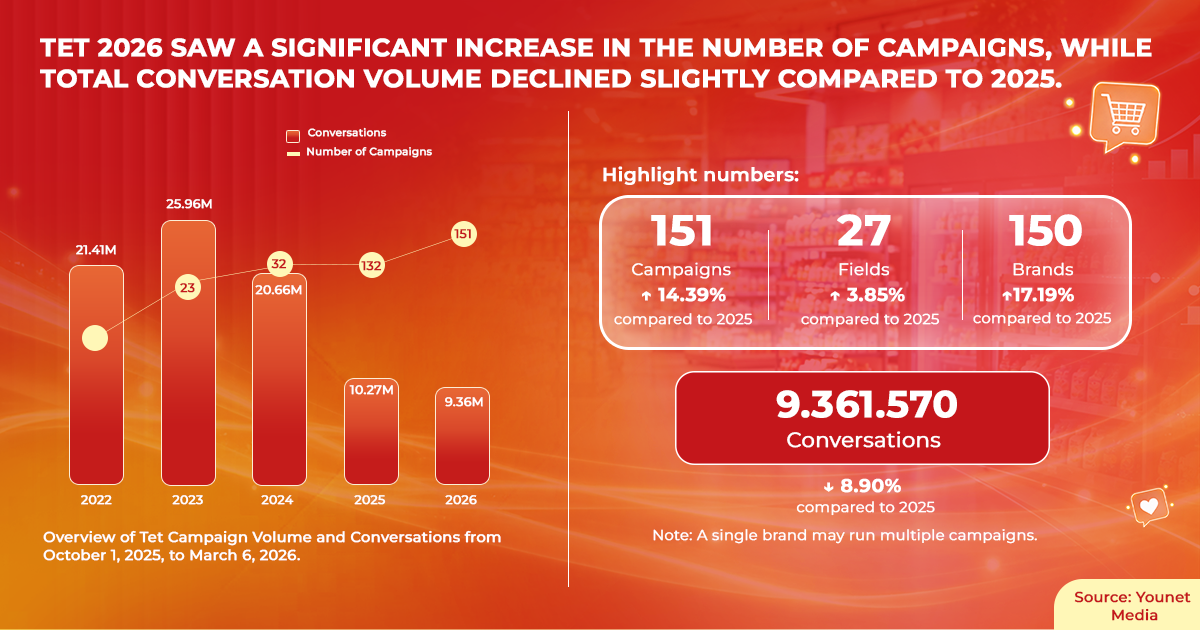
Competition intensified during Tết 2026, making the quality of discussion a greater priority for brands.
Source: Novaon Digital
This pressure is particularly relevant to FMCG, a sector characterised by frequent purchases, relatively low transaction values and consideration cycles that can be shorter than those in many other categories. On highly interactive platforms, consumers can move quickly from watching content to asking about prices, researching products or placing an order. The purchase journey therefore does not always follow a linear path from awareness to research and consideration. Content that meets a real need, delivered by the right creator and paired with an attractive offer, can prompt a purchase at the moment of engagement.
Social outreach is an approach through which brands expand their reach and build influence via networks of content creators, key opinion leaders (KOLs), key opinion consumers (KOCs), online communities, social media pages and user-generated content (UGC). In the year-end FMCG landscape, it needs to be understood as more than booking KOLs and KOCs or distributing content in online communities. The challenge is to connect social influence with time-sensitive conversion opportunities, especially when a short peak selling season leaves little room for delays in adjusting strategy.
What opportunities and challenges do FMCG brands face when communicating on social media during the 2026 year-end season, particularly under pressure to grow sales?
Ms. Trần Lụa:
The year-end season is both a major growth opportunity and a period of intense competitive pressure for FMCG brands. Shopping demand is stimulated by a succession of holidays, promotional events and preparations for the new year. Given the category’s relatively short purchase cycles and high repeat-purchase frequency, brands have many opportunities to reach consumers with an immediate need. However, rising demand does not automatically make consumers more likely to choose a particular brand.
At the same time, challenges come from several directions: competition between brands, rapidly changing shopping behaviour, the cost of reaching customers and businesses’ own need to use resources efficiently. As we enter the final stretch of Q4 2026, revenue and conversion performance become key priorities. Brands have little time for prolonged experimentation or activities that generate reach without demonstrating their value to business objectives.
Key considerations for social outreach during the year-end peak season
Source: Novaon Digital
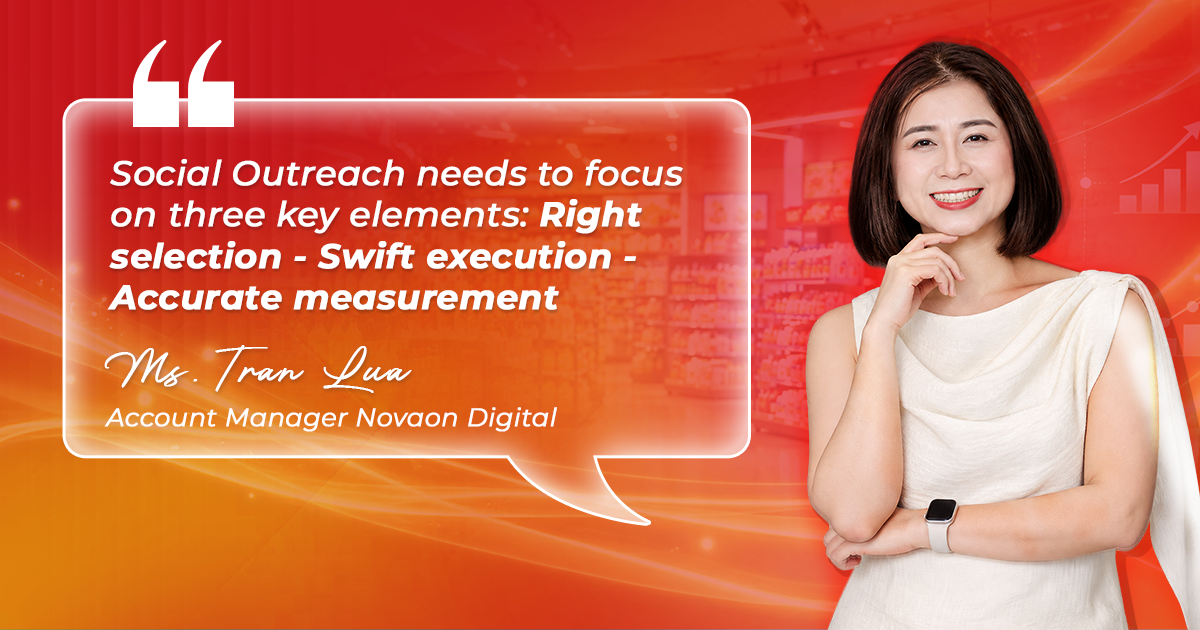
From an account management perspective, and based on my experience working with FMCG brands at Novaon Digital, I believe social outreach needs to focus on three principles: choose well, move fast and measure accurately.
Choose creators, communities and audiences with genuine purchase needs. Move fast when testing content and offers, and reallocate resources according to performance. Measure accurately by prioritising orders, revenue and conversion costs, while also tracking engagement quality and brand influence.
The goal of year-end social outreach is no longer simply to maximise reach or engagement. It is to turn conversations with the right audiences at the right time into opportunities for sales growth, which can also create a foundation for long-term brand value.
II. From creator strategy to conversion: Building social outreach around the right audiences and shopping moments
As KOLs and KOCs become a common feature of marketing campaigns, partnering with someone who has a large following is no guarantee that a message will resonate. The fit between the product, creator, community and usage context requires closer consideration. A product review, a conversation in a community group and a creative challenge can each play a different role in building awareness and consideration.
Social outreach should therefore begin with the structure of the network: who captures initial attention, who helps consumers understand the product, which communities are best suited to sustaining discussion, and what content themes connect these activities. Clear roles also help prevent multiple channels from repeating the same message without adding value.
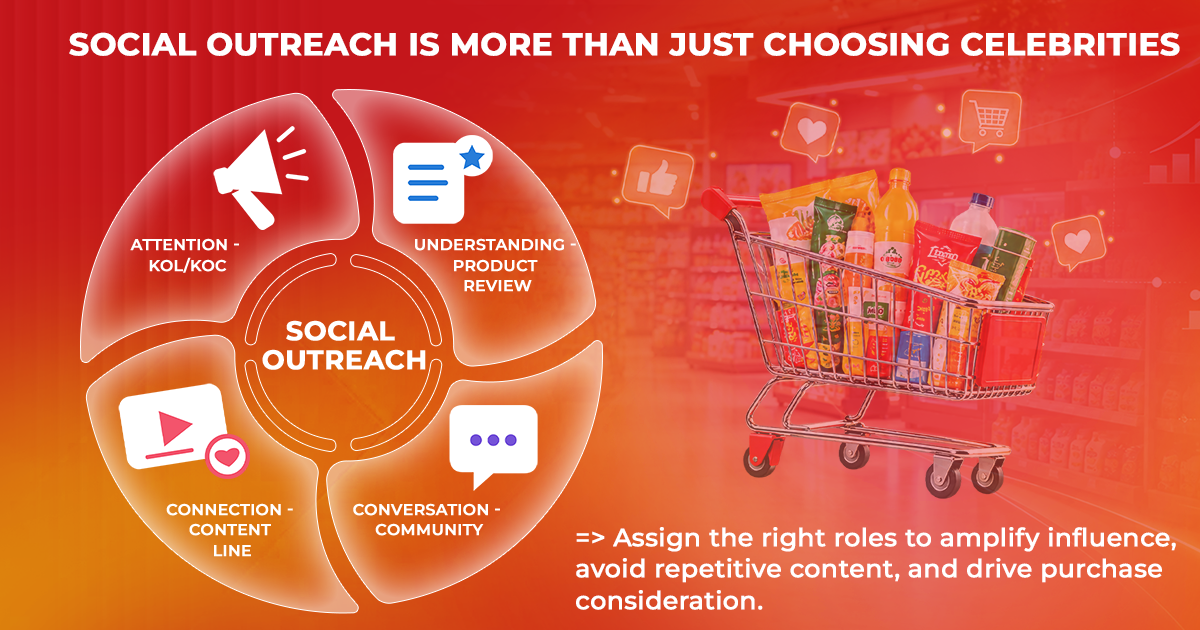
Effective social outreach gives each channel a clear role, connects content across touchpoints and avoids repetitive messaging.
Source: Novaon Digital
With so many FMCG brands investing in KOLs, KOCs and online communities at year-end, how should brands structure and allocate their social outreach network to build a competitive advantage beyond reach?
Ms. Trần Lụa:
To create a competitive advantage through social outreach, FMCG brands need to segment influencers by their role and potential contribution to business objectives, rather than focusing solely on reach.
High-profile KOLs can attract attention and build awareness; experts provide specialist perspectives, explain products and strengthen trust; while macro and micro creators, KOCs and UGC bring first-hand experiences and social proof, and can support conversion through affiliate marketing.
More importantly, influencer selection must be based on audience fit, engagement quality and demonstrated conversion ability. For creators who actively drive sales, often referred to as “key sellers”, brands should review gross merchandise value (GMV), add-to-cart (ATC) activity and completed orders. They should also break down the data, for example by distinguishing GMV generated through livestreams from GMV generated through shoppable videos. This helps identify the right partnership format and make the most of each creator’s strengths, rather than relying only on follower counts or views.
Each influencer group also needs its own content direction and KPIs, presenting the product from different angles to stimulate demand and encourage purchases. Budgets should reflect each group’s role and performance, avoiding excessive investment in famous names whose ability to convert may be unproven. What matters is not how many influencers a brand works with, but whether it selects the right people, assigns the right roles and allocates resources to generate business value.
Beyond selecting the right creator network, timing can determine the effectiveness of a social outreach strategy. In Q4, consumer needs and readiness to buy can shift quickly around promotional events, payday, online shopping campaigns and year-end holidays. Content that performs well early in a campaign may become less effective when consumers start looking for deals or are ready to make a purchase.
Social outreach plans therefore need to adapt across campaign stages, rather than keeping the same audiences, messages and execution throughout. Brands need to establish clear objectives, core messages and execution principles, while maintaining close, ongoing coordination with their creator network to capture short-lived shopping opportunities.
Early on, creator content can introduce usage occasions and stimulate demand. As the peak approaches, product reviews, deal-focused communities and content directing shoppers to relevant outlets can make purchase consideration more concrete. Immediately before the holiday, information on product availability, delivery times and suitable points of sale may become more important than content designed purely to attract attention. The exact approach should be adapted to the product category and distribution network.
FMCG products typically have short purchase cycles, and shoppers may decide to buy while interacting with content. During the year-end peak season, how should brands choose creators and purchase triggers at each stage to avoid missing conversion opportunities?
Ms. Trần Lụa:
FMCG is characterised by frequent purchases, short consideration cycles and purchase decisions that can happen at the point of engagement. In Q4 in particular, consumer behaviour changes constantly around sales events, stock-up needs, gifting and preparations for the festive season. Brands therefore need to adapt their choice of creators, platforms and conversion triggers to each moment, rather than following a fixed plan.
At the launch stage, high-profile KOLs and macro creators can quickly attract attention and stimulate demand. Facebook is suited to expanding community discussion, while TikTok is well placed to spread short-form videos and generate interest through entertainment and product experiences.
As the campaign gains momentum, brands should increase the involvement of micro creators, KOCs and creators who offer first-hand reviews to reach audiences with specific needs. Content should explore customer value, product experience and year-end usage occasions in greater depth. Execution also needs to suit each platform: visual, fast-paced videos on TikTok; reviews and community conversations on Facebook; and product information and shopping offers on e-commerce platforms.
During the final sales push, prioritise creators who have demonstrated conversion ability through shoppable videos, affiliate marketing or livestreams. During livestreams in particular, creators need to respond continuously to viewers: spend more time on demonstrations when shoppers are interested in product benefits, answer questions as they arise, and adjust bundles, vouchers or time-limited offers to encourage purchases. For FMCG, bundle value, gifts with purchase and savings on multi-buy offers can be important purchase triggers.
Trần Lụa’s perspective on choosing creators and purchase triggers during the peak sales push
Source: Novaon Digital
However, creators and platforms should not be assigned rigidly to specific stages. Brands need to monitor engagement, product clicks, conversion rates and GMV by creator, content asset and livestream, so they can adjust audiences, messaging and budgets promptly.
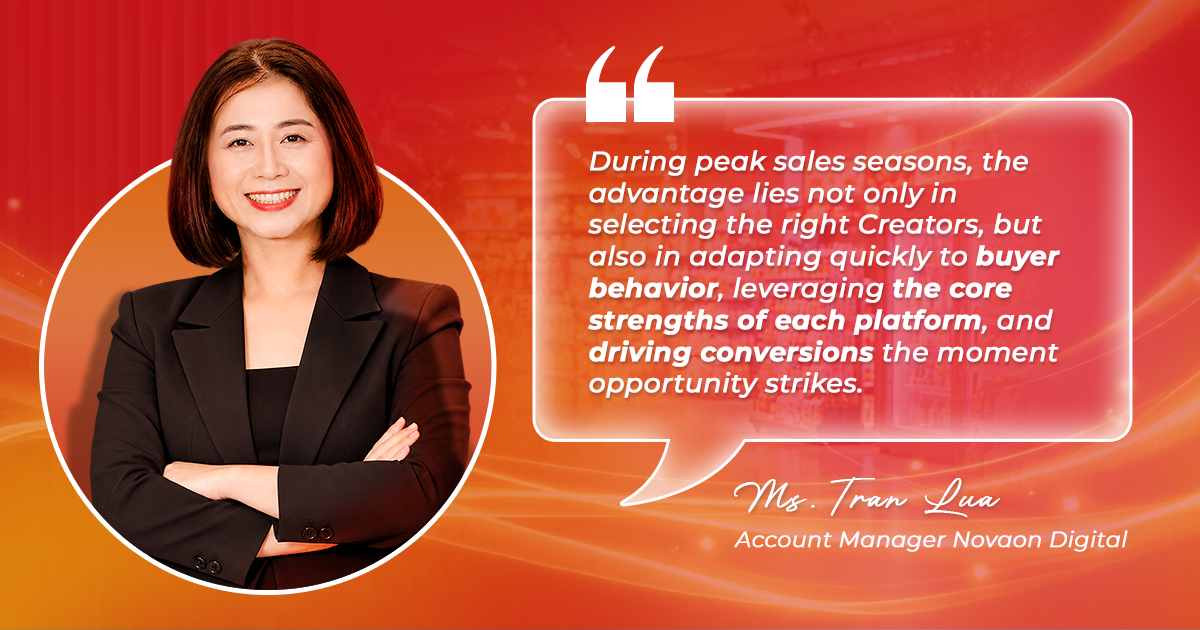
During the peak sales push, competitive advantage comes not only from choosing the right creators, but also from adapting quickly to shopper behaviour, using each platform’s strengths and activating conversion opportunities as they emerge.
III. Measuring social outreach from discussion quality to business performance
When social outreach is expected to support sales, performance assessment cannot stop at reach, views or total discussion volume.
YouNet Media’s Winning Tết 2027 report adds a perspective on engagement quality through its Qualified Users and Content From Qualified Users (CFQU) metrics. Of the 9.36 million discussions about Tết 2026 campaigns, approximately 1.32 million came from qualified users, corresponding to a ROCFQU of 14.14%.
These metrics help brands look beyond discussion volume to assess the quality of user participation. However, they still measure social media activity and do not directly represent orders or revenue.
To track social outreach’s contribution during the selling season, brands need a measurement framework with several layers. Alongside reach and engagement quality, this can incorporate signals closer to purchase behaviour, such as product clicks, store visits, promotional code redemptions and trackable transactions.
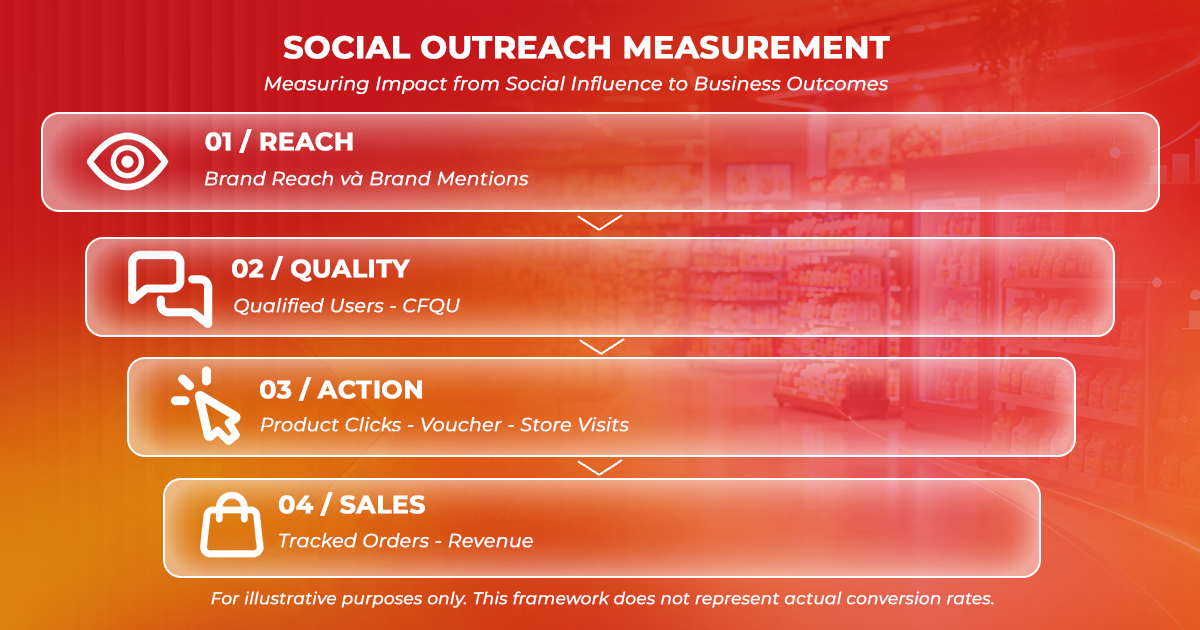
Social outreach measurement should connect reach, discussion quality, shopping behaviour and actual conversions.
Source: Novaon Digital
When sales become a core objective of a year-end FMCG campaign, which metrics should brands use to assess and optimise social outreach, and demonstrate its contribution to business results?
Ms. Trần Lụa:
When sales are a core objective, social outreach should be measured by campaign stage and influencer group, rather than against a single set of KPIs. The priority is to define primary metrics, supporting metrics and expected performance levels at the planning stage.
During the awareness stage, reach, views, engagement and brand mentions help assess audience exposure and influence. As the campaign moves into a stronger sales push, the focus should shift to product clicks, add-to-cart activity, orders, GMV and conversion costs. Influencers should be assessed according to their campaign role and proven strengths. For awareness objectives, brands should prioritise reach and influence. For sales objectives, the focus should be on the ability to generate orders and revenue, whether the partner is a high-profile KOL with a proven sales record, a KOC or an affiliate creator.
Alongside KPIs, brands need to set acceptable cost thresholds for each creator group and campaign stage. Examples include a maximum cost per order, a target return on ad spend (ROAS), or a target ratio of GMV to creator fees. These thresholds should reflect profit margins, order values and business objectives, rather than simply comparing revenue with the cost of a KOL partnership.
During the Q4 peak in particular, data needs to be integrated and updated in near real time so brands can assess performance by creator, content, platform and individual livestream. This allows them to adjust budgets, messages and offers, or choose more suitable creators for subsequent stages, instead of waiting until the end of the campaign to review results.
Finally, brands need to distinguish revenue attributed to promotional codes or shopping links from the incremental revenue actually generated by the campaign. The effectiveness of social outreach lies not just in reported numbers, but in how data is used to make timely decisions, control costs and improve conversion opportunities during the selling season.
The year-end festive season creates growth opportunities while putting FMCG brands under pressure to make faster decisions in a constantly changing media environment. From targeting the right audiences and defining the roles of creators and communities to adapting content around shopping moments, social outreach requires a combination of strategy, agile execution and appropriate measurement. When outreach activities are closely connected to shopping signals and performance data, brands have a stronger basis for allocating resources, capturing conversion opportunities and pursuing sales growth during the peak season.
Thank you for sharing your insights.