From financial transactions to meaningful brand moments, here’s how banking and finance brands can rethink Brand Experience for the 2026 festive season.
The year-end festive season is a peak shopping period and a time when a wide range of financial needs come into play. From paying for gifts and booking travel to budgeting for Tết and deciding how to use a year-end bonus, each activity involves a financial decision shaped by different needs, expectations and emotions.
This is the basis for a shift from Promotion-led Marketing to Moment-based Brand Experience. By combining Strategy, Creative and Technology, financial brands can play a meaningful role in the situations that matter to customers.
1. The market context: How the 2026 festive season brings Financial Moments into focus
The shopping season now spans several occasions in Q4 2026, Vietnam’s shopping calendar brings together a series of sales and celebrations, from 10.10, 11.11 and 12.12 to Christmas, New Year 2027 and Tết, Vietnam’s Lunar New Year. This extended shopping season creates more occasions for consumers to make payments, use credit, save and manage their finances.
The Holiday Shopping Study, conducted by Ipsos on behalf of Meta and released in Vietnam in September 2026, shows how Vietnamese consumers participate in shopping across these festive occasions.
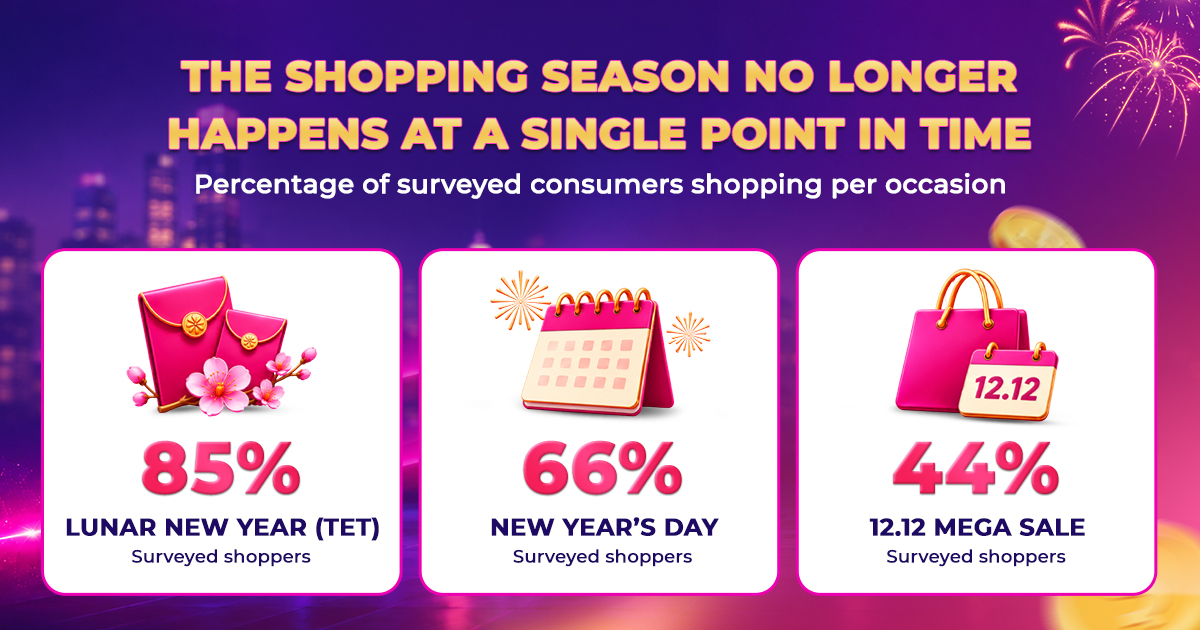
Shopping participation across festive occasions shows how demand extends throughout the season, giving banking and finance brands more opportunities to show up as financial needs arise.
Source: Novaon Digital
Recent surveys suggest that consumers want to preserve the festive experiences they value while managing their budgets more carefully.
According to Ipsos’ Tet 2026 Sentiment survey, 84% of respondents said they spent the same amount or more during Tết 2026 than in the previous year. Consumers were more deliberate about what they spent on, prioritising purchases that mattered to their families. 53% did most of their shopping within one to two weeks before Tết, underscoring the importance of reaching customers when their needs arise.
A survey by Worldpanel by Numerator Vietnam also found that around 60% of respondents planned to cut spending on non-essential products during Tết 2026. Consumers were actively deciding where to spend, how to allocate their budgets and what each purchase was worth to them.
Digital payments are part of the festive shopping journey
Alongside changing shopping habits, Vietnam’s digital payment ecosystem continues to expand, bringing financial services into more everyday activities.
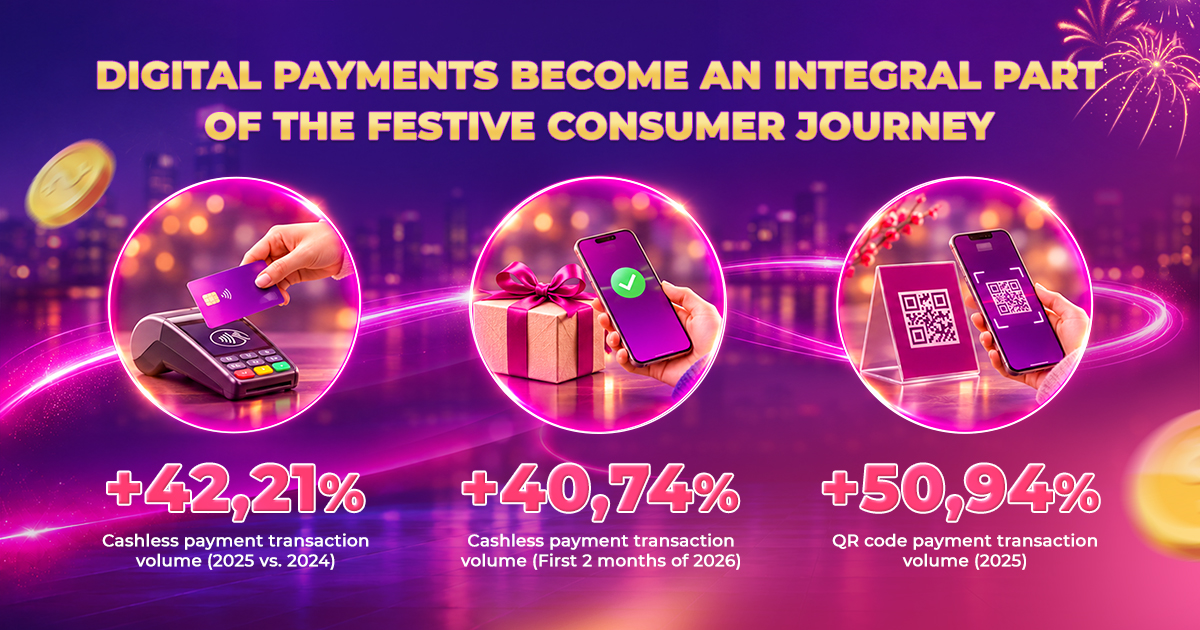
Digital payments are becoming part of the festive shopping journey.
Source: Novaon Digital
The widespread use of digital banking, QR codes and online payments gives financial brands opportunities to connect with consumers as they shop, book services or send money. Banks can integrate their services into these activities and reach customers beyond their own apps.
Visa’s State of Digital Commerce in Asia Pacific 2025 study, conducted by YouGov and released in April 2026, reinforces this trend. 76% of Vietnamese consumers surveyed shopped online two to three times a month, up 19 percentage points from 2024.
Six Financial Moments shape festive financial needs
Viewed through the lens of Financial Moments, each festive occasion brings a different set of financial needs into focus.
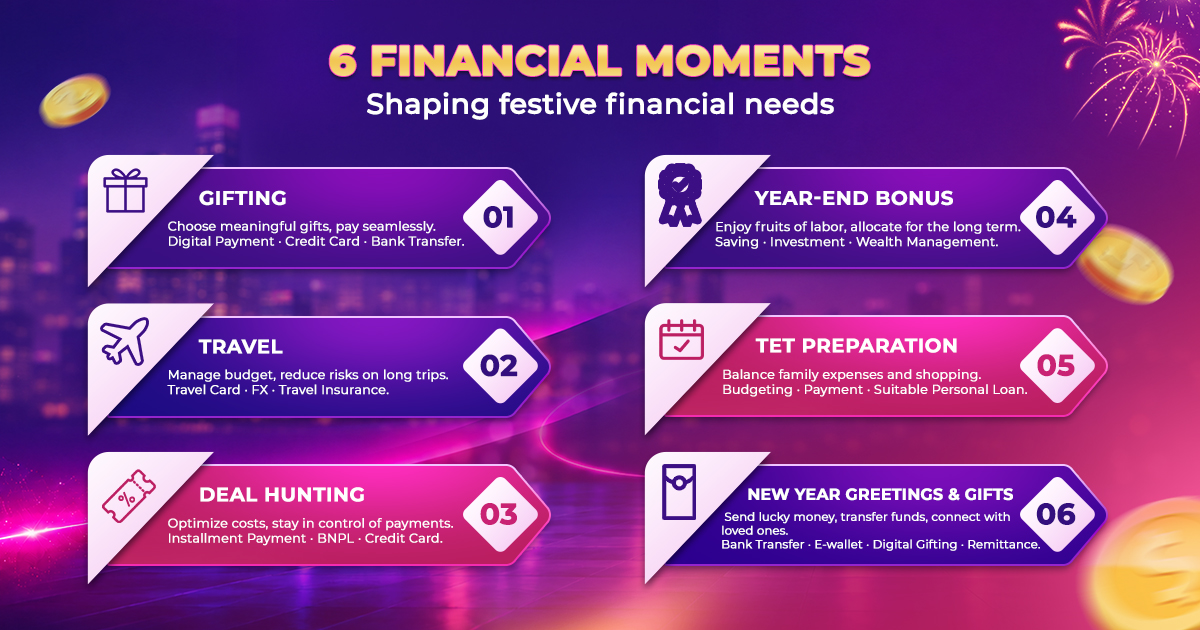
Six moments that shape financial needs during the festive season.
Source: Novaon Digital
Financial products become meaningful when they help customers achieve their goals with greater ease, confidence and control. The question for the industry is which Financial Moments to prioritise, what solutions to offer and how to deliver an experience that makes the bank a natural choice.
2. The challenge for banking and finance: When promotions alone can’t drive decisions
The festive season creates opportunities to grow transaction volumes, while intensifying competition for visibility, relevant messaging and lasting customer relationships. With banks offering similar cashback, discounts, fee waivers and card benefits, promotional value alone gives brands little room to stand out over time.
Three challenges stand out.
2.1. Promotion Saturation
During 11.11, 12.12 and Tết, customers can choose from cashback offers, partner deals and payment promotions from banks, e-wallets and e-commerce platforms.
When offers look alike, customers may simply choose whichever provider has the best deal at checkout. To become a preferred choice over time, brands can connect offers to specific customer needs and make the benefits clear in the context of the experience.
For example, a bank could turn a broad “Get cashback when you pay” message into a campaign called “Make More of Your Year-End Getaway.” The campaign could bring together flight offers, benefits for overseas spending and travel budgeting tools. Alongside cashback, customers get practical support for planning and enjoying their trip.
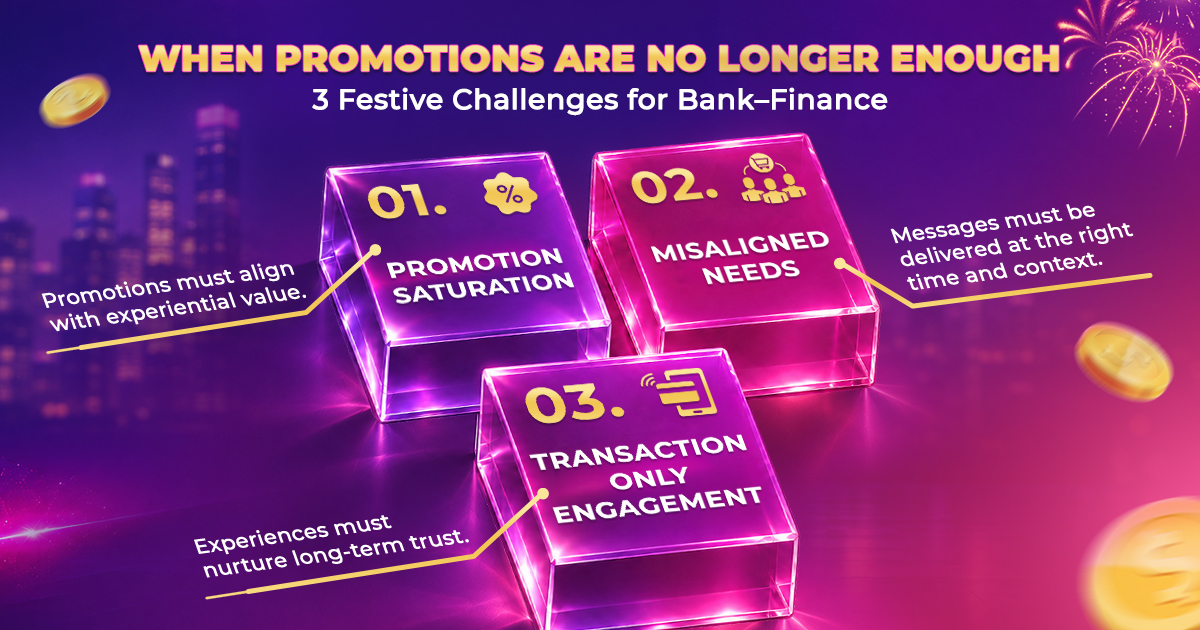
From promotion-led marketing to experiences built around customer needs.
Source: Novaon Digital
2.2. Moment Relevance Gap
A financial product may suit several situations, but what makes it appealing varies by customer and moment.
Someone who has just received a year-end bonus may be interested in saving or investing. A customer about to book a trip may need a card for international payments, foreign currency and insurance. Someone planning their Tết shopping may care most about staying within budget and paying easily.
When communications follow only the promotional calendar or product catalogue, brands can miss the moment a customer actually needs the service.
A Kantar study released in September 2026 highlighted a tension. 85.6% of Vietnamese adults who use the internet and took part in the survey liked receiving personalised messages about products, services and offers, while 70.2% said they were bothered by receiving too many messages.
This points to a shift from Campaign-centric Communication to Moment-centric Communication, where timing, context and relevance matter as much as frequency.
2.3. Transaction-to-Relationship Gap
A successful transaction is only one step towards a lasting customer relationship.
Customers might use one bank’s card to claim a shopping offer, another app to transfer money and a different financial institution to save or invest. When the experience ends at checkout, the brand misses an opportunity to build on that interaction.
For important financial decisions, customers also value reassurance. The UOB ASEAN Consumer Sentiment Study 2026, which surveyed 5,000 people across five ASEAN markets, found that 43% associated wealth with being free from financial worries or debt, while 41% associated it with being able to provide for their families. Respondents’ primary banks were the most trusted to act in their financial interests, at 76%. These figures describe the region as a whole.
Customers value the tools that make transactions possible, along with the sense of control and support that helps them make financial decisions with confidence. That makes Brand Experience increasingly important. Banks can connect communications, advice and product use so that each interaction meets an immediate need and builds trust over time.
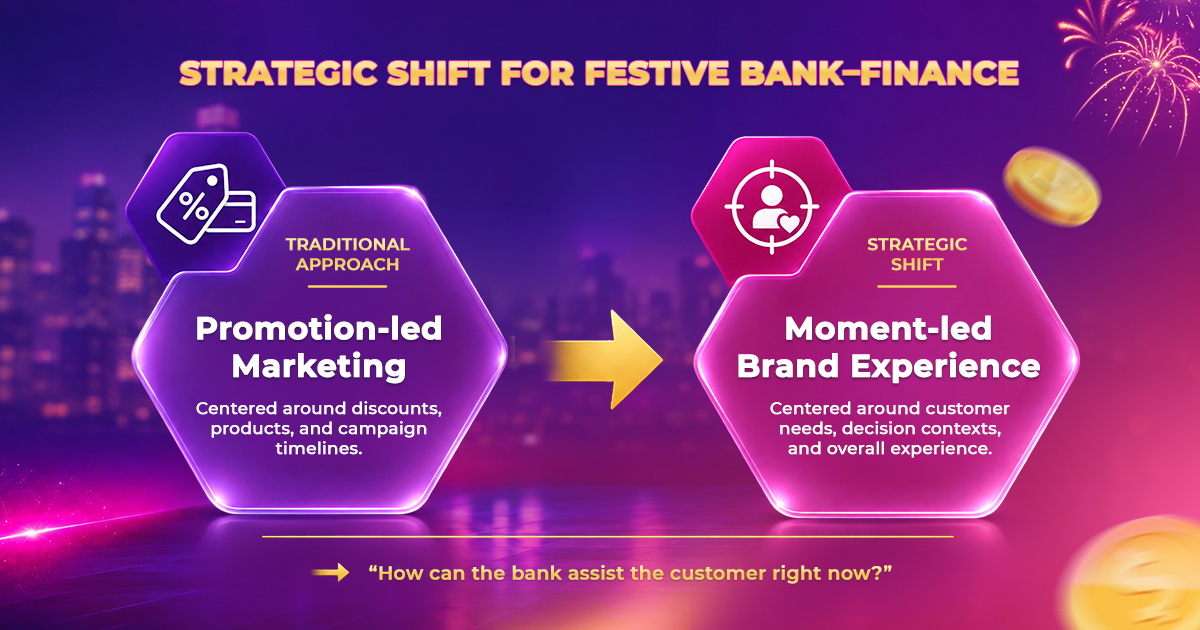
From promotion-led marketing to experiences built around Financial Moments.
Source: Novaon Digital
3. Six Brand Experience solutions that combine Strategy, Creative and Technology
To turn Financial Moments into growth opportunities, banking and finance brands need experiences that connect an understanding of customer needs with clear communication and practical decision support. The Strategy-Creative-Technology (S-C-T) model provides a framework for doing this.
3.1. Financial Moment Mapping
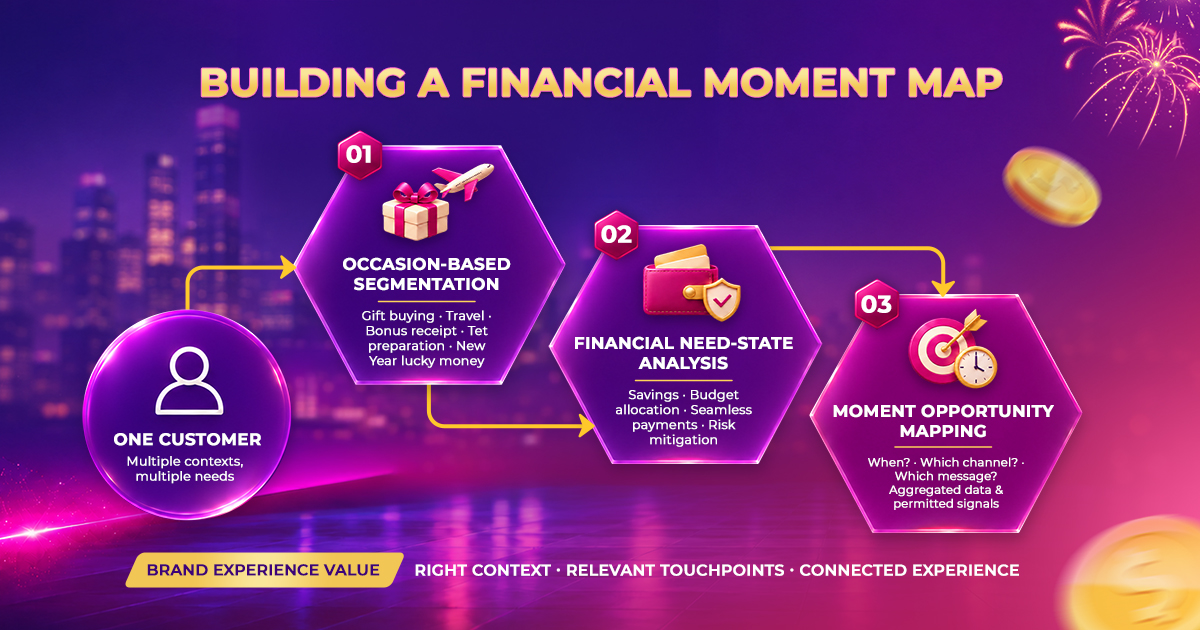
Identifying when customer needs arise so brands can show up in the right context.
Source: Novaon Digital
Financial Moment Mapping identifies and groups the situations in which customers develop financial needs. It considers the context, what motivates the customer, the product they may need and when they are likely to make a decision.
Age and income are useful starting points for segmentation. Mapping Financial Moments helps banks see how the same customer can have several different needs over the course of the festive season.
- Occasion-based Segmentation groups customers by situations such as buying gifts, travelling, receiving a bonus, preparing for Tết or giving lucky money.
- Financial Need-state Analysis identifies what customers want to achieve, such as saving, allocating a budget, making payments more easily or reducing risk.
- Moment Opportunity Mapping brings together aggregated behavioural data, shopping calendars and signals the bank is authorised to use. This helps the brand decide when to show up, which channel to use and what message to deliver. In practice: In November and December, a bank could map the needs of three groups preparing for year-end travel, shopping during Mega Sale events or starting to plan their Tết finances. The bank could tailor its content, solutions and customer journeys to each group.
Brand Experience value. Brands can make each interaction more relevant by connecting a specific financial need to an experience customers can use.
3.2. Occasion-based Emotional Storytelling
Occasion-based Emotional Storytelling draws on familiar financial situations and explores the feelings and intentions behind decisions to spend, save or give.
During the festive season, buying a gift can be a way to show someone you care. Setting money aside can represent progress towards a future goal. Sending money at Tết can help families stay connected.
- Moment-based Brand Films tell short stories about everyday financial milestones, such as preparing for your first Tết after starting work, buying a gift for your parents or taking a family trip.
- Contextual Creative Messaging adapts the message to the occasion and what the customer needs. A payment offer can help customers enjoy an experience they’re looking forward to, while a savings product can support a goal for the new year.
- User-generated Financial Stories invite customers to share milestones like their first savings goal, the first Tết they planned on their own or the first gift they bought for their family. In practice: A bank could launch a campaign called “What’s Worth Saving For This Tết?” The campaign could follow young adults as they divide their year-end bonuses between supporting family, treating themselves and saving for the future. The stories can naturally lead into budgeting tools, savings accounts and digital payment features.
Brand Experience value: Financial products become easier to relate to when customers can see how they fit into their own lives. The bank can show it understands what customers care about and what they’re working towards.
3.3. Contextual Financial Experience
Contextual Financial Experience puts financial services where the need arises, so customers can find a suitable option with fewer searches, steps or switches between platforms.
The experience supports the customer at the point of decision, when product information and tools can help them choose.
- Embedded Financial Services make relevant payment, instalment or insurance options available when customers place an order, check out or sign up for a service, through licensed partners.
- Contextual Offer Activation surfaces benefits that match a transaction or need. A customer actively researching a trip, for example, could see relevant travel card benefits.
- Financial Decision Support gives customers tools to calculate instalment costs, compare payment options and work out what fits their budget. In practice: During 12.12, a customer buying a home appliance from a retail partner could see the bank’s payment options at checkout, including payment in full and instalments where eligible. The interface could clearly show the total amount payable, repayment term, interest rate and fees so the customer can choose an option that fits their budget.
Brand Experience value: Fewer steps and clearer choices make transactions easier and give the bank a useful role in the shopping experience.
For Buy Now, Pay Later (BNPL) and consumer credit, brands should prioritise transparency and affordability and avoid using festive pressure to encourage customers to borrow beyond their needs.
3.4. AI-powered Moment Personalization
AI-powered Moment Personalization uses data and AI to recognise customer needs, adapt content, recommend services and provide support in specific financial situations.
It builds on demographic information by prioritising signals from the customer’s current context, especially when the customer initiates the interaction.
- AI-powered Next-best Experience uses authorised data to suggest relevant content or tools, such as a travel budget planner, a Tết spending tracker or information about savings products.
- Personalized Financial Content tailors messages and guidance to goals customers choose themselves.
- Conversational Financial Assistants help customers look up card benefits, transaction fees, budgeting tools and product information through chat.
- Intelligent Journey Orchestration connects interactions the bank is authorised to record across its website, app and customer service channels, reducing repetitive messages. In practice: A customer opens their banking app and selects “Plan My Tết Budget.” An AI assistant could use the expenses the customer shares to help allocate their budget and suggest relevant spending trackers or savings tools.
Brand Experience value: Customers receive more relevant support and fewer messages they don’t need, making the banking experience easier and more personal.
In financial services, AI requires data safeguards, explainable outputs and a way to reach a human adviser when needed. Affordability assessments, product suitability checks and professional advice remain essential when decisions involve risk.
3.5. Gamified Financial Wellbeing
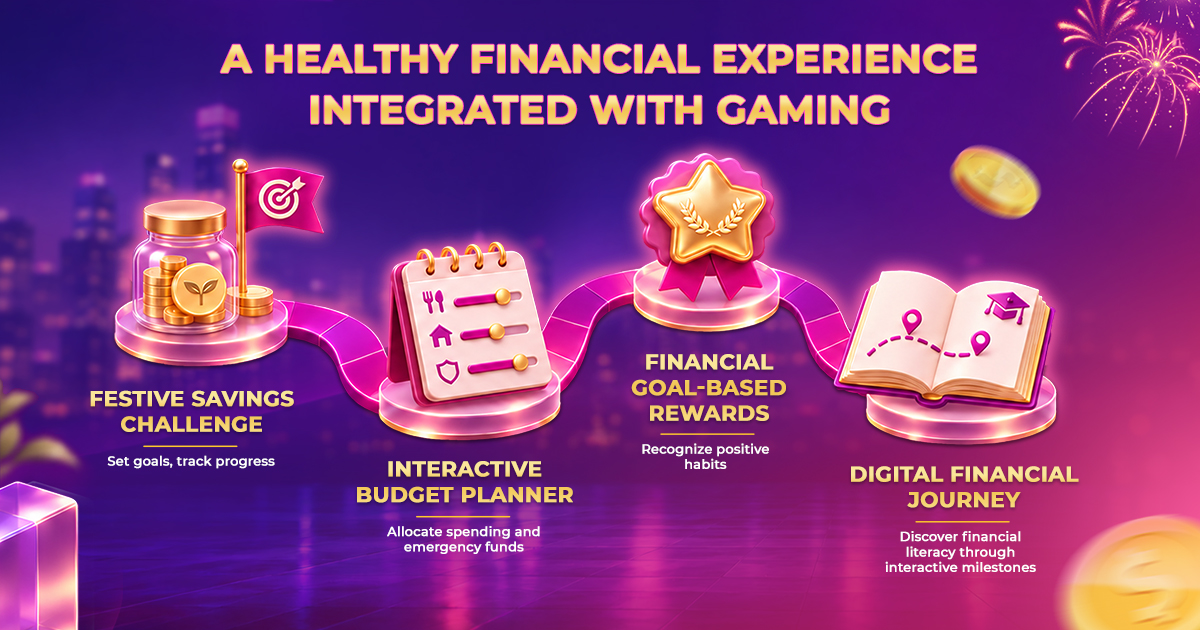
Game mechanics can encourage healthy financial habits.
Source: Novaon Digital
Gamified Financial Wellbeing uses game mechanics to help customers build healthy spending, saving and planning habits.
During the festive season, it can make financial goals easier to start and give customers a reason to keep going as they see their progress.
- Festive Savings Challenges encourage customers to set a goal and track their progress towards Tết or another future plan.
- Interactive Budget Planners help customers allocate money for shopping, travel, gifts and unexpected expenses.
- Financial Goal-based Rewards recognise actions such as creating a savings plan or completing a financial education activity.
- Digital Financial Journeys guide customers through interactive activities to build money management skills before, during and after the festive season. In practice: A bank could launch “21 Days to Save for Tết,” allowing customers to set savings goals, track progress and earn digital badges as they reach milestones. Customers could turn their achievements into a personalised New Year card to share.
Brand Experience value: Customers take a more active role in managing their money, and the bank can stay engaged by supporting their financial wellbeing throughout the season.
3.6. Connected Festive Banking Experience
Connected Festive Banking Experience links communications, interactions, transactions and customer service in one consistent journey throughout the festive season.
Banks can connect 11.11, 12.12 and Tết within a shared experience, with content and tools tailored to what customers need at each stage.
- Omnichannel Moment Campaigns connect messaging across social media, digital advertising, banking apps and retail partner activations.
- Phygital Banking Activations combine in-person experiences with digital tools such as interactive booths, QR codes and apps at shopping centres, retail events or community activities.
- Post-transaction Relationship Journeys continue after payment through spending summaries, card benefit management or financial planning for the next stage. In practice: A bank could launch “Your Festive Financial Journey” in three stages. Customers could make the most of Mega Sale offers, manage spending during Christmas and New Year, and prepare their Tết budgets. They could pick up where they left off in the banking app, with a partner or at an in-person activation.
Brand Experience value: A connected journey makes it easier for customers to discover relevant services and gives them reasons to stay engaged after the shopping season ends.
Together, these six solutions form a connected approach to Financial Moments. Banks can choose which solutions to use based on the customer’s goal, the occasion and the nature of the product.
4. Novaon Digital’s Expert Perspective: The Right Moment and the Right Value Are Key to Standing Out During the Festive Season
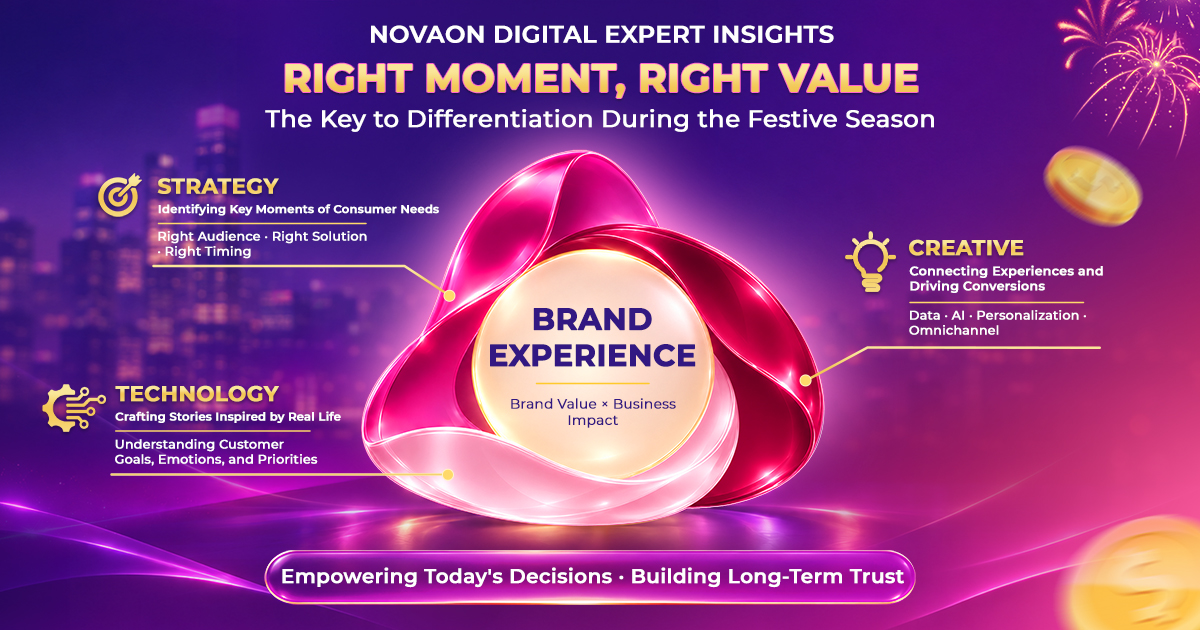
Combining Strategy, Creative and Technology to deliver experiences that offer the right value at the right moment.
Source: Novaon Digital
From Novaon Digital’s strategic perspective, the festive season gives banking and finance brands an opportunity to redefine their role in the customer journey, moving from providing products and processing transactions to becoming partners who support customers in making meaningful financial decisions in their lives.
Across the festive shopping calendar, banks should focus on the Financial Moments where their capabilities best align with customers’ actual needs.
A customer may choose a credit card because they want to enjoy a trip, open a savings account to work towards a family goal, or use a money transfer service to send a New Year gift. Each transaction has a different motivation, so brands need to adapt their messaging, solutions and experiences accordingly.
By combining Strategy, Creative and Technology, Novaon Digital proposes three priorities for festive-season marketing in financial services.
First, brands should move from building campaigns around promotional calendars to identifying the moments when customer needs can drive decisions. Analysing consumer insights, spending behaviour and interaction data can help banks identify the right audience, the right solution and the right time to reach them.
Next, brand communications should draw on everyday stories in which financial products address real needs. When messaging reflects customers’ goals, emotions and priorities alongside product features and offers, brands have an opportunity to build a deeper connection.
Finally, BrandCom activities should connect with interactive experiences and the conversion journey. Through data, AI, personalisation technology and omnichannel touchpoints, brands can guide customers from awareness to exploration and service use in one seamless, consistent journey.
Brand Experience is where brand value and business performance meet. A relevant experience can support an immediate financial decision while strengthening trust, customer satisfaction and long-term relationships.
Conclusion: When Every Financial Decision Becomes an Opportunity to Build the Brand
The 2026-2027 festive season shows that growth opportunities in banking and finance come from both the scale of consumer spending and the variety of financial needs that arise in everyday life.
From small payments to decisions about saving, investing or preparing a household budget, each Financial Moment gives banks an opportunity to demonstrate their value and build a connection with customers.
As competition intensifies, promotions can encourage customers to make an initial transaction. Relevant experiences, a genuine understanding of customer needs and trust are what can sustain the relationship over time.
The future of festive-season marketing in banking and finance goes beyond increasing transaction volumes. It lies in helping customers make better financial decisions at the moments when they need support.