This is where Brand Communication (BrandCom) and Emotional Storytelling open up a new approach. The focus shifts from product features to stories about people, lifestyles, and emotional value. Beyond demonstrating how well a car performs, brands need to help customers feel what it would mean to own it, drive it, and make it part of their lives.
1. Market Context: The Technology Race Makes Brand Differentiation Harder
From 2025 to 2026, the automotive market has seen shifts in both the pace of technological development and the way consumers choose brands. From advanced driver assistance systems (ADAS) and in-vehicle AI to connected technology and over-the-air (OTA) software updates, automakers continue to expand their feature offerings to stay competitive.
According to Deloitte’s 2026 Global Automotive Consumer Study, which surveyed more than 28,500 consumers across 27 countries, car buyers are increasingly interested in technologies that improve their day-to-day experience. They place particular value on connected features related to safety and security. AI-powered personalization and the ability to update vehicle software are also becoming more prominent in consumer expectations.
As brands develop similar sets of technologies, adding new features alone becomes a less reliable source of competitive advantage. Technology can differentiate a vehicle’s capabilities, though that difference may be less apparent in how customers perceive the brand.
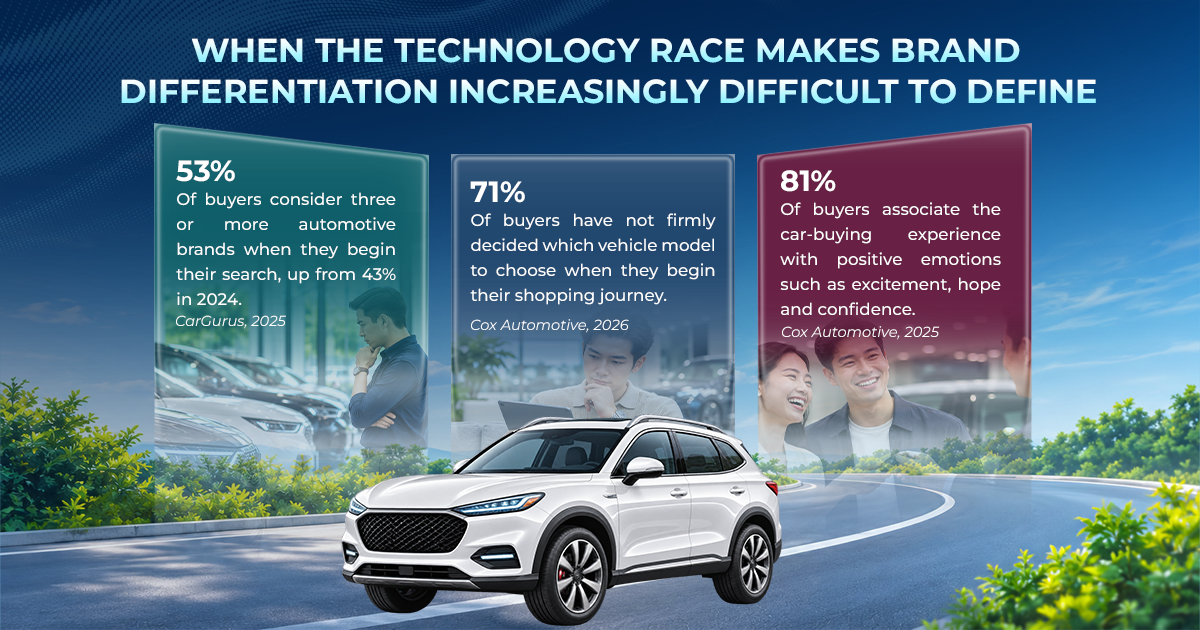
As vehicle technologies become more similar, experience and emotion give automotive brands opportunities to stand out.
Source: Novaon Digital
The figures above reflect three important shifts in automotive consumer behavior.
These shifts pose a new communication challenge for the automotive industry. When brands can all demonstrate quality, performance, and technology, what makes customers remember, favor, and ultimately choose one brand over another?
Product differences help a brand make the shortlist. An emotional connection and a clear sense of what the brand means can give customers a reason to choose it and stay with it. Functional criteria remain important. Deloitte’s 2026 study still identifies product quality, performance, and price as leading factors in brand choice. Emotional Storytelling therefore builds on demonstrable product strengths to increase perceived value and give customers a clearer sense of what sets the brand apart.
2. From Product-Focused Advertising to Lifestyle & Emotion-Led Branding: The Shift in Automotive BrandCom
For many years, automotive communication has relied primarily on Product-Focused Advertising, using design, technical specifications, engine performance, technology, and standout features to persuade customers.
This approach works when brands need to introduce a new product, demonstrate a competitive advantage, or help customers compare their options. As more vehicles offer similar functional benefits, however, feature-led messages risk becoming difficult to tell apart.
This has opened up a new direction for BrandCom through Lifestyle & Emotion-Led Branding.
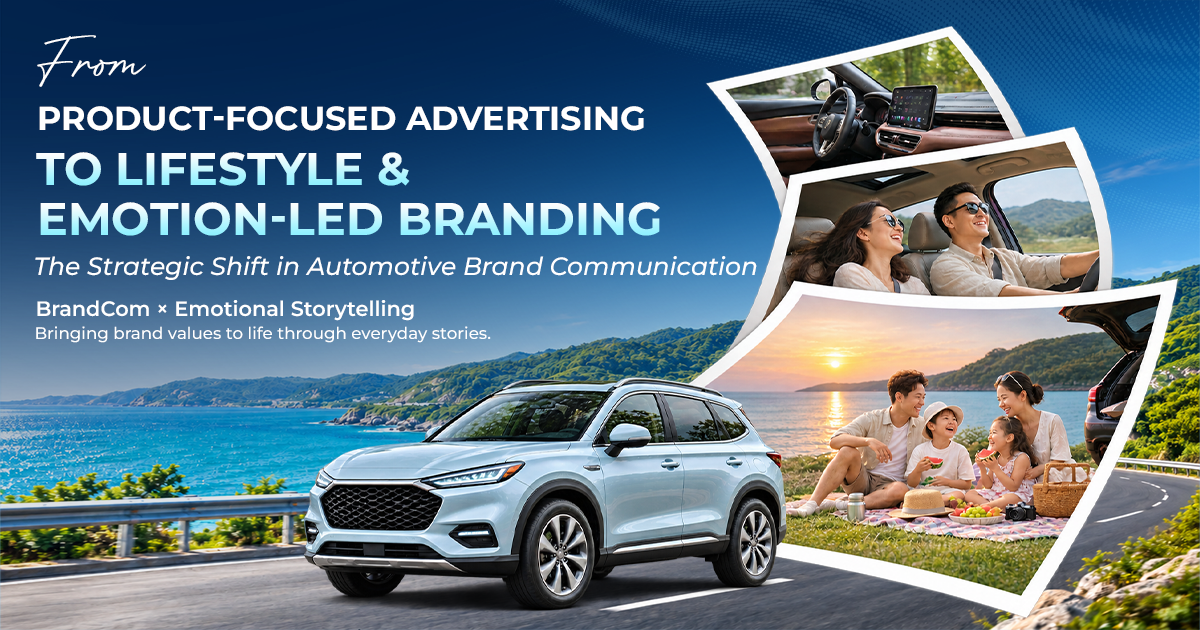
As communication moves from product features to emotional storytelling, the car becomes a companion in life’s meaningful moments
Source: Novaon Digital
What Do BrandCom and Emotional Storytelling Mean?
Brand Communication (BrandCom) is the process of developing and consistently communicating a brand’s positioning, values, personality, and identity across customer touchpoints. Its long-term focus is on shaping brand perceptions and associations and building relationships with customers over time.
Emotional Storytelling uses stories, situations, and experiences to evoke an emotional response. In the automotive industry, the car can play a supporting role in the story, accompanying people through meaningful moments in their lives.
Together, BrandCom and Emotional Storytelling turn brand values into stories that customers can feel, remember, and relate to their own lives.
3. BrandCom Through Strategy, Creative, and Technology: Turning Brand Stories Into Experiences Customers Can Feel
For Emotional Storytelling to have a lasting impact, automotive BrandCom needs to carry the same ideas from brand positioning and content development through to customer experience design.
3.1 Interactive Brand Storytelling
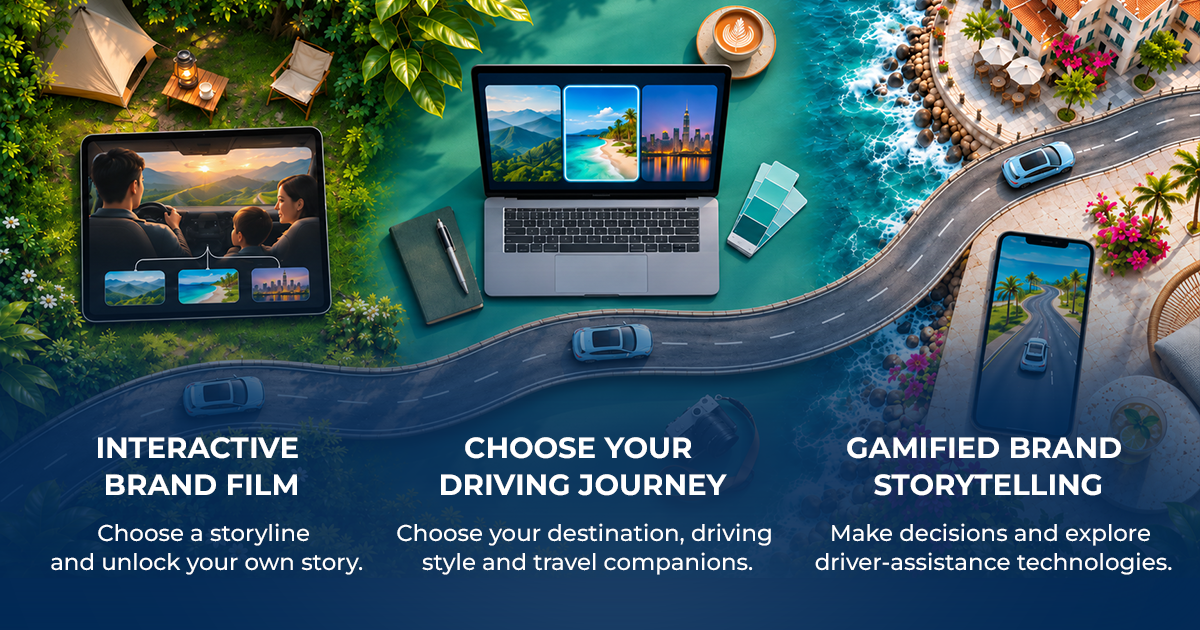
Active participation helps customers experience the brand story and connect with it emotionally.
Source: Novaon Digital
Interactive Brand Storytelling invites customers to take part in exploring a brand story through choices and interactions on digital platforms. Users can choose the scenarios, characters, or journeys that best suit their needs and lifestyles.
In the automotive industry, this approach helps brands translate technical features into experiences grounded in everyday life, creating an emotional connection between customers and the vehicle.
Formats and applications:
- Interactive Brand Film. Create a branching video that lets viewers choose between journeys such as a family vacation, an outdoor adventure, or a daily commute. Each choice leads to a different story and highlights the aspects of the vehicle that matter in that situation.
- Choose Your Driving Journey. Develop an interactive microsite or landing page where customers choose a destination, driving style, and travel companions to explore different ways of using the car.
- Gamified Brand Storytelling. Design interactive challenges where users make driving decisions, respond to different situations, and discover the driver assistance technologies relevant to each one. Example application: An SUV brand launches Every Journey Tells a Story, a campaign that lets users choose from three journeys: exploring nature, taking a family trip, or driving around the city. Each journey opens up a different interactive story, helping customers discover the vehicle’s performance, comfort features, and safety technology in contexts that matter to them.
BrandCom value: Active participation helps customers remember what the brand offers by experiencing it for themselves.
3.2 AR/VR Driving Experience
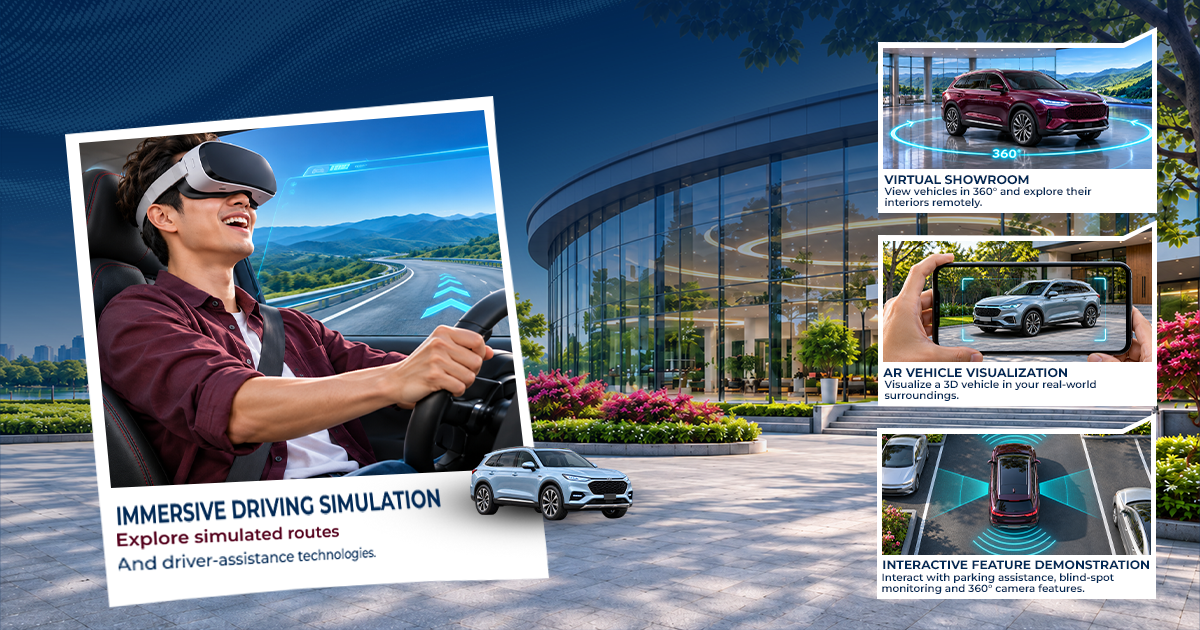
AR and VR let customers explore a car’s design, experience driving it, and interact with its features in a digital environment.
Source: Novaon Digital
An AR/VR Driving Experience uses Augmented Reality (AR) and Virtual Reality (VR) to recreate spaces, vehicle features, and driving scenarios in a digital environment.
In automotive BrandCom, these technologies help bridge the gap between seeing a vehicle and experiencing it firsthand. They also give brands a way to communicate their values through exploration and interaction.
Formats and applications:
- Virtual Showroom. Recreate a showroom in 3D so customers can see the vehicle from every angle and explore its interior, colors, and equipment before visiting a dealership.
- Immersive Driving Simulation. Use VR to place users on simulated city streets, highways, or mountain roads, demonstrating how the vehicle performs and how its driver assistance technologies work.
- AR Vehicle Visualization. Let users display a 3D model of the car on their phones in a real-world setting, such as a driveway, garage, or parking space, to get a sense of its size and design.
- Interactive Feature Demonstration. Create simulated scenarios where customers can see how technologies such as parking assist, blind-spot warnings, and 360-degree cameras work. Example application: An electric vehicle brand hosts a VR event called The Future of Every Drive, where customers explore what it might be like to get around a city of the future. They interact with driver assistance, connectivity, and smart comfort features to see how the vehicle could fit into modern life.
BrandCom value: AR and VR make product benefits that are hard to convey through traditional advertising easier to see and experience. This can improve recall and encourage customers to learn more or take a real test drive. Simulations should accurately reflect the limits of the technology and give users a realistic understanding of the car’s performance and safety capabilities.
3.3 AI-Powered Personalization
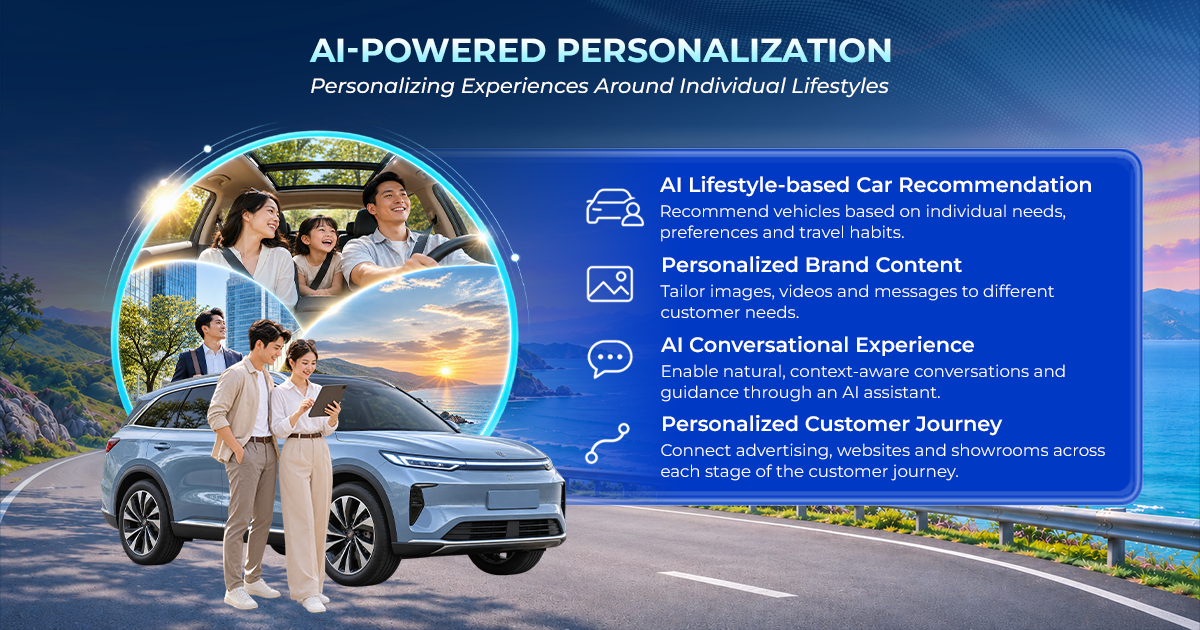
AI helps tailor vehicle recommendations, content, and experiences to each customer’s needs and lifestyle.
Source: Novaon Digital
AI-Powered Personalization uses artificial intelligence to analyze customer needs, preferences, and relevant interaction data. Brands can then tailor their communications and the way each customer explores the product.
In the automotive industry, AI can recommend suitable models and help brands tell stories that reflect each customer segment’s lifestyle, goals, and reasons for owning a car.
Formats and applications:
- AI Lifestyle-Based Car Recommendation. Ask customers about their travel needs, interests, and driving habits. The system then recommends a suitable model and tells a story about the experience it could offer.
- Personalized Brand Content. Adapt images, videos, and messages to different needs. Customers with families might see content about safety and comfort, while those who enjoy adventure travel might see content about performance and what the car is like on the road.
- AI Conversational Experience. Integrate an AI assistant into a website or microsite so customers can discuss their needs, explore features, and receive relevant advice in a natural conversation.
- Personalized Customer Journey. Connect interaction data from ads, websites, and showrooms to deliver relevant content at each stage, from awareness and consideration to test-drive registration. Example application: An automotive brand creates an experience called Your Life, Your Drive. Customers answer a few questions about their lifestyle, favorite trips, and travel needs. AI then recommends a suitable model and creates a personalized story showing how the car could fit into the experiences they are looking for.
BrandCom value: Personalization makes brand messages more relevant, helps customers feel understood, and gives them a natural reason to move from emotional interest to considering the vehicle. Brands should use data they have permission to use, be transparent about how they use it, and avoid drawing unsupported conclusions about customers.
3.4 Phygital Brand Activation
Phygital Brand Activation connects in-person experiences with digital platforms and technologies to create a seamless brand journey across offline and online environments.
In the automotive industry, firsthand experience still plays an important role in purchase decisions. Phygital activation extends the value of showrooms, launch events, and test drives by turning them into touchpoints that support interaction, personalization, and continued engagement.
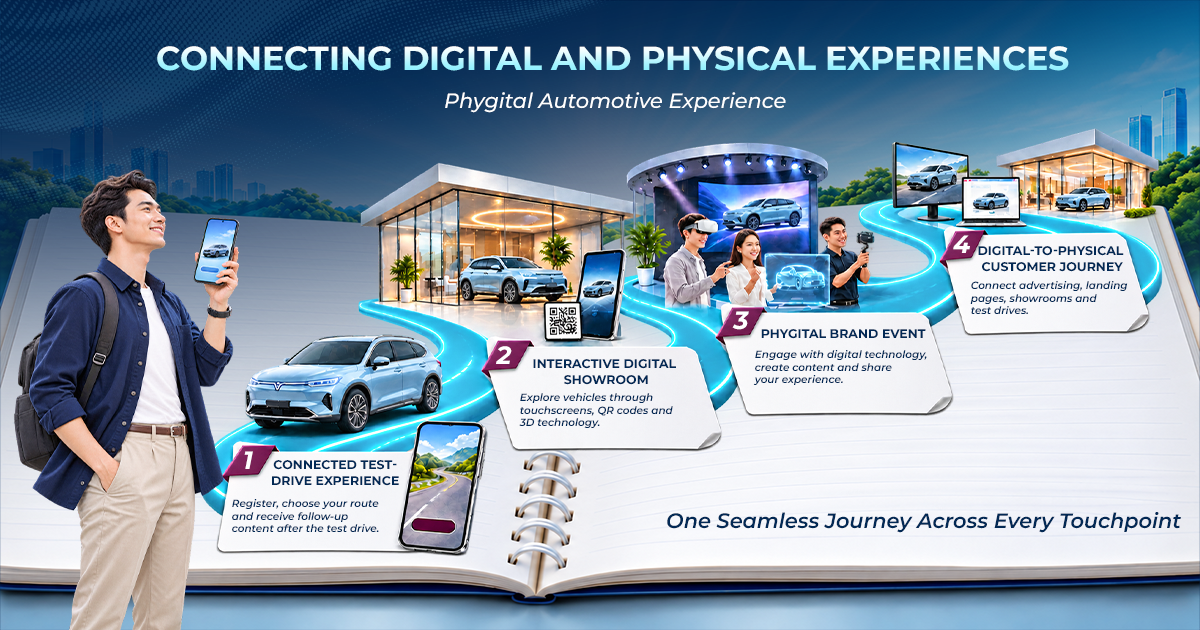
The role of the four solutions in the BrandCom journey
Source: Novaon Digital
Formats and applications:
- Connected Test-Drive Experience. Customers register and choose a test-drive route on a digital platform before attending the event. Afterward, the system sends a recap, details about the model, and information on the features that interested them.
- Interactive Digital Showroom. Combine physical display vehicles with touchscreens, QR codes, and 3D technology so customers can explore features, configure a vehicle, and save their choices.
- Phygital Brand Event. Create spaces where attendees can interact with digital technology, take part in challenges, create personalized content, and share it on social media.
- Digital-to-Physical Customer Journey. Connect ads, landing pages, and event registration with showroom visits and test drives so customers can pick up where they left off at each touchpoint. Example application: An automotive brand runs a campaign called Drive Your Next Chapter. Customers start by creating their dream journey on a microsite. At the event, they scan a QR code to activate their personalized experience, explore a suitable model, and take a test drive. After the event, they receive a recap video of their journey and content about the car they tried.
BrandCom value: Phygital activation connects the emotions evoked by brand communication with firsthand product experience. It also creates a series of touchpoints that nurture the customer relationship and support conversion.
4. Case Studies: How Volvo and BMW Turn Product Strengths Into Emotional Stories
Volvo and BMW illustrate two approaches to Emotional Storytelling in the automotive industry. Volvo tells stories about safety and what it means to protect people. BMW builds on its The Ultimate Driving Machine positioning to focus on the driving experience and the feeling of being in control behind the wheel.
Case Study 01. Volvo Cars – From Safety Features to Stories Worth Protecting
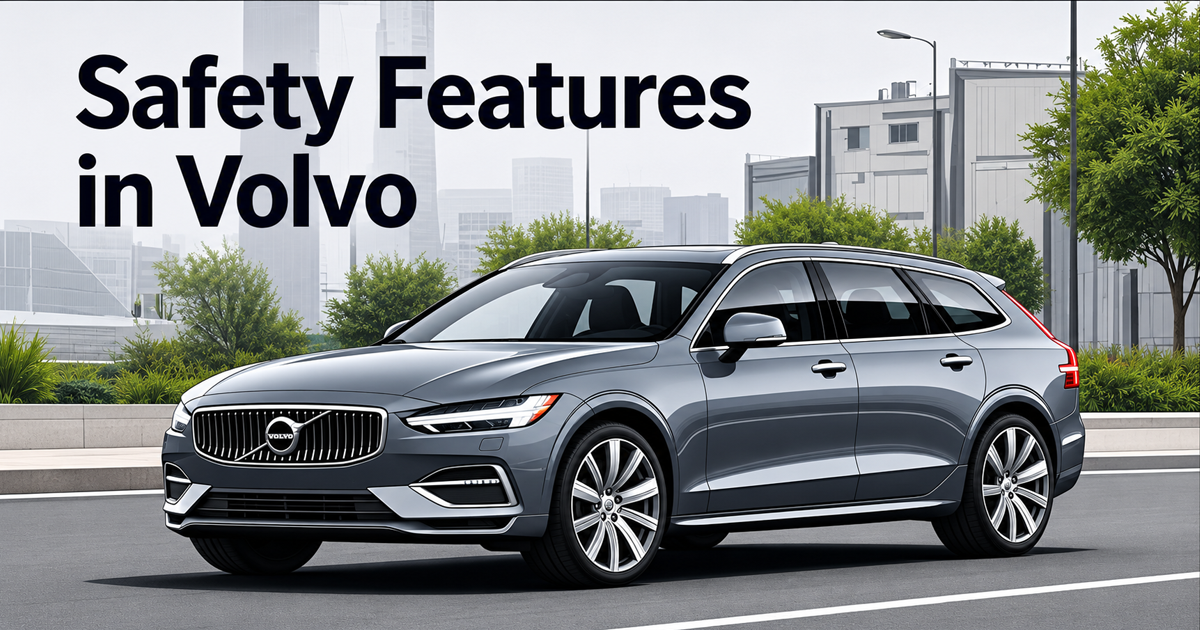
Volvo Cars – From Safety Features to Stories Worth Protecting
Source: Volvo Cars
Background
Volvo has long been associated with safety. As more automakers develop driver assistance and occupant protection technologies, Volvo has had to look beyond individual safety features for ways to stand out in its communications.
The challenge was to find a fresh way to talk about a familiar core value. Volvo wanted customers to recognize its reputation for safety and feel what that safety could mean for their own lives.
Strategy – Emotional Reframing of Safety
Volvo kept its core positioning and changed how it expressed it. The brand put collision prevention and protective technology in a broader context by connecting safety with the moments people cherish and the futures they look forward to.
This strategy is evident in Moments, a brand film released in late 2024 that continued to draw attention in 2025. The film places the Volvo EX90 within a story about a family and its hopes for the future, so viewers experience the safety message through the story before encountering the technical details.
Execution
Volvo used Cinematic Human Storytelling in a film that runs just under four minutes. It focuses on everyday moments, the anticipation of a family expecting a baby, and the future they imagine together.
The film opens by building empathy through its characters, storyline, and visual language. The Volvo EX90 appears as part of the family’s life, and the value of safety is tied directly to what they want to protect.
Following the main film, Volvo released versions told from the car’s point of view. The 60-second and 15-second videos explain the EX90’s safety technologies more explicitly, linking the emotional story to specific product benefits. This combines Emotional Hero Content with Product Proof Content. The emotional story draws attention and creates a connection, while the feature-led videos provide evidence to support the message.
Results
– 25M+ views on LinkedIn
– 2.7M views on the brand’s Instagram account
– 351.9M potential reach across owned social channels and through social sharing during the week the film went viral
BrandCom Takeaway
Volvo’s approach turned a functional feature into an emotional value that people could relate to.
Volvo told a story about lives, relationships, and moments worth protecting. Safety took on a broader meaning as a brand promise centered on people.
This is an example of Emotional Value Translation, an approach particularly suited to brands with strong product capabilities that want to build a deeper connection with customers.
Case Study 02. BMW – The Ultimate Driving Machine: From Performance to Driving Emotion
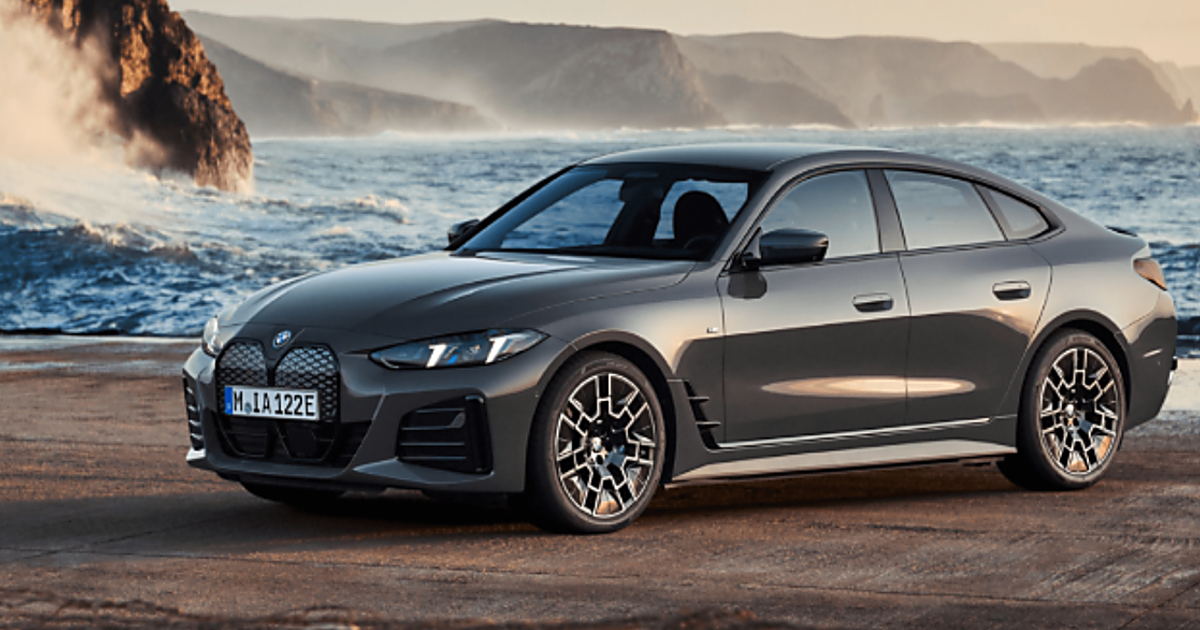
BMW – The Ultimate Driving Machine: From Performance to Driving Emotion
Source: BMW
Background
In the premium automotive market, design, build quality, technology, and performance all play an important role in brand positioning. BMW’s challenge was to build an identity that stood out in the premium segment and remained consistent across generations of vehicles.
Since the 1970s, BMW has positioned itself as The Ultimate Driving Machine, defining what sets its cars apart through performance and the experience behind the wheel, moving beyond traditional symbols of luxury. According to historical materials BMW published in 2025, Martin Puris coined the tagline in 1974, and it became an important part of BMW’s communications in the US. (Source: BMW Group PressClub)
Strategy – Driving Pleasure as Brand Identity
BMW used superior vehicle performance as the basis for an emotional benefit: the pleasure and excitement of driving.
The brand linked technical attributes such as acceleration, cornering precision, and vehicle control to the driver’s own experience. The promise was about how it feels to put those capabilities to use.
Volvo’s approach to Emotional Branding speaks to the desire to feel protected and to protect loved ones. BMW’s approach centers on feeling in control, enjoying the freedom to drive, and taking pleasure in the journey.
Execution – BMW Films’ The Hire
One of the best-known examples is The Hire, a short-film series that debuted in 2001. BMW invested in Branded Entertainment, producing cinematic action films in which BMW cars played an important role in the story.
The series starred Clive Owen as a professional driver and brought in acclaimed filmmakers. Chase scenes, high-speed driving, and difficult routes let audiences see and feel what the cars could do through the action on screen. (Source: BMW Group PressClub)
The creative strategy behind The Hire had three elements.
Performance-Driven Cinematic Storytelling. The car’s performance drives the plot. Viewers get a feel for its speed, agility, and control through the action scenes themselves.
Entertainment-First Brand Content. The films give viewers a reason to seek them out for entertainment. The brand stays visible throughout, and the story moves ahead without interruptions for direct product pitches.
Experiential Product Demonstration. The car’s handling and performance provide visible proof of The Ultimate Driving Machine positioning. The car helps the driver demonstrate his skill and take control of the situation.
Results
– 100M+ cumulative film views by 2005
– 74% increase in sales, as reported in campaign effectiveness records
– $26M in equivalent earned media value
BrandCom Takeaway
BMW shows that Emotional Storytelling can draw on the experience of using a product. Alongside stories about family and relationships, brands can evoke excitement, freedom, pride, or a sense of control.
By making performance part of the story, BMW turned technical strengths into an entertainment experience that audiences could feel and remember. This illustrates Performance-Led Emotional Branding, where the driver’s experience becomes central to the brand’s identity.
As a historical case, The Hire still offers a reference for developing brand content in 2025-2026. The principle to carry forward is to identify a genuine product strength and translate it into a consistent emotional experience.
5. Expert Perspective From Novaon Digital: From Emotional Storytelling to Long-Term Brand Value
The development of Emotional Storytelling opens up new opportunities for automotive brands to differentiate themselves, especially as the car-buying journey becomes increasingly complex and customers encounter more options before making a decision.
The challenge, however, lies in connecting emotional stories to brand positioning, backing them up with actual product capabilities, and maintaining that connection consistently throughout the customer journey.
From a Strategy – Creative – Technology perspective, automotive brands should focus on three priorities.
First, define a clear Emotional Brand Territory. Brands need to identify an emotional value that aligns with their competitive strengths and customer expectations. Positioning centered on the freedom to explore, family safety, or the pleasure of driving is only convincing when supported by corresponding product features, service quality, and real-world experiences.
Second, develop Brand Storytelling into a long-term content system. Beyond investing in a single emotional TV commercial at launch, brands can develop several strands of content that express the same core value, including brand films, customer stories, community content, test-drive experiences, and communication activities tailored to each stage of vehicle ownership.
Third, connect Emotional Storytelling with Brand Experience and business performance. Technology can amplify content and help brands design experiences that are personalized, interactive, and measurable. Alongside views and engagement, brands should track metrics such as Brand Awareness, Emotional Association, Brand Consideration, Test-Drive Intention, Qualified Leads, and Purchase Intent. These metrics should be measured against their respective objectives. Brands should avoid assuming that higher emotional engagement will translate directly into sales.
The role of BrandCom therefore extends beyond increasing awareness to building brand meaning, strengthening brand favorability, and motivating customers to take the next steps in their journey. Conclusion: When technology is a requirement for competing, emotion becomes an opportunity to stand out. In an automotive market continually reshaped by technology, design, and new standards for customer experience, having a good product is an important prerequisite. Building a brand that people remember and like takes more.
Combining BrandCom with Emotional Storytelling gives automakers a way to turn functional benefits into values people can relate to more easily. From Volvo’s stories about safety and protecting lives to BMW’s focus on the excitement of getting behind the wheel, both brands help customers understand the product and feel what the brand means.
To be effective, an emotional strategy needs to be grounded in an understanding of customers, expressed through creative content, and extended through connected digital experiences. The Strategy – Creative – Technology (S – C – T) model can support this approach by linking brand positioning, communication, and brand experience.
In this new era for the automotive industry, technology helps brands demonstrate what a car can do. Emotion helps customers understand why that car deserves to be part of their lives.