The holiday season has always been one of the most competitive periods for the fast-moving consumer goods (FMCG) industry. Across food and beverages, personal care, and household products, shopping demand is driven by diverse occasions, from preparing for gatherings and choosing gifts to stocking up on essentials or treating oneself after a year of hard work.
However, the ways consumers discover and select products are evolving. Purchase interest may arise while watching a cooking tutorial, following a creator’s product experience, or participating in a livestream shopping session. At the same time, AI is enabling more flexible content development, personalized interactions, and more relevant product discovery experiences.
As the boundaries between marketing communications and commerce continue to blur, the challenge for FMCG brands is no longer simply how much to invest in TikTok or how many creators to collaborate with. The priority is to connect Content – Creators – Commerce – AI & Technology into an integrated ecosystem that delivers brand value, customer experiences, and measurable business outcomes.
1. Holiday FMCG 2026: Competition Expands from Retail Shelves to Content Touchpoints
E-commerce Growth Positions FMCG Among the Leading Categories
Vietnam’s e-commerce market entered the 2026 year-end shopping season with positive growth momentum. According to YouNet ECI’s Vietnam E-commerce Revenue & Consumer Trends Report Q3/2026, gross merchandise value (GMV) across four major e-commerce platforms reached approximately VND 411.7-411.8 trillion in the first nine months of the year, representing 22% year-over-year growth.
In Q3 alone, the market recorded 27% growth, exceeding the 19% growth rate registered in the first half of the year. Notably, FMCG generated VND 29.4 trillion in GMV in Q3 2026, up 36% year over year, making it the second-largest category among those monitored. Across the first nine months, FMCG recorded 26% growth.
Source: YouNet ECI, Vietnam E-commerce Revenue & Consumer Trends Report Q3/2026, October 2026.
FMCG growth was not driven by higher prices alone. According to YouNet ECI, price increases contributed approximately 17% growth in Q3, while product sales volume rose by around 18%. This suggests that underlying consumer demand on online channels is expanding, rather than GMV growth being driven solely by higher product prices.
With high consumption frequency, repeat-purchase potential, and relevance to everyday needs, FMCG brands are well positioned to develop e-commerce as an ongoing sales channel rather than relying exclusively on major promotional events.
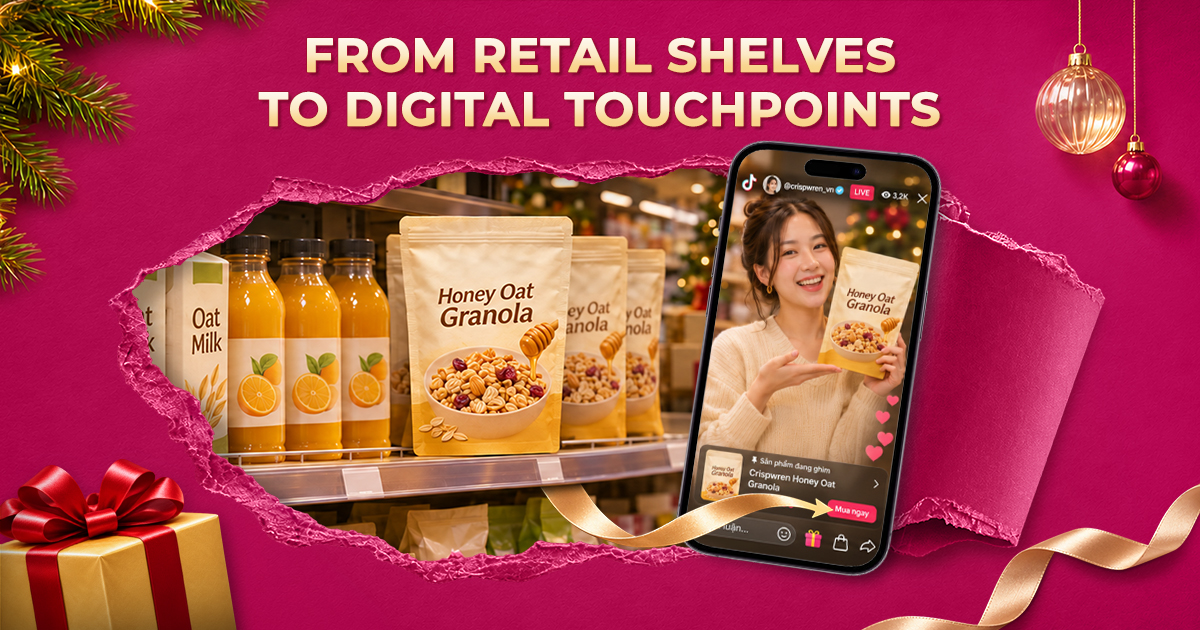
Digital content is reshaping holiday FMCG shopping behavior.
Source: Novaon Digital
The Holiday Season Is No Longer Defined by a Single Shopping Occasion
Alongside market growth, seasonal shopping behavior is becoming increasingly distributed across multiple occasions.
According to the Holiday Shopping Study conducted by Ipsos for Meta, 85% of surveyed Vietnamese consumers reported shopping during Lunar New Year (Tet), 66% during New Year, and 44% during the 12.12 shopping event.
Source: Meta × Ipsos, Holiday Shopping Study, published September 2026.
These figures reflect the prevalence of different shopping occasions throughout the holiday season, rather than the revenue contribution of each event.
For FMCG brands, each period may be associated with different consumer needs. Shopping events such as 10.10, 11.11, and 12.12 create opportunities to stimulate purchases through promotions and product discovery. Meanwhile, Christmas, New Year, and the lead-up to Tet generate additional demand for food, beverages, household care products, and gifting options.
This makes maintaining brand visibility throughout the holiday season increasingly important. Brands need to develop content tailored to specific consumption occasions while aligning marketing communications with relevant product portfolios and commercial promotions.
TikTok Shop Strengthens Its Position in the E-commerce Landscape
According to YouNet ECI, TikTok Shop recorded 38% year-over-year GMV growth during the first nine months of 2026, compared with Shopee’s 12% growth. Their respective GMV market shares over the nine-month period reached approximately 45% and 53% within the monitored market. TikTok’s competitive advantage extends beyond transaction capabilities. The platform connects content, creators, and shopping experiences within a single ecosystem. An entertaining video can spark purchase interest, creators can help consumers better understand products, and livestream shopping can address questions while encouraging purchase decisions.
However, as more brands compete for attention across content-driven touchpoints, producing engaging videos or offering promotions is no longer sufficient to sustain a competitive advantage. Brands must also strengthen their creative capabilities, personalization strategies, and campaign optimization efforts. This creates further opportunities for AI & Technology to play a more significant role in FMCG marketing.
2. Social Commerce, Creator Commerce, Live Commerce, and Affiliate Commerce: Four Mechanisms Driving Content-Led Commerce
Social Commerce: When Purchase Demand Begins with Content
In traditional e-commerce, consumers typically begin their shopping journey with an already identified need. Social Commerce introduces another approach: purchase interest can emerge while consumers engage with content and interact on social platforms.
For FMCG brands, a cooking tutorial may introduce viewers to a new seasoning product. Content about preparing for year-end celebrations can showcase beverages, while gift-basket recommendation videos may encourage consumers to discover products that were not originally on their shopping lists.
According to the TikTok Shop Vietnam Summit 2026, TikTok Shop’s GMV in Vietnam increased by 66% in 2025. During the same period, the number of shoppable short-form videos grew by 45%, reflecting the expansion of content formats directly connected to product discovery and purchasing.
Source: TikTok Newsroom, TikTok Shop Vietnam Summit 2026, July 2026.
For FMCG brands, Social Commerce enables products to appear naturally within real-life consumption occasions. When combined with AI, brands can also develop multiple content variations for different holiday contexts, from gift recommendations to family meal preparation, making their communications more relevant to specific consumer segments.
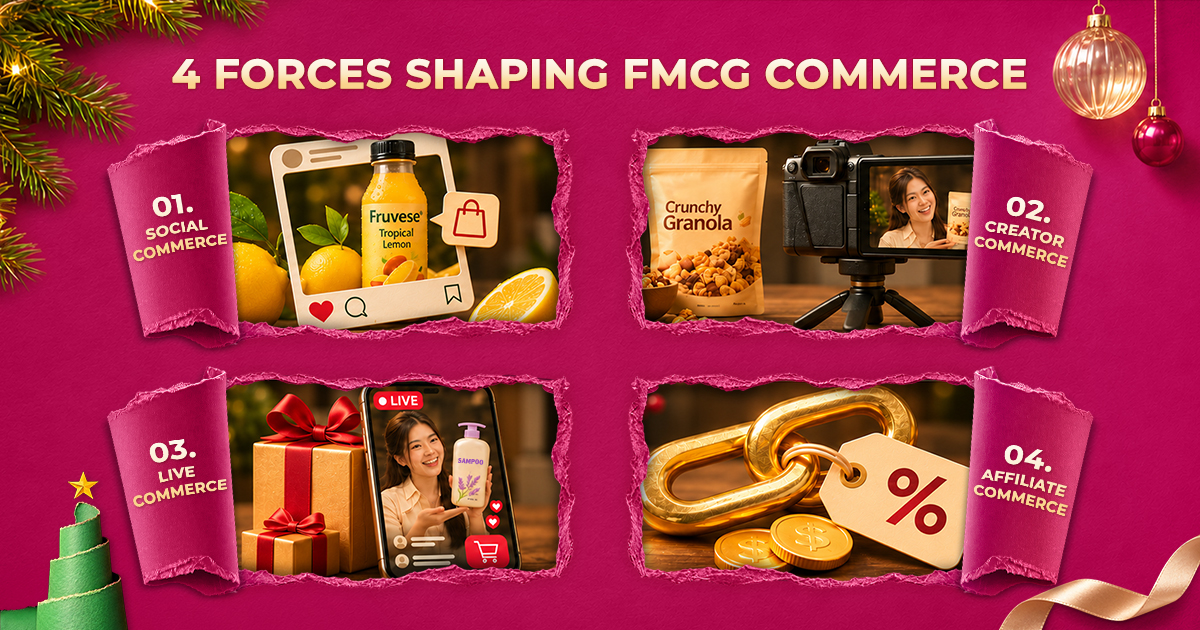
Four commerce trends are reshaping the FMCG shopping journey.
Source: Novaon Digital
Creator Commerce: When Creators Become Active Participants in the Purchase Journey
Creator Commerce expands the role of content creators from message amplifiers to commercial partners who can influence product discovery, evaluation, and purchasing decisions.
Within the FMCG industry, food creators can introduce products through recipes, lifestyle creators can develop holiday gift guides, and family-focused creators can share authentic product experiences in everyday household settings.
According to TikTok Shop, the number of creators participating in affiliate marketing on the platform in Vietnam increased by 140% in 2025 compared with the previous year.
This expansion highlights the growing importance of creators within the content-driven commerce ecosystem.
For brands, follower count is no longer the only criterion for creator selection. Category relevance, community quality, and the ability to produce persuasive content must also be considered.
AI can support this process by analyzing content performance, consolidating community feedback, and assisting with creative ideation.
However, technology should remain an enabling tool rather than replacing creators’ authentic experiences and distinctive voices.
Live Commerce: Bringing Product Experiences, Engagement, and Shopping Together in Real Time
Live Commerce integrates product demonstrations and customer interactions into a single livestream shopping environment.
Viewers can watch product demonstrations, ask questions, compare products, and access promotional offers without leaving the content experience.
For FMCG brands, livestream shopping can be activated through holiday meal preparation tutorials, gift bundle showcases, personal care product demonstrations, or product recommendations for families.
According to TikTok Shop, the number of affiliate creators participating in livestream commerce in Vietnam doubled in 2025.
Beyond attracting viewers, livestream effectiveness also depends on host quality, content structure, pricing strategies, and order fulfillment capabilities.
AI can support livestream operations by consolidating frequently asked questions, analyzing audience feedback, and identifying products or content generating strong interest, allowing brands to make more informed adjustments.
Affiliate Commerce: Expanding Product Discovery Networks and Conversion Opportunities
Affiliate Commerce enables creators and content partners to promote products through affiliate marketing arrangements and earn commissions based on predefined conditions.
For FMCG brands, this model creates opportunities to expand product discovery touchpoints, particularly during the holiday season when consumers consult multiple sources before making purchase decisions.
A single product may appear in review videos, gift guides, product tutorials, or livestream sessions hosted by different creators.
However, expanding an affiliate network also increases management complexity.
Without a clear strategy, brands may face inconsistent messaging, repetitive content, or excessive reliance on price discounts to compete.
To maximize effectiveness, brands need to align affiliate activities with product strategies, content guidelines, and performance measurement frameworks.
Data analytics and AI tools can support partner performance evaluation, identify high-potential content, and help allocate collaboration resources more effectively.
These four mechanisms are not entirely separate.
Social Commerce represents a broader commerce model; Creator Commerce emphasizes the role of creators; Live Commerce focuses on real-time interaction and selling; while Affiliate Commerce operates through performance-based partnerships.
An FMCG campaign can integrate multiple mechanisms simultaneously, with AI & Technology supporting stronger creative execution, operational efficiency, and performance measurement.
3. From Content to Purchase: When Content Becomes Part of the Commerce Journey
The growth of Social Commerce does more than introduce another sales channel. It also changes how brands structure the customer journey. Traditionally, marketing communications focused on building awareness and engagement, while product research and purchasing took place across separate touchpoints.
Today, these activities can be connected more directly through content, creators, and integrated commerce features on digital platforms. This shift can be summarized through four stages: Content → Engagement → Product Discovery → Purchase
AI can support each stage, from content development and personalized interactions to shopping experience optimization.
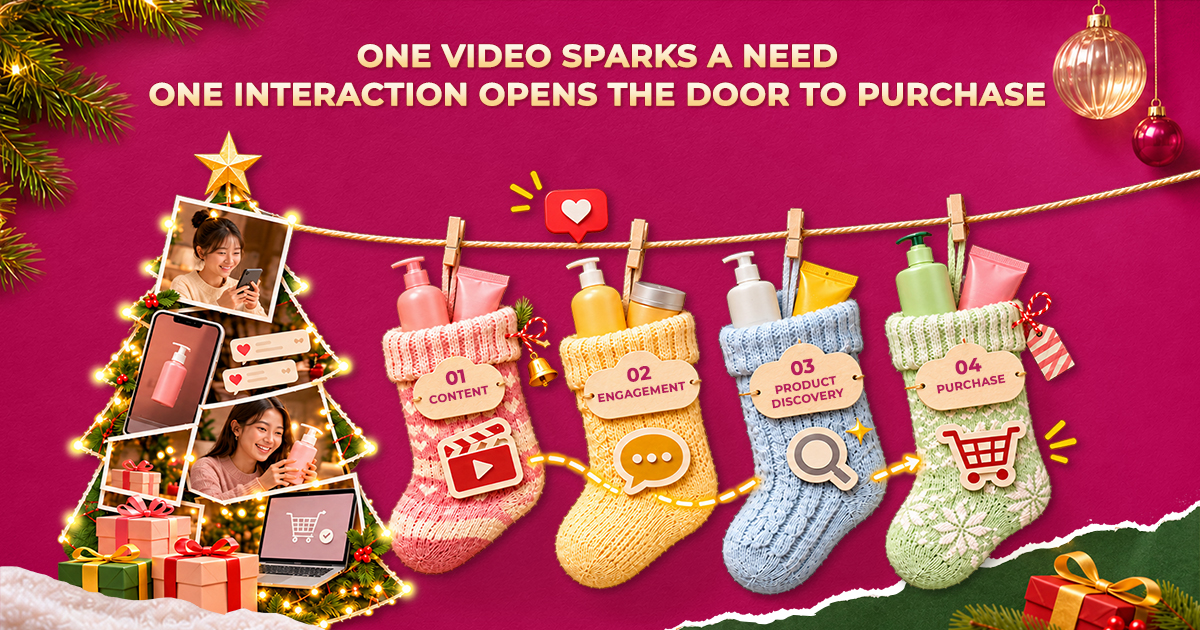
Connecting content, engagement, and product discovery to drive conversions.
Source: Novaon Digital
Content: Capturing Attention Through Real Consumer Needs
During the holiday season, consumers are exposed to large volumes of advertising content and promotional offers. To stand out, brands need to address specific consumer needs, such as preparing family meals, selecting gifts, practicing self-care, or organizing year-end gatherings. Beyond conventional content production, Generative AI can support the development of visuals, videos, and advertising variations tailored to different contexts. This allows brands to experiment with multiple creative approaches while maintaining consistency in brand identity and messaging.
Engagement: Turning Attention into Meaningful Interactions
Once consumer interest has been captured, content should encourage active participation through comments, shares, questions, or interactions with creators.
In particular, combining AI with gamification can expand the possibilities for interactive experiences. Rather than simply participating in promotional minigames, consumers can create personalized Christmas cards, receive gift recommendations, or join AI-assisted creative challenges. These activities enable brands to deliver more personalized experiences while encouraging users to participate and share content within their communities.
Product Discovery: Turning Interest into Product Exploration
Once content generates interest, consumers begin exploring products through reviews, tutorials, online storefronts, or community recommendations.
According to the TikTok Shop Vietnam Summit 2026, revenue generated through search activity on TikTok in Vietnam increased by 55% in 2025, while revenue from the Shop Tab grew by 67%. These figures suggest that the platform supports not only spontaneous product discovery but also increasingly intentional product searches. At this stage, AI can support product recommendations, gift bundle suggestions, and relevant content based on information and behavioral signals that brands are permitted to use.
However, these recommendations must be accompanied by accurate information about product benefits, pricing, and specifications.
Purchase: Shortening the Path from Purchase Intent to Transaction
Once consumers have identified suitable products, the shopping experience becomes a critical factor in conversion. Shoppable videos, livestream shopping, and affiliate content help consumers access purchasing touchpoints more conveniently. AI can support advertising performance analysis, identify conversion barriers, and recommend adjustments to content or budget allocation.
Nevertheless, order generation still depends on several factors, including pricing, promotions, storefront credibility, inventory availability, and delivery speed. During the holiday season, the ability to fulfill orders on time can significantly influence customer experience. In practice, the shopping journey is not necessarily linear. Consumers may watch content multiple times, compare reviews from different creators, search across e-commerce platforms, or complete purchases at physical retail stores.
Therefore, brands should approach Content-to-Commerce as a connected, multi-touchpoint ecosystem in which technology enhances relevance and operational efficiency, rather than assuming that every content view directly generates a transaction.
4. AI & Technology: Expanding Creative Capabilities, Engagement, and Holiday FMCG Campaign Optimization
During peak shopping periods, FMCG brands must address multiple demands simultaneously: producing content quickly, reaching diverse consumer segments, maintaining engagement, and driving conversions within a limited timeframe. Advances in AI are enabling more flexible approaches to marketing execution. Beyond automation, technology can support multiple stages of a campaign, from content creation and experience design to data analysis and performance optimization.
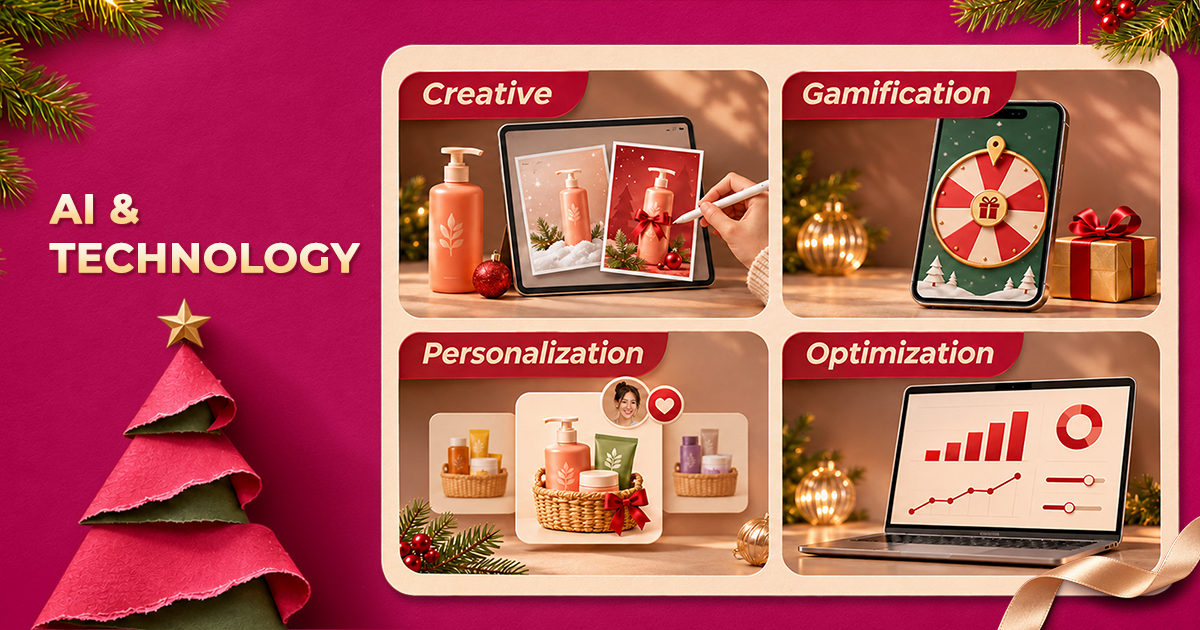
AI enhances creativity, personalization, and FMCG campaign optimization.
Source: Novaon Digital
AI-Generated Creative: Scaling Content Creation Across Holiday Occasions
Generative AI enables brands to support the development of product visuals, key visuals, advertising videos, and content variations tailored to different consumer segments or shopping occasions.
For example, a beverage brand can develop multiple visual variations for Christmas parties, gatherings with friends, New Year gifting, or family celebrations. Instead of relying entirely on a single set of creative assets, AI enables creative teams to explore additional executions suited to different marketing touchpoints. This application can help shorten certain stages of ideation and content adaptation.
However, brands must continue to ensure product representation accuracy, creative quality, copyright compliance, and consistency with brand identity.
AI-Powered Gamification: Transforming Engagement into Personalized Experiences
Gamification is already widely used in holiday marketing campaigns, ranging from lucky spins and loyalty point systems to interactive challenges and reward-based activities. When combined with AI, gamification can move beyond fixed interaction mechanics to deliver experiences with a stronger sense of personalization.
For example, an FMCG brand could launch a minigame that allows users to upload photos and generate AI-powered Christmas cards, select festive themes to receive personalized gift-basket suggestions, or participate in creative challenges featuring branded products. Participants can not only receive promotional benefits but also create personalized content to share on social media, expanding campaign reach through community participation. To deliver meaningful value, these experiences need simple participation mechanics, relevant rewards, and a clear connection to the brand’s products or campaign objectives. When personal images are involved, brands must also obtain appropriate consent and establish transparent data-handling practices.
AI Personalization: Tailoring Content and Shopping Recommendations
During the holiday season, the same FMCG product may serve different purposes, including personal consumption, gifting, or shared household use. AI can support the analysis of relevant behavioral signals to recommend products, gift bundles, content, or promotional offers tailored to different consumer needs.
For instance, consumers interested in year-end party menus may receive recommendations for suitable ingredient bundles, while those searching for gifts may discover product sets based on their budgets and intended recipients. The value of personalization lies not simply in delivering more messages, but in helping consumers discover more relevant options. Its effectiveness depends on data quality, integration across touchpoints, and compliance with personal data protection requirements.
AI-Powered Optimization: Connecting Data to Improve Campaign Performance
During peak shopping periods, content and advertising performance can change rapidly in response to consumer demand, promotional activities, and competitive dynamics. AI can support the consolidation of data from multiple touchpoints, analyze content performance, identify potential customer segments, and recommend adjustments to advertising activities or resource allocation.
For campaigns integrating creators, livestream shopping, and affiliate marketing, technology can also support performance comparisons across content categories, partners, and product portfolios. This enables brands to better identify which activities contribute most effectively to business objectives. However, AI does not automatically guarantee revenue growth. Its actual value should be assessed through relevant metrics such as engagement, product discovery, conversion rates, customer acquisition costs, and profitability.
Overall, AI & Technology do not replace Social Commerce or Creator Commerce. Instead, they enhance execution capabilities across the entire ecosystem.
When applied with clear objectives, technology can help FMCG brands connect creativity, engagement, data, and commerce into a more consistent customer experience.
5. Content-to-Commerce and Creator-led Commerce: Two AI-Enabled Strategic Approaches for Holiday FMCG Marketing
Content-to-Commerce: Connecting Content, Technology, and Commercial Objectives
Content-to-Commerce is a strategic approach that connects content creation with the product discovery and purchasing journey, assigning each content category a specific role.
For FMCG brands, the process can begin by identifying key consumption needs during the holiday season and developing content aligned with each stage of the customer journey. At the awareness stage, content can focus on emotions and seasonal consumption moments. As consumers move into consideration, brands can prioritize tutorials, reviews, and product demonstrations. At the conversion stage, livestream shopping, product bundles, and shoppable content can support purchase decisions.
AI can contribute to this process through creative asset variations, personalized experiences, and content performance analysis. For example, a food brand could develop a campaign centered on year-end party preparation. The campaign might begin with menu inspiration videos, followed by recipe tutorials from food creators, AI-powered minigames that generate personalized menus or invitations, and product bundles promoted through livestream shopping. The key is that these activities should not operate independently. They should address a shared consumer need while remaining connected to the brand’s product portfolio, sales channels, and performance measurement framework.
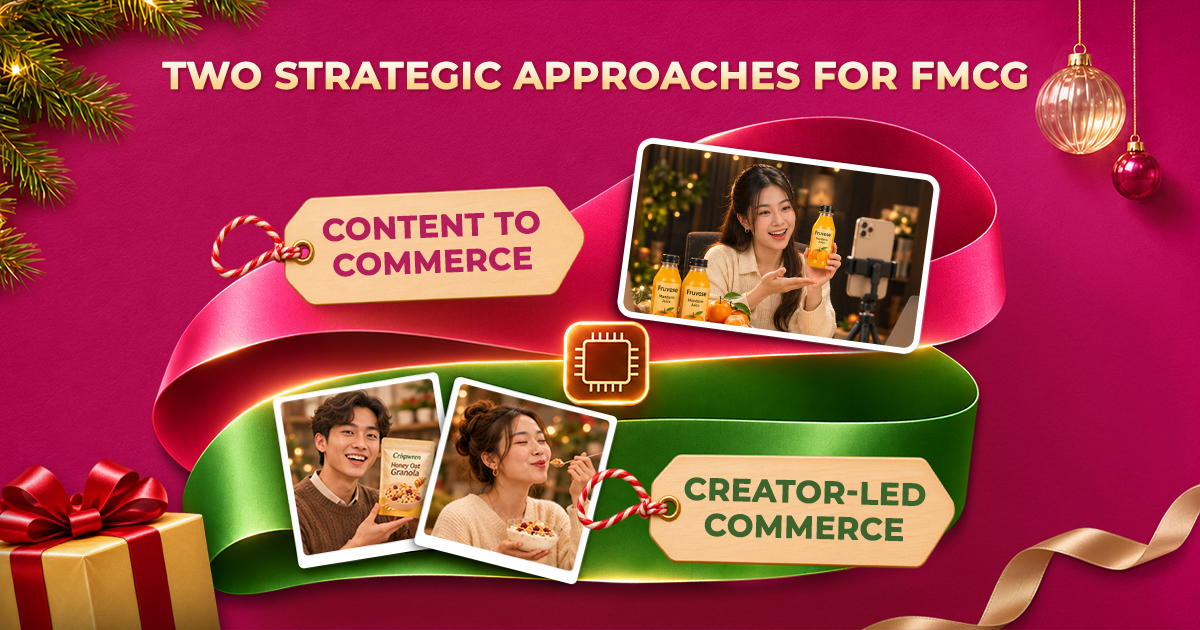
Integrating Content-to-Commerce, Creator-led Commerce, and AI to drive growth.
Source: Novaon Digital
Creator-led Commerce: Combining Creator Influence with Data and Technology
While Content-to-Commerce focuses on connecting content with commercial activities, Creator-led Commerce emphasizes the role of creators in generating demand and influencing purchasing behavior.
Instead of working with creators through isolated sponsored posts, brands can build a network of partners with different roles throughout a campaign. Creators with strong storytelling and reach can support awareness. Category-specialist creators can provide product experiences and reviews. Partners with strengths in livestream shopping or affiliate marketing can contribute more directly to conversion. Technology can help brands assess creator relevance, consolidate content performance data, and evaluate the contribution of different partner groups.
Generative AI can also support ideation and creative asset development, while creators continue to play the central role in communicating authentic experiences and building trust within their communities. For holiday FMCG marketing, this approach allows brands to appear across diverse consumption contexts while maintaining alignment between brand messaging, engagement activities, and sales objectives.
From Short-Term Campaigns to an Integrated Operating Model
To implement these two approaches effectively, FMCG brands need to coordinate three core capabilities.
Strategy – Consumer- and Data-Driven Planning: Identify target audiences, consumption occasions, priority products, and the role of each touchpoint throughout the shopping journey.
Creative – Content and Experience Development: Develop campaign concepts, creator content, livestream shopping experiences, and interactive activities tailored to product characteristics. AI can expand creative capabilities, but execution must remain strategically guided and quality-controlled.
Technology – Connected Experiences and Performance Optimization: Apply AI, data, and measurement tools to support personalization, campaign management, and performance evaluation from engagement to conversion.
Beyond views and engagement, brands should track metrics such as product page visits, conversion rates, average order value, revenue, creator collaboration costs, and post-promotion performance.
Importantly, GMV growth does not necessarily translate into profit growth. If affiliate commissions, advertising expenses, promotional costs, and operational expenses rise faster than revenue, a campaign may deliver impressive sales figures without generating proportionate economic returns. Therefore, integrating Content-to-Commerce, Creator-led Commerce, and AI & Technology should be viewed as a long-term operational capability rather than a solution limited to a single shopping season.
6. Holiday FMCG Marketing 2026: Growth Opportunities at the Intersection of Content, Creators, Commerce, and AI
The continued development of TikTok Shop and the creator ecosystem is creating new opportunities for FMCG brands to reach consumers at the very moment purchase needs begin to emerge. However, as more brands invest in short-form videos, livestream shopping, and affiliate marketing, competitive advantage becomes increasingly difficult to sustain through content volume or promotional incentives alone. At the same time, AI offers opportunities to improve marketing effectiveness through more flexible content creation, interactive experience design, personalized shopping recommendations, and data-driven campaign optimization.
For FMCG brands, the opportunity does not lie in adopting as many tools as possible, but in selecting and integrating solutions that align with consumer needs, product characteristics, and business objectives.
Brands can leverage content and creators to stimulate demand, commerce touchpoints to support conversions, and AI to improve experience relevance and operational efficiency. More importantly, data generated across these activities can help brands better understand key consumption occasions, high-interest product categories, and value-driving content. These insights can then inform marketing strategy and optimization for future shopping seasons.
Conclusion
Holiday FMCG Marketing 2026 highlights the growing convergence of content, creators, and e-commerce, with Social Commerce, Creator Commerce, Live Commerce, and Affiliate Commerce collectively supporting the journey from product discovery to purchase. For FMCG brands, the opportunity lies not in implementing these approaches separately, but in connecting them through Content-to-Commerce and Creator-led Commerce strategies that translate consumer attention into measurable business outcomes.
Guided by its Strategy – Creative – Technology (SCT) approach, Novaon Digital addresses this challenge by combining strategic thinking, creative content development, and technology applications in marketing.
This integrated approach provides a foundation for FMCG brands to deliver experiences that better reflect evolving consumer behavior while connecting brand-building objectives with business performance. During the holiday season, growth opportunities belong not only to brands with the greatest visibility, but also to those capable of turning consumer attention into meaningful value and connecting touchpoints into an effective shopping journey.