1. The FMCG Market: E-commerce Growth and the Fragmentation of the Shopping Journey
Vietnam’s fast-moving consumer goods (FMCG) market is seeing significant changes in how consumers seek information, choose products, and make purchase decisions. The growth of digital platforms gives brands more opportunities to reach consumers while making the shopping journey more varied and less predictable.
According to Worldpanel’s Vietnam FMCG Outlook 2025 report, Vietnamese consumers are choosing from a growing number of brands, products, and retail channels. As spending pressures increase, purchase decisions are shaped by price, perceived value, convenience, and the brand experience.
The pace of e-commerce growth reflects this shift.
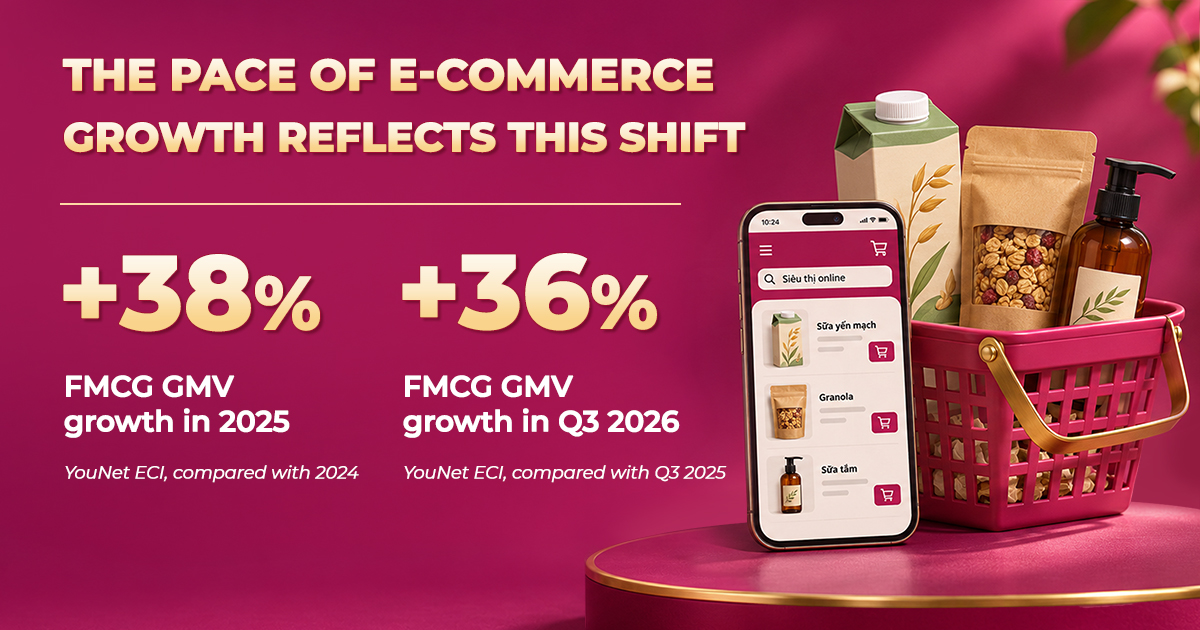
FMCG GMV growth on the e-commerce marketplaces surveyed (YouNet ECI)
Source: Novaon Digital
Notably, FMCG rose to become the second-largest category on the e-commerce marketplaces tracked by YouNet ECI in 2025, behind fashion and accessories. In the first nine months of 2026, the category continued to grow, rising 26% year on year. This shows that e-commerce is becoming an increasingly important part of FMCG brands’ distribution and growth.
However, online growth does not mean that consumers are abandoning traditional retail outlets. In practice, shoppers are increasingly combining different ways of buying.
According to PwC’s Voice of the Consumer Survey 2025 – Vietnam Snapshot, Vietnamese consumers shop for food and groceries both online and in person. For supermarkets and large grocery stores, 54% of respondents chose to combine both methods. For local stores and convenience stores, 59% preferred to shop in person.
This reflects a reality: consumers no longer rely on a single channel throughout the shopping journey. They might encounter brand content on social media, check prices and product reviews on an e-commerce marketplace, and then buy from a nearby store for convenience. The reverse can also happen. An in-store experience may prompt consumers to look up information and order online the next time they shop.
Social media makes this journey even more flexible. At the TikTok Shop Vietnam Summit 2026, the platform released data showing that 76% of Vietnamese consumers are likely to search for a product, click to view it, or add it to their cart after engaging with authentic content. This suggests that content can build awareness, establish trust, and prompt shopping actions at the same time.
The FMCG shopping journey is therefore shifting from a linear model to one with multiple touchpoints, where awareness, consideration, and purchase can overlap.
The Challenge for FMCG Brands: A Multichannel Presence with a Fragmented Experience
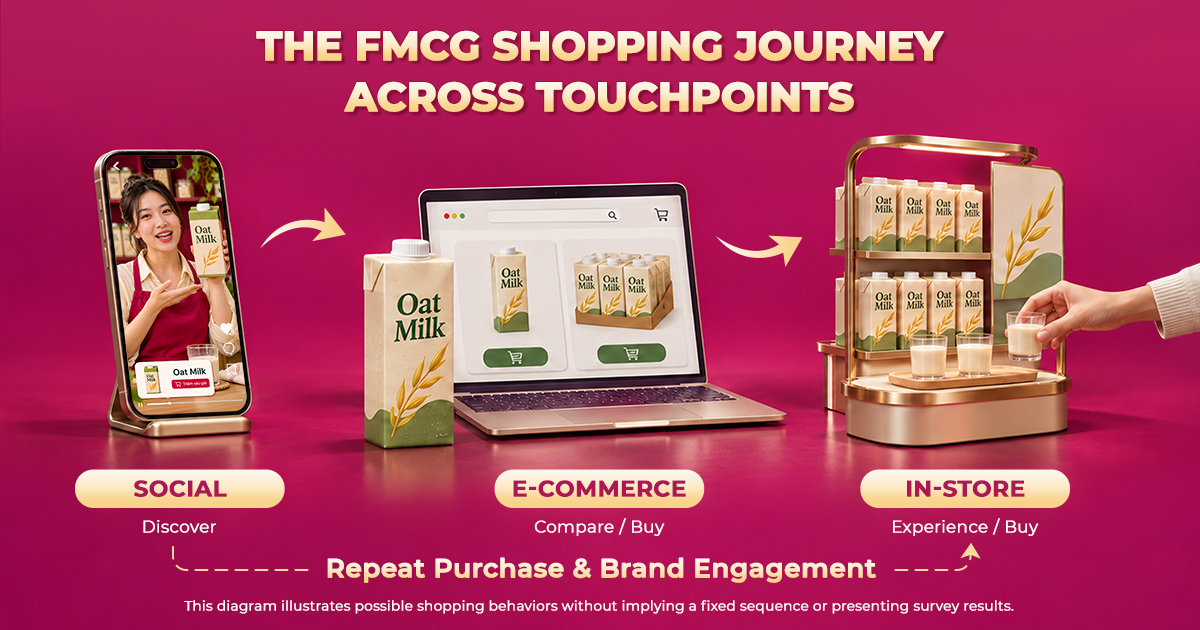
Illustration of the Multi -Touchpoint FMCG Customer Journey
Source: Novaon Digital
As shopping journeys grow more complex, expanding a brand’s presence across platforms is no longer enough to create a competitive advantage.
A brand may run a social media campaign with high reach, generate strong sales through an e-commerce storefront, and maintain a wide distribution network. However, when these three activities operate with separate goals, messages, and data, consumers may still encounter inconsistent experiences across touchpoints.
On social media, consumers may see a message about a product’s value but struggle to find where to buy it. On e-commerce marketplaces, product information and offers may be out of step with the campaign. At physical stores, the brand may miss the chance to build on interest generated through earlier interactions.
This fragmentation creates three major challenges: a disjointed brand experience, missed conversion opportunities between channels, and difficulty measuring how much communications actually contribute to sales.
In FMCG, many purchase decisions are made quickly, individual orders tend to be low in value, and repeat purchase frequency matters. Breaks in the journey can therefore directly affect growth.
The question now goes beyond how a brand can appear on multiple channels. It is how every touchpoint can contribute to a unified shopping experience.
2. Omnichannel Brand Experience x Commerce: From Separate Communications and Sales Activities to a Seamless Brand Experience
As consumer behavior changes, FMCG brands need to shift from developing individual channels in isolation to connecting the entire customer journey.
The multichannel model focuses on increasing the number of touchpoints and sales channels. Omnichannel Brand Experience focuses on making those touchpoints consistent and connected, regardless of where consumers begin or complete a purchase.
Combined with Commerce, this model maintains a consistent brand identity and emotional experience while linking communications interactions to purchase opportunities. It also uses post-purchase data to continue building relationships with consumers.
This approach is built on the coordination of Strategy – Creative – Technology. Strategy defines each channel’s role and the business objectives. Creative develops experiences and messages suited to each context. Technology helps connect data, optimize operations, and measure performance.
Brands need an integrated set of solutions that links communications planning to commercial activities.
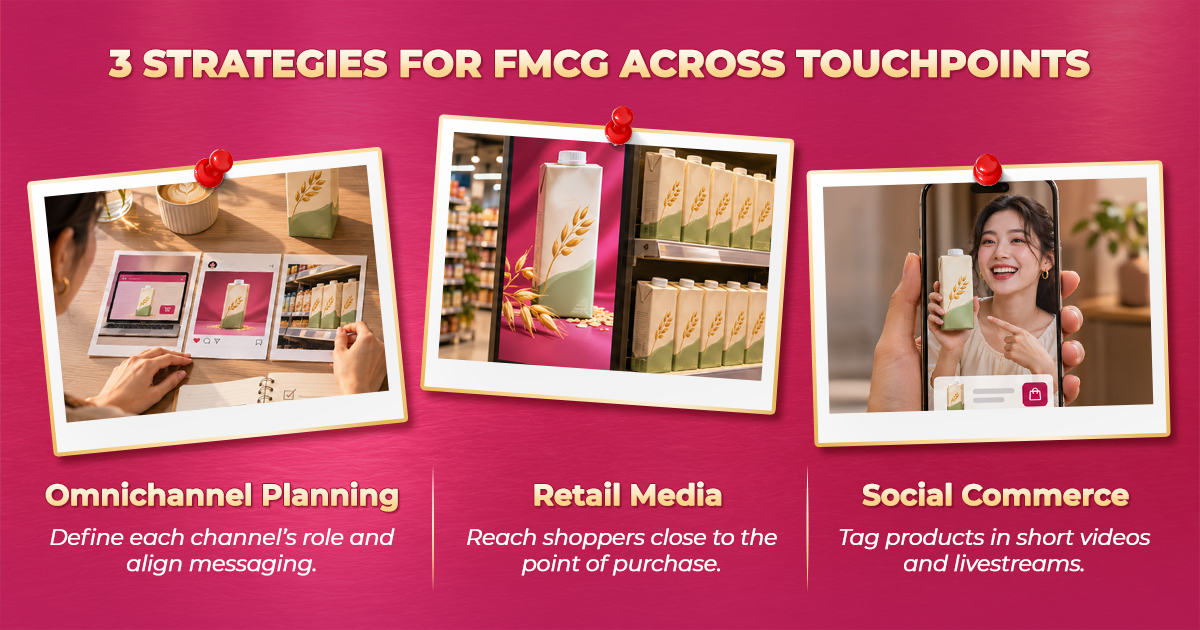
Three Strategies for FMCG Across Touchpoints
Source: Novaon Digital
Omnichannel Planning: Planning an Omnichannel Experience
Omnichannel Planning is the process of developing a plan to reach consumers across all touchpoints based on shopping behavior, the role of each channel, and the brand’s overall objectives.
In FMCG, this means analyzing when needs arise, identifying which channels influence purchase decisions, and assigning messages accordingly. Social media can inspire consumers, KOLs and KOCs can demonstrate products and share their experiences, e-commerce marketplaces can support conversion, and physical stores can make products accessible and convenient to buy.
For example, when launching a new beverage line, a brand can publish creative content on TikTok and Facebook to encourage trial, incorporate creator reviews that direct consumers to its online storefront or retail outlets, and coordinate in-store displays and sampling.
The key is for channels to work together toward a shared experience and commercial objective. The core brand message stays consistent while its execution is adapted to each platform.
Retail Media: Communications Within the Retail Ecosystem
Retail Media uses advertising placements and data available within a retailer’s ecosystem to reach consumers close to the point of purchase.
It can take the form of sponsored product search ads on e-commerce marketplaces, banners on online storefronts, co-marketing programs with supermarkets or retail chains, and advertising screens and displays at the point of sale.
For FMCG brands, Retail Media offers a way to turn interest into purchases. After seeing campaign content, consumers may encounter the brand again when actively searching for a product or choosing among items in a retailer’s assortment.
A personal care campaign, for example, could combine how-to content on social media with sponsored product ads on Shopee while expanding its presence in retail chains through product displays and relevant promotions.
Retail Media effectiveness depends on more than generating impressions close to purchase. It also depends on product relevance, pricing, stock availability, and the ability to measure actual incremental sales.
Social Commerce: Shopping Integrated Into Social Media
Social Commerce brings product discovery, content engagement, and shopping together on social media, shortening the distance between interest and action.
In FMCG, it can take the form of short videos with tagged products, livestreams that offer advice and sell products, reviews from KOLs and KOCs, affiliate marketing programs, or initiatives that encourage users to share their firsthand experiences.
Social Commerce combines engaging content with the ability to convert interest directly into purchases. Product storytelling, tutorials, and answers to questions can help consumers build trust and make decisions during the interaction itself.
For everyday categories such as food, beverages, and personal care, brands can create content around specific occasions or uses. This creates natural opportunities to buy beyond those generated by promotions alone.
To be effective, Social Commerce needs to be closely coordinated with inventory planning, pricing policies, order fulfillment capabilities, and the brand’s other commercial activities.
Connected Data & Measurement: Connecting Data and Measuring Performance Across Channels
Communications and sales activities create touchpoints with consumers. Data gives brands a basis for understanding how those touchpoints relate to one another.
A centralized approach to data integration brings together and analyzes information from sources such as digital advertising, social media engagement, e-commerce storefronts, websites, loyalty programs, and sales data shared by distribution partners.
A centralized analytics and reporting system lets brands track key metrics ranging from reach, engagement, and product searches and page visits to orders, revenue, repeat purchase rates, and return on investment.
For example, if a campaign featuring KOLs or KOCs increases product searches without a corresponding rise in sales, the brand can examine pricing, stock availability, product page content, or the checkout experience to identify the cause.
Even with connected data, brands may be unable to attribute every action to an individual consumer across all platforms. In practice, brands need to combine data they are permitted to access, campaign tracking codes, aggregate analysis, and methods for measuring incremental sales to reliably assess each channel’s contribution.
3. Case Study: How FMCG Brands Connect Experience and Commerce
Brands have integrated brand experience with commerce in various ways, from connecting communications and sales across platforms to developing channels for direct consumer interaction.
L’Oréal and PepsiCo illustrate two different approaches. L’Oréal combines content and experiences with omnichannel distribution, while PepsiCo expands its reach through direct-to-consumer sales.
Case Study 01: L’Oréal – Connecting Brand Experience with Sales Conversion
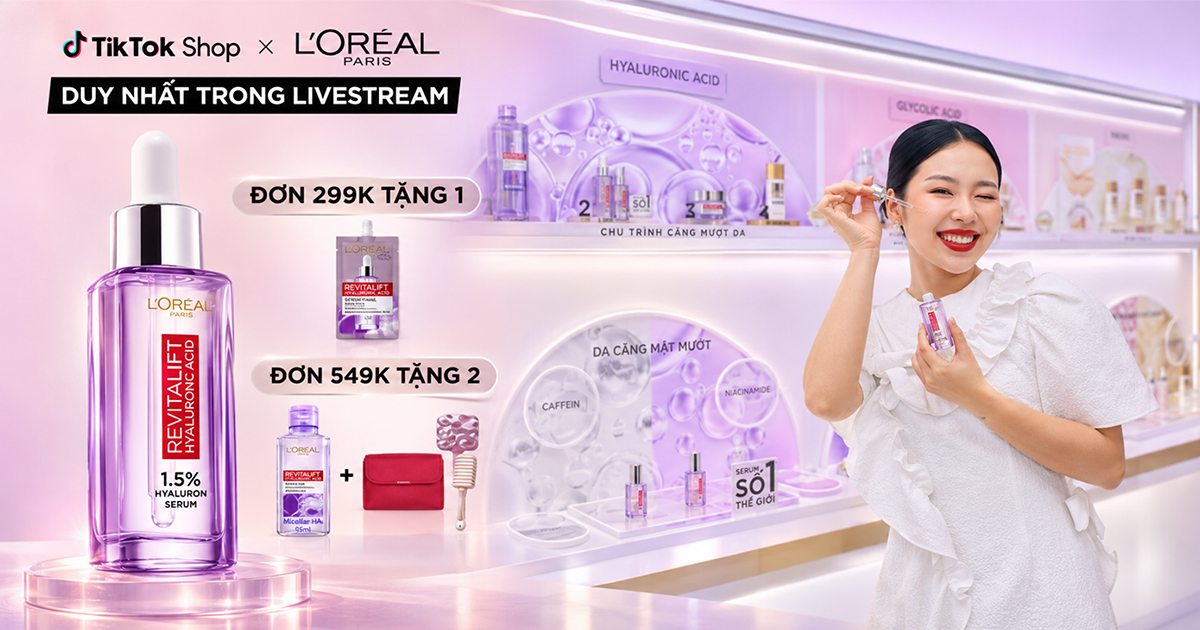
L’Oréal Paris Revitalift combines TikTok Shop livestreams with in-store experiences
Source: L’Oréal
In a highly competitive skincare market, L’Oréal Paris recognized that increasing product visibility alone was insufficient to drive purchase decisions. Consumers needed clear information, reliable advice, and firsthand experience to choose the right products.
In its Hyaluronic Acid Revitalift campaign in Vietnam, the brand combined educational content about skincare ingredients with entertainment and commerce. It ran the campaign across social media, worked with KOLs and KOCs, hosted TikTok livestreams, and used e-commerce marketplaces such as Shopee and Lazada.
The campaign went beyond promoting product benefits. It involved dermatologists and creators who explained the ingredients, showed consumers how to use the products, and shared firsthand experiences. Livestreams and product placements let consumers learn about and purchase products within the same content ecosystem.
According to the campaign case study published on WARC, the campaign recorded 300 livestream sessions that met the required standards, a total of 700 hours of broadcasting, 7,000 units of serum sold in one week, and a nine-point increase in the brand perception metric tracked.
At the group level, L’Oréal’s 2025 Integrated Report states that e-commerce accounted for about 30% of total group sales. The company is also developing Beauty Tech solutions such as virtual try-ons, skin analysis, and personalized product recommendations to connect online and in-store experiences.
L’Oréal’s case shows how designing content around consumers’ information needs and connecting it with commerce can help a brand build trust, prompt action, and improve the experience at the same time.
The Hyaluronic Acid campaign illustrates how Social Commerce can be integrated with sales channels. L’Oréal’s broader omnichannel strategy operates at the group level. The two levels should be distinguished when evaluating results.
Case Study 02: PepsiCo Direct-to-Consumer: Expanding the Direct Shopping Experience with the Brand
PepsiCo adopts the D2D model to expand the brand experience
Source: PepsiCo
Alongside connecting communications and retail platforms, another avenue for FMCG brands is building channels that sell directly to consumers, known as Direct-to-Consumer (D2C).
In May 2020, PepsiCo announced the launch of PantryShop.com and Snacks.com in the US to meet growing demand for online food and beverage purchases during the pandemic.
PantryShop.com offered product bundles for everyday needs such as snacking, starting the day, or recovering after exercise. Snacks.com let consumers choose directly from more than 100 products in the Frito-Lay portfolio.
A notable feature was how PepsiCo organized the shopping experience around how people would use the products, going beyond organizing products by brand. The platforms were optimized for mobile devices, making it easy to choose products and check out. According to PepsiCo, the two platforms went from concept to launch in under 30 days.
This model gave PepsiCo a direct consumer touchpoint alongside its traditional distribution network. Through D2C, the company gained more opportunities to understand consumer needs, test ways of bundling products, develop assortments for different usage occasions, and build direct relationships with customers.
D2C serves as a complement to retail. For FMCG brands, where broad distribution and easy access matter, direct sales channels are better suited to enhancing the experience, testing products, and using customer data where permitted.
PepsiCo’s case shows the value of designing the shopping experience around actual needs while creating more ways for the brand to connect with consumers. This D2C initiative launched in 2020. The original PepsiCo announcement does not disclose specific sales growth figures for the two websites, so it provides no basis for conclusions about their long-term performance.
4. Novaon Digital’s Perspective: Challenges and Growth Opportunities in Omnichannel Brand Experience
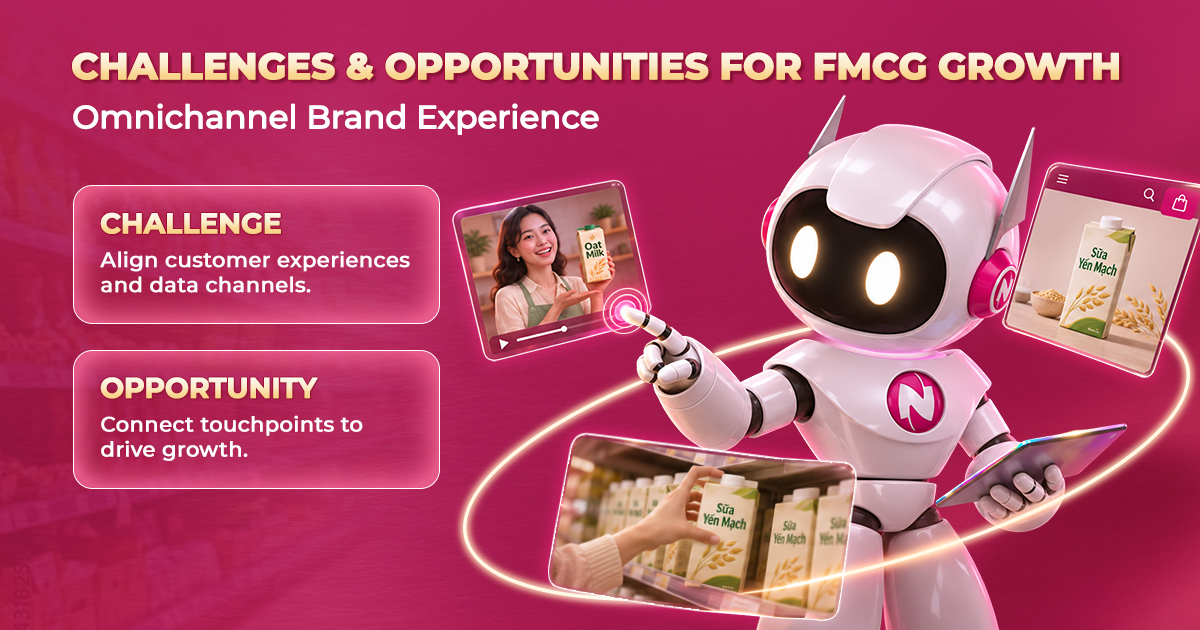
FMCG Growth Challenges and Opportunities in Omnichannel Brand Experience
Source: Novaon Digital
From a communications strategy perspective, the rise of Omnichannel Brand Experience × Commerce gives FMCG brands an opportunity to align brand-building goals more closely with business performance. Making this shift also requires changes in how brands plan, coordinate, and measure their activities.
Challenge: Delivering a consistent experience in an increasingly complex ecosystem. The first challenge is fragmentation across teams and operations. At many companies, brand communications, e-commerce, and retail development are handled by different departments with separate objectives and performance measures. A campaign can therefore perform well on individual platforms without meaningfully connecting the entire consumer journey. The second challenge is connecting data. When consumers shop across multiple platforms and distribution networks, it becomes difficult to determine how each touchpoint contributes to sales. In FMCG in particular, sales through distributors and traditional stores are not always fully captured by digital communications measurement systems.
Brands also face pressure to balance short-term growth with long-term brand value. Relying too heavily on promotions or campaigns that drive immediate conversions may boost short-term sales without necessarily making consumers more likely to favor the brand or keep choosing it. Opportunity: Use each touchpoint to build brand value and generate commercial value. Advances in digital platforms and data technology are giving FMCG brands more ways to build campaigns that connect communications directly to business outcomes.
First, brands can use Social Commerce to bring content, experience, and shopping together. Campaigns can shorten the journey from awareness to conversion by using creative content that conveys brand value and prompts action at the same time.
Next, the growth of Retail Media gives brands more opportunities to be visible when consumers are close to making a purchase decision. It also helps manufacturers, e-commerce platforms, and retailers coordinate more effectively.
Finally, technology and data allow brands to move gradually from measuring individual activities to assessing the overall contribution of marketing. With well-organized data, companies can allocate resources based on their actual impact on consumer behavior and business results.
In Novaon Digital’s view, companies can begin by identifying the touchpoints that have the greatest impact on the shopping journey, without having to invest in every platform at once. They can then build an integrated plan suited to their resources and gradually improve their ability to connect data.
At the heart of this shift is putting consumers first and combining three capabilities: strategy, creativity, and technology. Together, they can deliver a consistent, convenient experience that supports growth.
As FMCG competition intensifies, broad reach and a presence across many platforms are only part of what gives brands an advantage. An advantage comes from connecting touchpoints into a journey that creates value. Each interaction can open up an immediate sales opportunity while strengthening the relationship between the consumer and the brand.
Omnichannel Brand Experience × Commerce therefore goes beyond integrating communications and sales channels. It is an approach to growth that develops brand experience and commercial performance together throughout the consumer journey.