I. The Role of Experiential Point-of-Sale Events in Banking & Finance During the Online Marketing Era
Experiential Point-of-Sale Events are a form of direct marketing event organized at points of sale, from traditional markets and shopping malls to trade fairs and brand stores, designed to create real interactions between a brand and its customers at the place of transaction. In the banking and finance sector, financial brands deploy this format as a strategic tool to achieve specific goals: increasing account opening rates, activating apps, and introducing new financial products to target customer segments such as small traders, household businesses, and SMEs.
However, the explosion of online marketing has profoundly shifted customer psychology and behavior. As eKYC identity verification and digital onboarding become increasingly common, many brands have begun to ask: is Experiential Point-of-Sale Event still necessary when customers can open an account or sign up for financial services with just a few taps on their phone?
The Importance of Physical Interaction in Financial Services
Source: Compilation
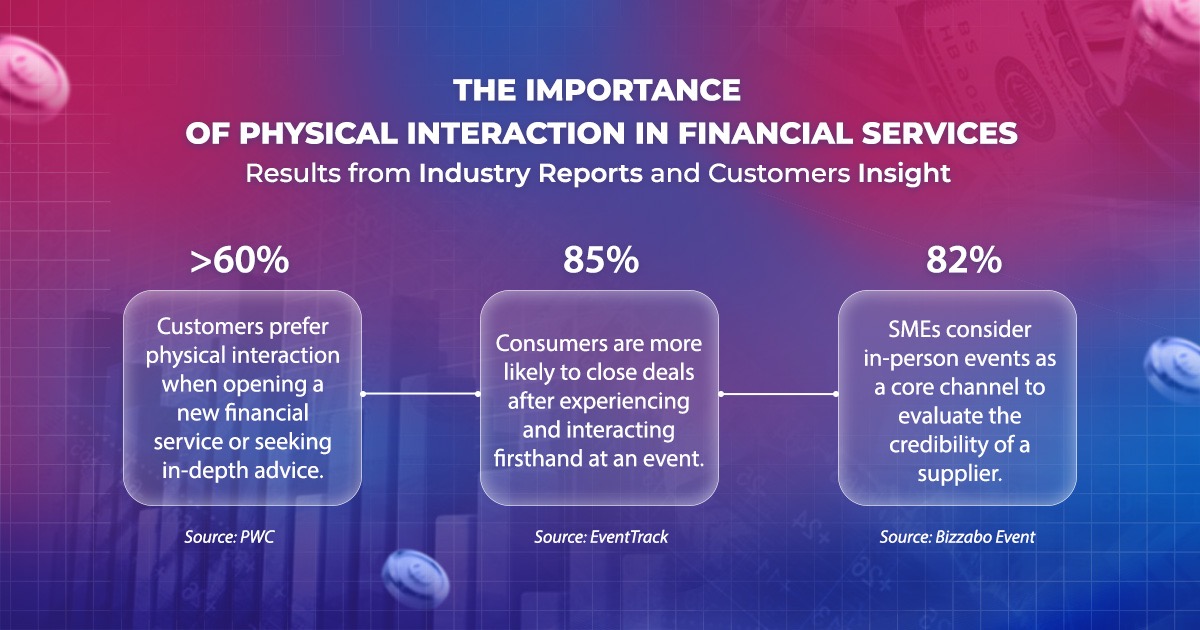
Real-world data tells a different story. According to a PwC report, despite familiarity with banking apps, more than 60% of customers still prefer physical interaction when opening new financial services or seeking in-depth consultations. The EventTrack report by Event Marketer also found that 85% of consumers are more likely to complete a transaction after directly experiencing and interacting with staff at an event. Particularly among B2B customers such as SMEs, 82% consider direct interactive events the most important channel for evaluating the trustworthiness of a financial service provider (Bizzabo Event Marketing Report).
These figures point to a core truth: digital delivers convenience, while Experiential Point-of-Sale Events deliver trust. And in the financial industry, trust is the decisive factor in customer behavior.
So what value does this format truly create that digital channels cannot replace, and how should Bank & Finance brands deploy it to achieve maximum effectiveness? We spoke with Ms. Tran Thi Thanh Thuy, PR & Event Manager at Novaon Digital, for answers.
★★★
Question 1: In your view, what value does Experiential Point-of-Sale Event bring to a Bank & Finance brand in terms of sales, branding, and customer reach?
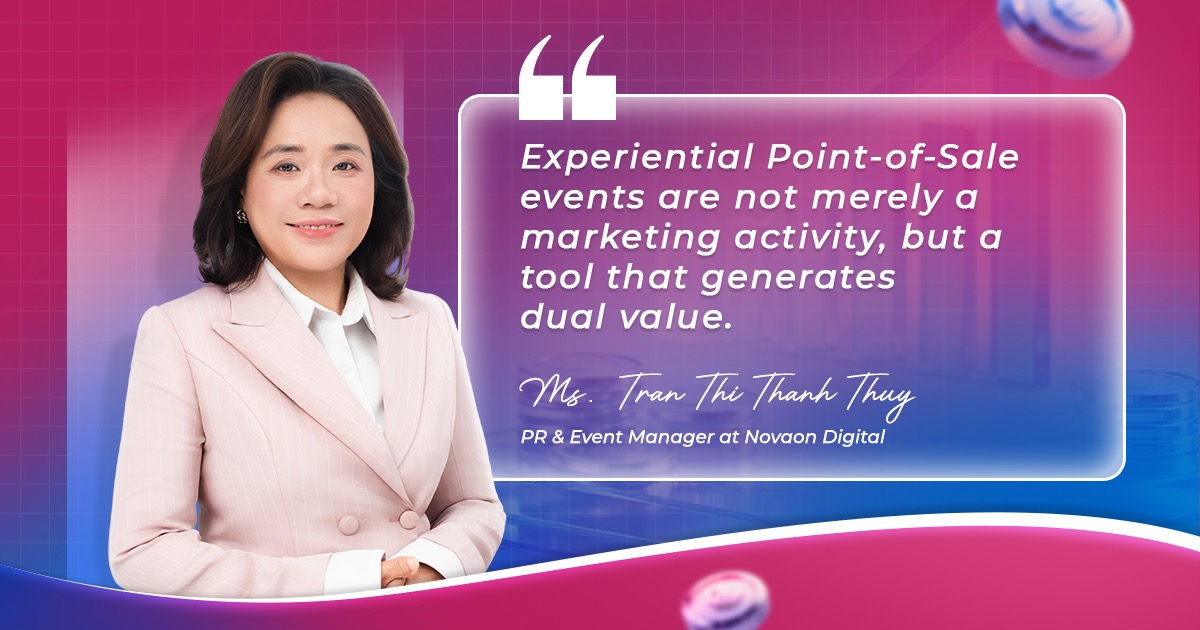
Ms. Tran Thi Thanh Thuy: The first thing I think we need to recognize is that Experiential Point-of-Sale Event is not simply a marketing activity. It is a tool that creates dual value, both in sales and branding, and these two values reinforce each other rather than operating separately.
On the sales side, this is one of the rare marketing formats capable of generating on-the-spot conversions. When customers are guided hands-on, have their questions answered directly, and feel sufficiently confident, they are willing to download an app, open an account, or register for a service right there during the event. This is something a display banner or an email marketing campaign can rarely accomplish within a single touchpoint.
The Value of Experiential Point-of-Sale Events for Brands in the Banking and Finance Industry
Source: Novaon Digital
On the branding side, the real value lies in the fact that Experiential Point-of-Sale Events build brand trust in a more lasting way. When customers have a positive experience at an event, they not only remember the brand but also tell the people around them. In the financial sector, word-of-mouth within local communities carries enormous influence, especially among small traders and household business owners.
And this leads to the third value, which I consider the most important: the ability to reach customer segments that digital misses. Not everyone is familiar with online advertising or willing to download an app just because they saw a banner. But when they are met in person, when they speak with a real human being, when they see a product working right in front of their eyes, the psychological barrier naturally dissolves. That is why Experiential Point-of-Sale Event remains an irreplaceable tool in the marketing strategy of Bank & Finance brands.
Question 2: Compared to digital marketing formats currently used by Bank & Finance brands, how do you see Experiential Point-of-Sale Events as distinctly different?
Ms. Tran Thi Thanh Thuy: I do not see this as a competition between two formats; they serve two different roles within the same system. But to understand why both are needed, we have to look directly at the core differences.
The first difference is in objectives. Digital marketing excels at reaching a broad audience and building brand awareness at scale. But Experiential Point-of-Sale Events do not compete on that front. Their goal is to convert behavior on the spot, to turn someone standing in front of a booth into an actual customer within that same session.
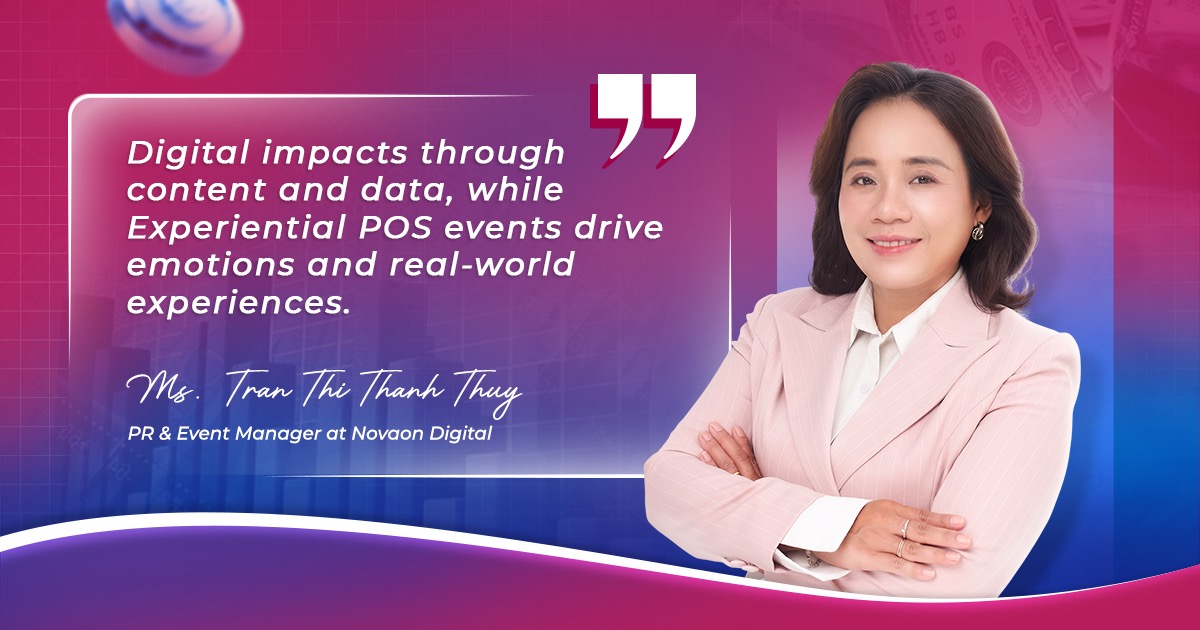
The second difference is in how trust is built. Digital influences through content, visuals, and data. Experiential Point-of-Sale Events influence through emotion and lived experience. This distinction is especially significant in the financial sector, because customers need to reach a certain threshold of trust before they are willing to share their personal or financial information.
The difference between Experiential Point-of-Sale Events and other forms of media communication
Source: Novaon Digital
The third difference is in which customer segments can be reached. Digital works very well with tech-savvy users who are accustomed to being online. But what about the busy small trader at the market, the household business owner who rarely uses social media, or the person who needs face-to-face conversation to be persuaded? That is precisely the group that Experiential Point-of-Sale Events can reach effectively, the group digital largely misses.
That is why, rather than asking whether to choose digital or Experiential Point-of-Sale Events, Bank & Finance brands should be asking how to make the two complement each other within an integrated strategy.
II. Strategy for Organizing Experiential Point-of-Sale Events in Banking & Finance at the Point of Sale
Most Experiential Point-of-Sale Event campaigns in the Bank & Finance sector are currently executed according to a familiar mindset: invest in an attractive booth, engaging minigames, and valuable giveaways. This is not wrong in itself, but it is solving the wrong problem. The issue is not whether the event is engaging enough; it is that all of these elements are assembled without an overarching strategy to guide customers toward the conversion point. The result is an event with traffic but no conversion.
The core distinction of the SCT framework that Novaon Digital has developed does not lie in doing more or doing differently, but in how the three layers, Strategy, Creativity, and Technology, are designed to work in synergy rather than in parallel. Strategy is not just planning; it is identifying the exact breakdown points in the customer journey so that Creativity can fill precisely the right gaps. Creativity is not just designing beautiful experiences; it is designing experiences capable of converting trust into action. And Technology is not just a support tool; it is the amplification layer that ensures each conversion generated on the ground continues to create value long after the event ends.
When these three layers operate correctly, an Experiential Point-of-Sale Event campaign is no longer a costly and hard-to-measure activation exercise but a systematic growth tool for a financial brand. The question becomes: in practice, how is that strategy deployed to overcome the psychological barriers unique to financial services customers at the point of sale?
★★★
Question 3: Unlike ordinary consumer goods where customers simply need to make a purchase, Bank & Finance requires customers to download an app, provide personal information, or complete identity verification on the spot, all of which represent significant psychological barriers. How do you think Experiential POS strategy should be designed to break down this hesitation and drive customers to complete these complex conversion actions at the event itself?
Ms. Tran Thi Thanh Thuy: This is the point where I believe many brands are designing their events in a direction that runs counter to the psychological nature of financial customers.
With everyday consumer goods, customers can make a purchase on impulse. But in financial services, impulse is not enough. Customers will not download an app or fill in personal information simply because they are in a good mood. They do so when, and only when, they have reached a sufficient level of trust. If a brand misreads this, it will produce an event with a large crowd but a near-zero actual conversion rate.
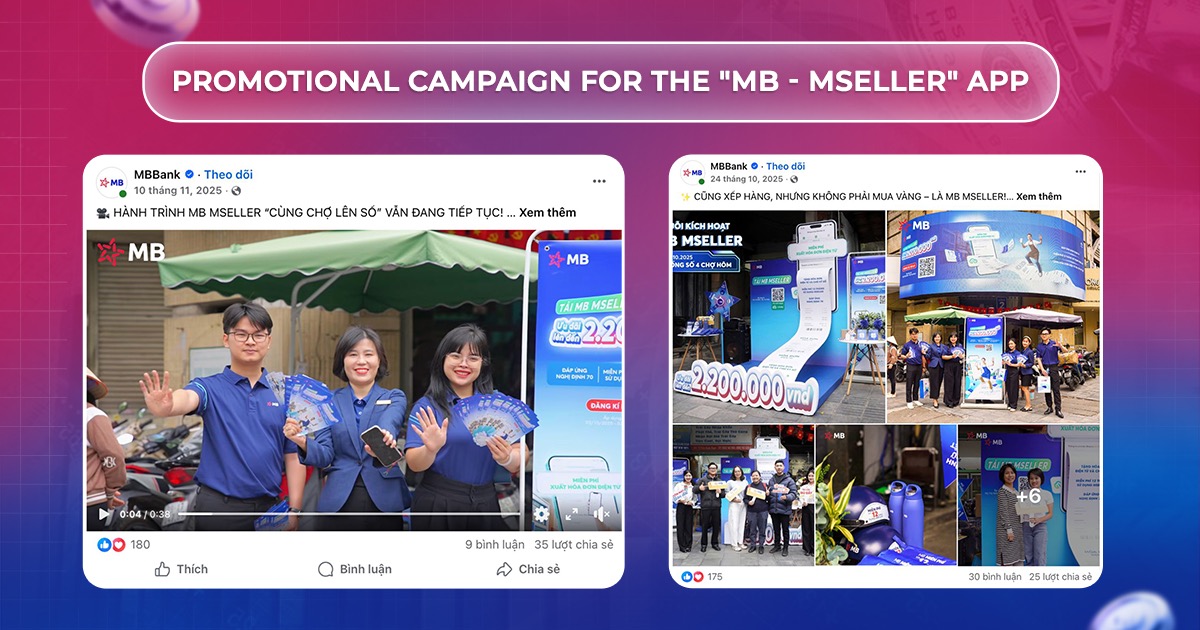
Novaon Digital partners with MB Bank in the Experiential Point-of-Sale Event campaign to promote the M-selling solution.
Source: Novaon Digital
The core design principle, therefore, is that the entire event must allow customers to feel ready on their own terms, not feel pushed. The sequence of activities must be designed as a deliberately trust-building journey. Staff must be trained with a consultative mindset, not a sales mindset. A staff member who rushes for the conversion from the very beginning will undermine the entire journey no matter how attractive the booth is.
I remember when working with a group of small traders at traditional markets, a segment that is both time-poor and entirely unfamiliar with digital financial services, we realized that a conventional approach would not work. During the mSeller app activation campaign for MB Bank, instead of using gifts to draw customers into the booth and then introducing the product, we completely reversed that flow: staff proactively visited each vendor’s stall, introduced the app’s benefits in the direct context of the trader’s daily work, supported them in downloading the app and opening an account on the spot, and only then guided them back to the booth to join the minigame and collect their gift. Conversion came first; reward came after.
The results showed that when the flow is designed in alignment with the customer’s psychology, conversion is not something the brand needs to push for. It happens naturally, because the customer has already arrived at that point in their own journey.
Question 4: In your view, how should Bank & Finance brands integrate Experiential Point-of-Sale Event strategy with other communication channels to create maximum synergistic impact?
Ms. Tran Thi Thanh Thuy: What I want to say plainly is that most Bank & Finance brands are wasting the largest portion of value generated by an Experiential Point-of-Sale Event campaign, that being the data and the emotions created at the event itself.
When customers participate in an event, download an app, open an account, or simply pause to ask for more information, those are behavioral signals more valuable than any digital advertising data. Yet most brands collect this data and leave it untouched, with no follow-up system to turn those signals into long-term customer journeys.
I always view Experiential Point-of-Sale Events as the midpoint of a closed conversion funnel, not the endpoint. Before the event, Social Media and Influencers play the role of building anticipation and drawing the right target customers to the venue. A person who already knows about the program before arriving will come with a completely different mindset than someone who wanders in by chance. During the event, all activities are designed to collect behavioral data organically while still delivering a great customer experience. And after the event is precisely when Technology truly comes into its own: all of that data is fed into a CRM system for personalized remarketing, nurturing those who have not yet converted, and reinforcing the loyalty of those who have taken action.
The stage that most brands overlook is the post-event period. Once the booth is dismantled, they consider the campaign closed. But in reality, that is when the cycle begins to deliver its true impact. Data from a well-executed event can fuel an entire remarketing system for months to come. Without a plan for the post-event phase, a brand is leaving the bulk of its campaign ROI lying on the ground.
III. Predictions on Industry Change & Expert Advice
The Experiential Point-of-Sale Event industry is at an inflection point. The purely physical activation model is gradually giving way to a new approach, one where the boundary between online and offline no longer exists in the eyes of the customer. According to a Deloitte report, more than 60% of global financial brands are reallocating budgets from traditional activation toward technology-integrated formats, where data from on-the-ground events is directly connected to the brand’s digital ecosystem. Additionally, research from Forrester indicates that 73% of consumers expect brands to recognize them and deliver a consistent, continued experience regardless of the channel, whether social media, app, or in-person at an event.
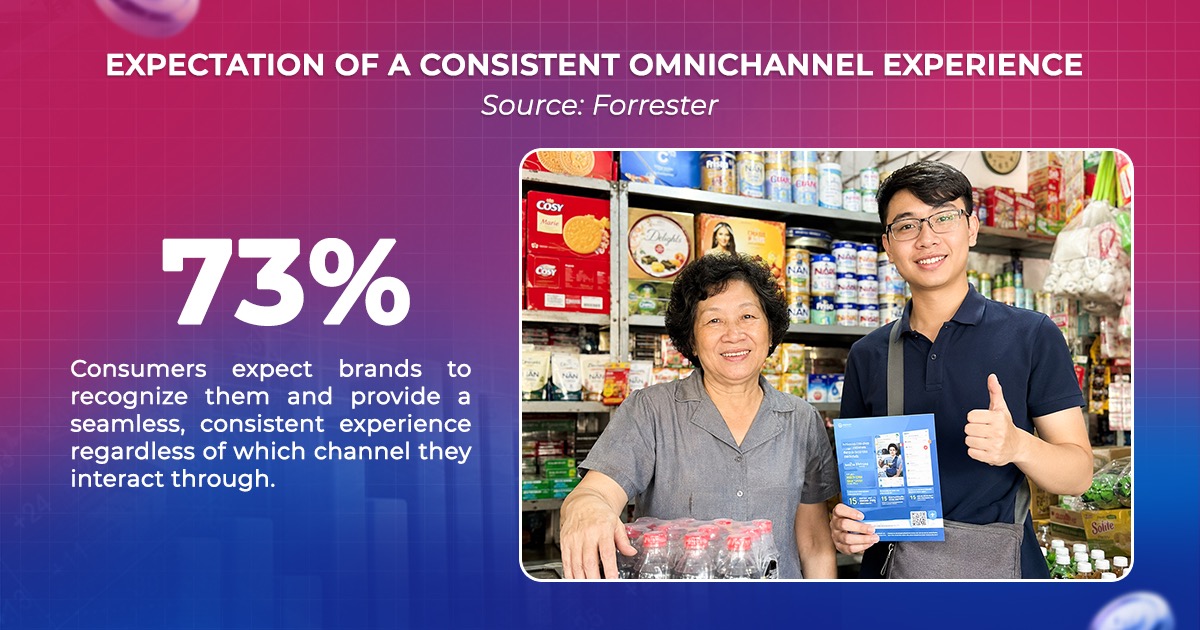
Consistency in the user experience has become a crucial factor in brand presence.
Source: Novaon Digital
These two figures place a clear pressure on Bank & Finance brands: customers now expect a seamless experience that the vast majority of current Experiential Point-of-Sale Event campaigns are not yet delivering. The question is no longer whether this format needs to change, but where to begin and in which direction so as not to be left behind.
★★★
Question 5: In light of the shifts in customer expectations and the evolution of digital marketing trends, how do you think Bank & Finance brands need to adjust their Experiential POS Event strategy to avoid falling behind?
Ms. Tran Thi Thanh Thuy: When it comes to “keeping up with trends,” the instinctive response from many brands is to turn to technology, adding more interactive screens, more QR codes, more gamification. But in my view, that is not the root of the issue.
The first thing that needs to change is not technology or budget. It is the mindset behind experience design.
Most Experiential POS campaigns today are still built around an implicit goal: organize an event to sell a product. The entire design logic, from booth layout to staff scripting, revolves around moving customers to the conversion point as quickly as possible. But that is the mindset of fast-moving consumer goods, not the mindset of financial services.
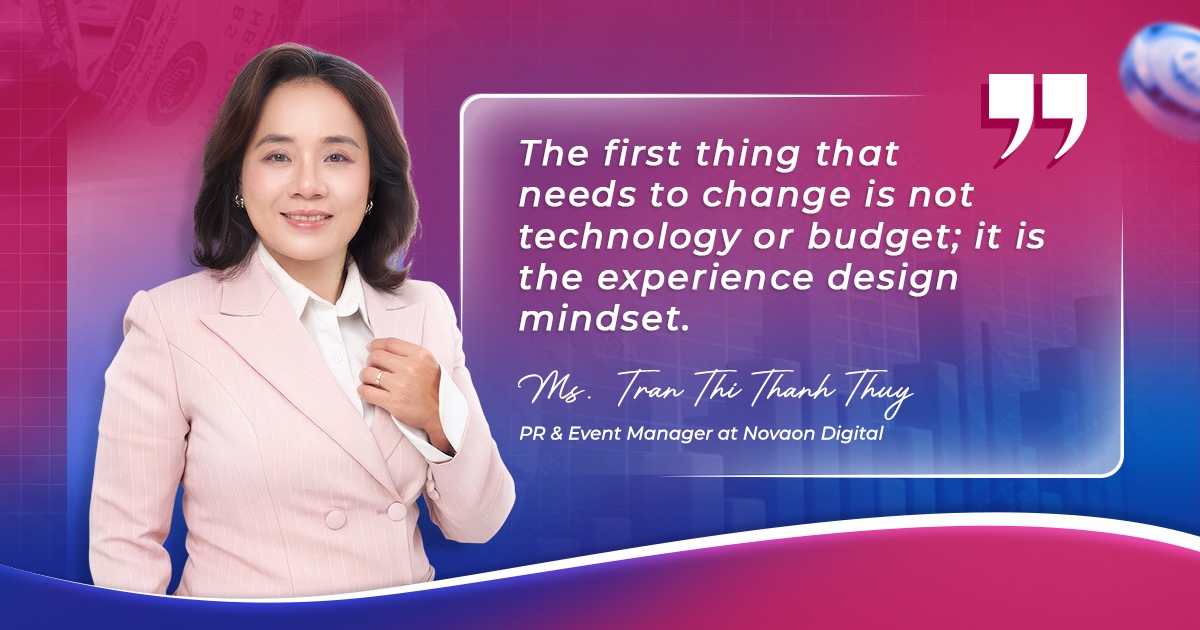
Strategic adjustments to EPOS Events that Banking and Finance brands should adopt to avoid falling behind, according to Ms. Thuy’s perspective.
Source: Novaon Digital
When thinking shifts toward building a consistent brand experience from online to offline, the entire approach changes. The question is no longer “how do we get customers to download the app today?” It becomes “how does the experience at today’s event connect with what they saw on social media beforehand, and how does it continue on the app after they leave?” When the question changes, decisions about space, technology, and staffing naturally fall into place, because they are all serving a larger and more clearly defined objective.
This is the shift that Bank & Finance brands need to make before addressing any other tactical adjustment. Phygital is not a feature that can be added on later. It must be designed from the inside out, from mindset down to every single touchpoint.
Question 6: Could you share 3 practical principles for CMOs in the financial sector who are deploying Experiential POS for the first time?
Ms. Tran Thi Thanh Thuy: From real-world deployment experience, I have distilled three principles that I believe any financial sector CMO must internalize before entering their first Experiential POS campaign.
The first principle is to manage every moment of contact. An event does not succeed or fail at the macro level; it succeeds or fails in each small moment: the way a staff member greets a customer, the waiting time at each station, the very first words spoken when approaching a busy trader in the middle of a market. Each of those moments can either add a layer of trust or shatter everything that was built before it. So do not manage the event only at the planning level. Manage it at the level of each specific touchpoint.
The second principle is the philosophy of “keep it simple.” In financial services, complexity is the enemy of conversion. When customers are faced with a multi-step registration process, multiple fields to fill in, and multiple screens to navigate, drop-off rates climb sharply even when trust is already there. The mission of Experiential POS strategy is to eliminate every unnecessary point of friction: the app download process must be streamlined to the bare minimum, staff must support customers through every single step, and everything that takes place at the event must be designed to feel easier, not more complicated, than doing it at home alone.
The third principle is the Commando mindset for the Event Manager. On the ground, there will always be variables no plan can fully anticipate, from changing weather and higher-than-expected foot traffic to technical failures in peak hours. What separates a successful Experiential POS campaign from a failed one sometimes has nothing to do with the original plan, but everything to do with the team’s ability to handle situations on the spot. Event Managers and all on-site staff must be empowered to make rapid decisions and trained to adapt flexibly without losing sight of the overall strategic direction. When the team carries that mindset, the event will run well even when nothing goes according to script.
Closing Thoughts
In a landscape where the Bank & Finance sector faces mounting pressure to grow its real-world user base, communication strategy can no longer stop at building awareness or optimizing digital ad performance. When trust remains the decisive factor in financial customer behavior, Experiential Point-of-Sale Events are not a replacement for digital. They are an indispensable link in completing the conversion journey.
However, for this format to truly deliver its value, the deployment mindset must shift first, from organizing events to sell products to building experiences that generate trust, and from standalone activations to a deliberately closed loop connecting online and offline.
For Novaon Digital, this is not merely a conversation about trends but a strategic dialogue. The insights shared by Ms. Tran Thi Thanh Thuy offer a practitioner’s perspective for Bank & Finance brands to shift their thinking: from event organizing to experience creation, and from measuring traffic to measuring genuine conversion.
Novaon Digital, with its expertise in consulting and deploying integrated communication solutions through the SCT framework, has been and continues to work alongside financial brands to turn every on-the-ground touchpoint into a systematic growth engine. Because ultimately, a sustainable financial brand is not built on what is advertised. It is built on the trust forged through every real experience.