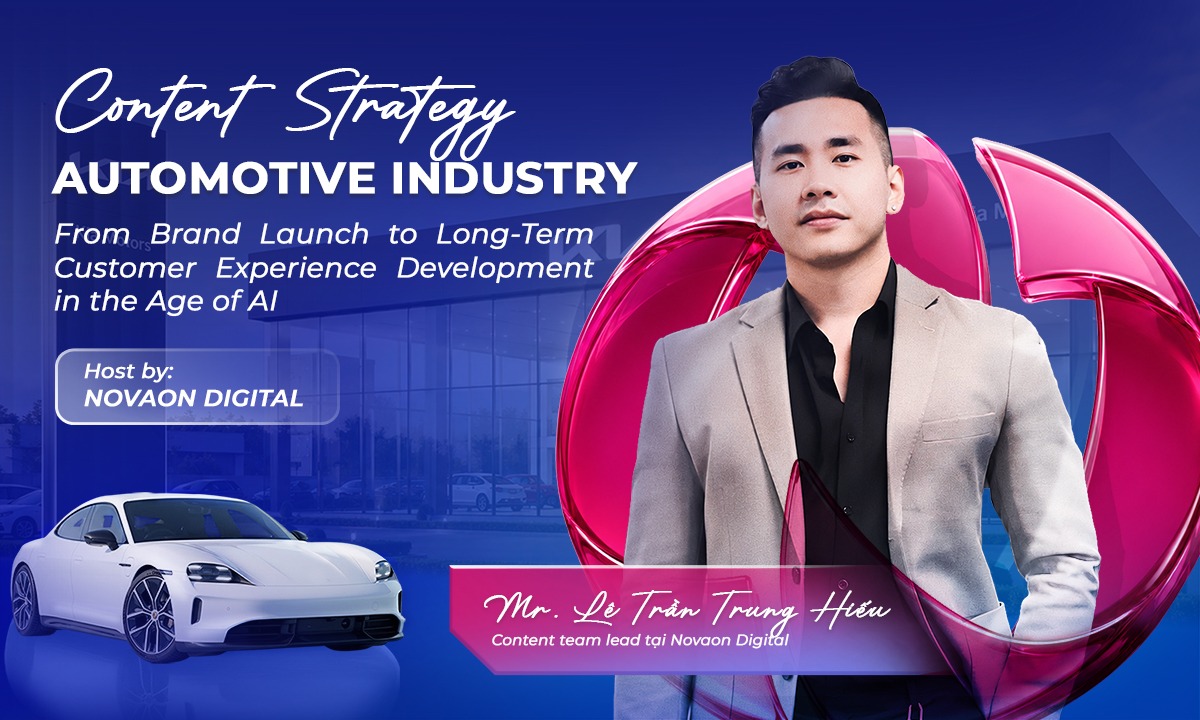
As AI reshapes the way customers search for, compare, and verify information before buying a car, content strategy in the Automotive industry also needs to be restructured. Content is no longer merely a tool for building awareness. It must become a system that supports customers in decision-making, from building trust for new brands and nurturing demand across lifestyle touchpoints to preserving emotional depth for the premium segment. In our discussion with Mr. Lê Trần Trung Hiếu at Novaon Digital, we will clarify these changes and the practical principles for Automotive brands in the AI era.
I. Content Marketing Strategy for Launching a New Automotive Brand in Vietnam in the AI Era
Content strategy in the Automotive industry needs to be restructured to support customers’ decision-making journey in the AI era.
Image source: Novaon Digital
Today’s car-buying journey no longer begins at the showroom. Before meeting a sales consultant, customers have already proactively searched, compared, and verified information through Google, social media, community groups, video reviews, and AI tools.
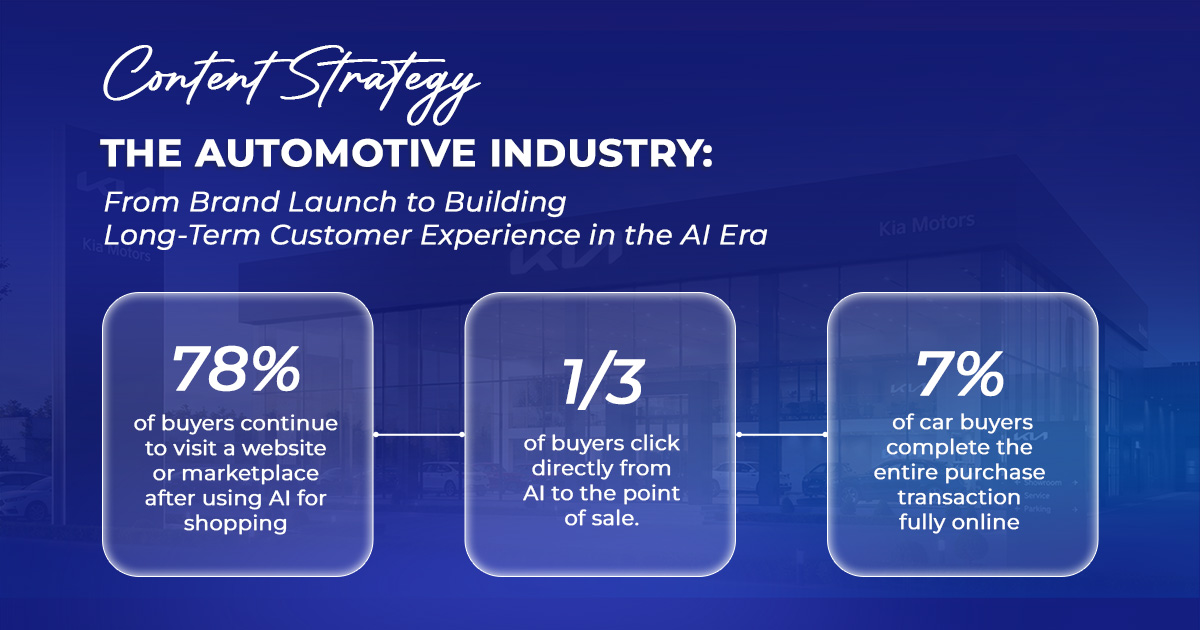
This is clearly reflected in the fact that AI is becoming the second-largest source of influence on purchase decisions among AI users for shopping, according to IAB x Talk Shoppe. After using AI, 78% of buyers continue to visit a website or marketplace, with approximately one-third clicking directly from AI to a point of sale. However, in the Automotive industry, the decision-making journey still requires multiple layers of trust. According to Cox Automotive, only 7% of car buyers complete the entire transaction fully online, showing that reviews, communities, direct consultation, test drives, and after-sales systems still play an important role in the consideration process.
In this context, the challenge for Automotive content is not merely to appear more frequently across digital touchpoints, but to build a content system with enough depth to answer customers’ concerns at each stage. If a brand focuses only on brand messaging while lacking decision-support content, traditional content strategy can easily break down before customers even step into the showroom.
- As AI changes the way customers search for, compare, and verify information when buying a car, in what direction should the traditional content strategy of a new automotive brand be restructured so that it does not break down along the decision-making journey?
Mr. Lê Trần Trung Hiếu: I believe AI does not change the need to buy a car, but it is completely changing the way customers build trust before making a purchase.
For many years, brands could guide the customer experience journey through advertising and mass communication. But today, customers are the ones actively shaping that journey through their own questions. They ask Google, ask AI, ask communities, or seek answers from reviewers before asking a salesperson.
Many automotive and motorcycle brands are still operating under the old logic: “I say what I have.” Meanwhile, today’s customers operate under the opposite logic: “I search for what I am curious about.” This is precisely why content marketing strategy needs to shift from campaign-centric to decision-centric.

Mr. Lê Trần Trung Hiếu – Content Team Lead at Novaon Digital, shares his perspective on the shift in content marketing from campaign-centric to decision-centric.
Image source: Novaon Digital
This means that instead of focusing only on conventional awareness-building content, brands need to build a content ecosystem capable of supporting customers’ decision-making at every stage. This is not something that can be done overnight, but it needs to start now.
At the current moment, content is no longer simply a tool for delivering messages. It is gradually becoming the infrastructure of trust. For example, if a customer asks AI: “Is this car durable?”, “Is this car more worth buying than another one?”, “Is this car suitable for my lifestyle habits?” or “With this budget, is this a reasonable choice?”, but AI cannot find enough high-quality data from the brand and the surrounding content ecosystem, it means the brand has lost part of its opportunity to be considered.
From a broader perspective, what matters is not only what the brand says, but whether the brand has enough content to appear in customers’ real questions. When search behavior changes, content must also change from “telling customers what to hear” to “answering exactly what customers need to know.”
★★★
Vietnam’s Automotive market is entering a new phase of competition as more and more new car brands enter the market, especially in electric vehicles and Chinese brands.
This is reflected in the strong expansion pace of new players: BYD opened its first 13 dealerships in Vietnam and aims to reach approximately 100 dealerships by 2026; Chery/Omoda & Jaecoo announced plans to build an USD 800 million factory in Thái Bình, with an expected capacity of 200,000 vehicles per year. Meanwhile, VinFast is expected to deliver around 170,000 vehicles in Vietnam in 2025, nearly double the figure in 2024.
In this context, the challenge for new automotive brands is not only to generate rapid coverage, but also to build enough trust signals around investment capability, distribution systems, after-sales service, and long-term market commitment, so that customers include the brand in their consideration set.
- In the launch phase of a new automotive brand, coverage can create awareness, but trust determines whether the brand will be considered. In your view, what should launch content prioritize to solve this challenge?
Mr. Lê Trần Trung Hiếu: The role of brand awareness is very important, and that is undeniably true. But today, the “memory capacity” in customers’ minds is also a massive data pool. They know many brands and are exposed to a great deal of information, so being known is no longer enough. A brand needs a second layer, which is assurance.
This is especially true for industries with high-value products such as automobiles and motorcycles. Customers can try a new soft drink for a few tens of thousands of VND to personally assess its quality. But very few people would spend hundreds of millions or even billions of VND just because they saw an impressive car advertisement. Customers in this industry are not only buying a means of transportation; they are also buying peace of mind for the next five to ten years.
Therefore, during the launch phase, the most important task of content marketing is not only to generate attention, but also to cushion and remove the sense of risk in the minds of target customers.
Specifically, launch content needs to clearly answer the following questions: Who am I? What mission do I bring to this market? How long will I stay? What makes customers believe that I will not disappear after a few years? If a problem occurs, how will customers be supported?
A very important content branch at this stage includes content about the dealer network, investment capability, after-sales capability, spare parts supply, warranty policies, and real experiences at the service workshop. These content lines have a much stronger impact on consideration decisions than ordinary product-introduction content.
Because beyond buying a car, customers also need to buy trust in the brand. Coverage helps the brand be seen, but assurance helps the brand be considered.
II. Maintaining and Nurturing the Customer Journey in the AI Era
Travel and summer touchpoints are becoming important contexts for Automotive brands to nurture car consideration.
Source: Novaon Digital
If the launch phase is when a brand needs to build initial trust, the maintenance phase requires the brand to appear at the exact moment when demand is being formed. In the Automotive industry, summer and travel are among the lifestyle touchpoints that can strongly activate car purchase demand.
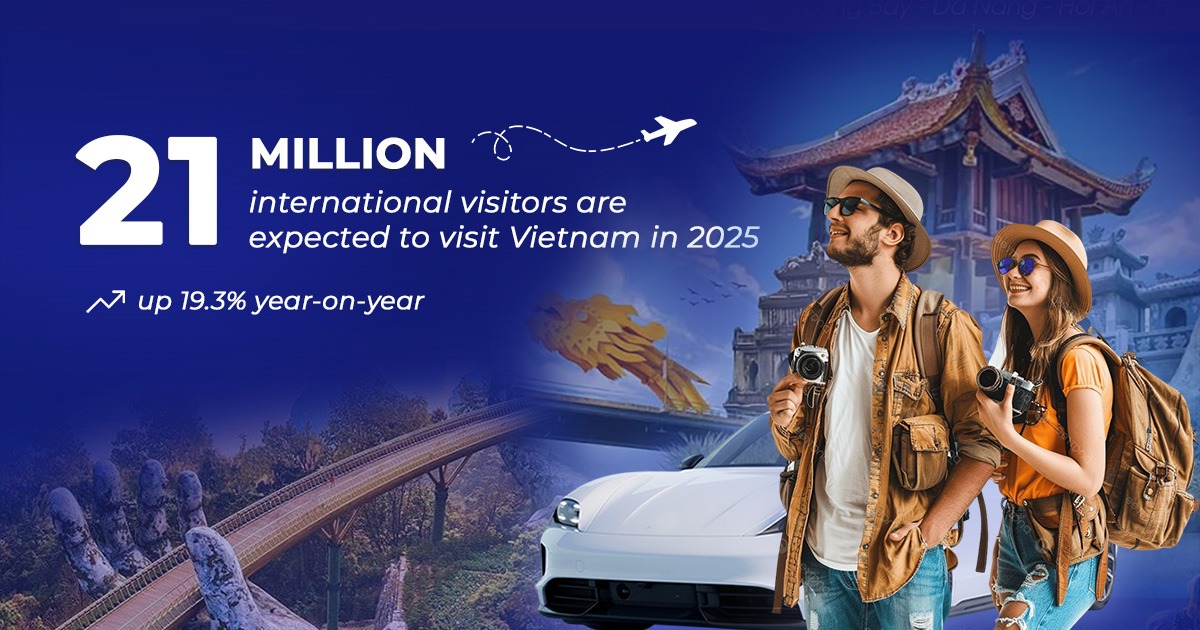
This is driven by the recovery of the tourism industry, as Vietnam is expected to welcome around 21 million international visitors in 2025, up 19.3% from the previous year.
In this context, customers no longer see a car merely as a means of transportation, but as part of the experience of vacations, road trips, or journeys with family. Factors such as safety, comfort, space, driving feel, and peace of mind also become easier to perceive in real usage contexts.
Therefore, the challenge of summer content is not only to inspire travel, but also to guide customers from the moment they plan a trip to mobility needs, car consideration, and specific actions such as researching, consulting, or taking a test drive.
- When customers begin planning their summer trips, what content touchpoint do Automotive brands often miss, despite its strong potential to influence car consideration demand?
Mr. Lê Trần Trung Hiếu: The need to consider or buy a car usually takes customers a relatively long time. This means the demand is formed long before customers enter a showroom or leave their contact information for consultation.
One of the most commonly missed touchpoints is the stage when customers are planning an experience. That is when they search for very everyday questions such as: “Where should a family of four go this summer?”, “Which route is beautiful for a short trip?”, “Is it inconvenient to drive an electric car over a long distance?”, or “What should be noted when children sit in a car for a long time?”
At first glance, this may seem like a travel-related topic. But in reality, these are moments when customers are unconsciously evaluating their current car. A long trip often reveals many issues that users may not notice in urban driving: the car is too cramped, the air conditioning is not stable enough, the trunk lacks space, there is not enough sense of safety for the family, or the in-car experience is not comfortable enough.
These inconveniences are precisely the seeds of demand for a new car. Therefore, content marketing should anticipate customers right at the stage when demand is being formed, instead of appearing only when customers have already started looking to buy a car.
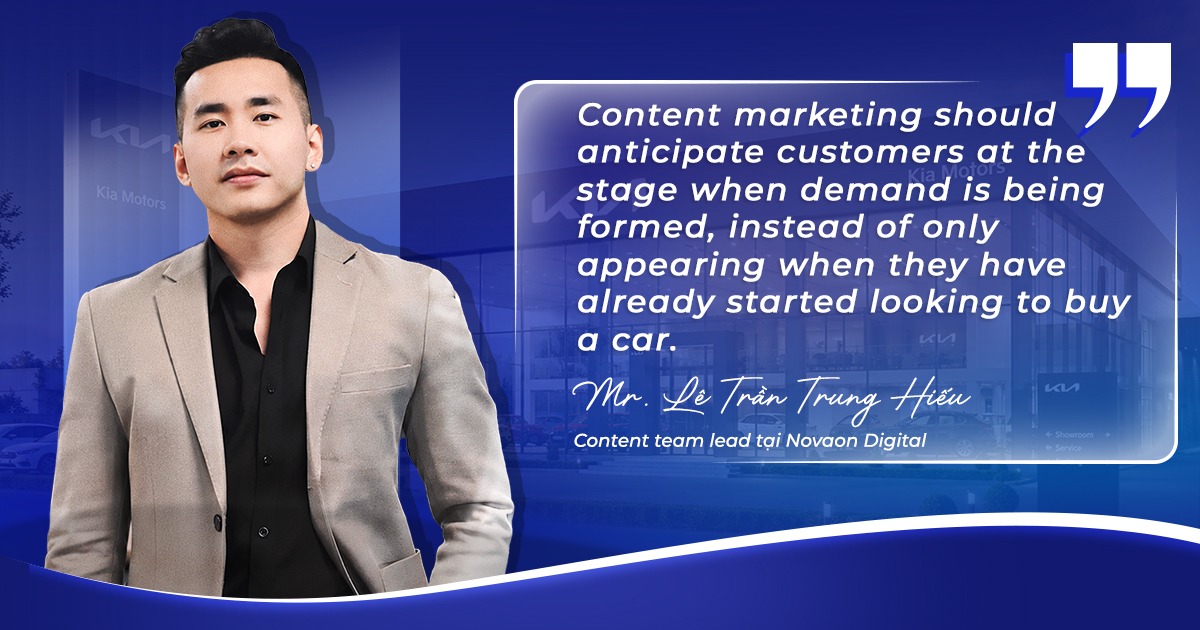
According to Mr. Lê Trần Trung Hiếu, Automotive content marketing should appear earlier, from the stage when customer demand is still being formed.
Image source: Novaon Digital
The most valuable touchpoint is not necessarily when customers search for “which car should I buy,” but may be when they are looking for a coastal route, calculating luggage for the whole family, preparing for young children on a long trip, or imagining a more complete vacation. These are the moments when customers can easily recognize the limitations of their current vehicle and begin forming the need to upgrade.
Therefore, Automotive brands should not only appear at purchase touchpoints. They need to be present earlier at experience touchpoints, where the real demand for buying a car is actually formed.
- In summer content campaigns for the Automotive industry, why do you think many brands are able to create emotion but fail to guide customers toward consideration or conversion?
Mr. Lê Trần Trung Hiếu: I think that in many cases, brands have told a very good story but have not built a bridge connecting emotion to action. This is a gap I see quite often in Automotive content campaigns.
For example, customers may watch a beautiful clip: a happy family, a memorable journey along a wonderful route, or striking images of a car that expresses the owner’s personality. But after scrolling past it, they still do not have a clear enough reason to think: “I need to learn more about this car.”
In other words, the brand has succeeded in creating emotion but has not succeeded in converting that emotion into motivation for consideration. Summer content should not only make customers see a beautiful trip. It needs to make them ask themselves: “If I changed cars, would my family truly be more comfortable on every trip?”, “If I had a more suitable car, would future journeys become easier?”, or “Is my current car limiting my life experience?”
In moments like these, consideration truly begins. Therefore, an effective summer content campaign should not stop at inspirational storytelling. It needs to be designed as a journey: from emotion, to need recognition, to reasons for consideration, and only then to action touchpoints such as learning more, registering for consultation, or booking a test drive.
Emotion is a very important starting point, but without a conversion logic behind it, that emotion will fade very quickly. What the brand needs is not to make customers feel that “this car looks beautiful on a trip,” but to make them feel that “this car can make my life better across many future journeys.”
III. Upgrading Brand Positioning and Emotional Differentiation in the AI Era
AI is entering marketing operations at a very fast pace, helping brands research, produce, optimize, and personalize content more effectively than before.
This is clearly reflected in its ability to improve content production costs, as Mondelez once stated that GenAI could help reduce content marketing production costs by 30-50%. However, increased production speed also brings a new risk: when many brands use the same tools, the same data, and the same optimization methods, content may become increasingly similar in language, visuals, and storytelling.
For the Automotive industry, especially the premium segment, the challenge is no longer to produce more or produce faster, but to correctly define the roles of technology and humans so that content is not only technically accurate, but still retains brand personality and emotional depth.
- In your view, how should content strategy for premium automotive brands in the AI era be built so that it can leverage the speed of technology while preserving the emotional depth that is core to differentiation?
Mr. Lê Trần Trung Hiếu: AI is making content production much easier and faster. But we must also acknowledge that if everyone can quickly create good content, then “good content” is no longer a competitive advantage.
This is especially true in the premium segment. Customers do not buy a luxury car only because the car itself is good. They also buy the feeling of affirming who they are, a value system they want to belong to, a lifestyle, or a very strong personal statement. These things cannot be created entirely with prompts.

AI can help brands move faster, but strategy, brand voice and identity still need to be led by humans.
Source: Novaon Digital
Therefore, I believe we need to re-plan the roles of AI and humans in content strategy. AI can research, synthesize, process data, analyze behavior, and support performance optimization. But humans must still be the ones who write emotion, define meaning, and preserve the spirit of the brand.
To put it simply, AI optimizes performance, while humans sharpen meaning. AI can help brands move faster, but humans must decide which direction to go, what voice to use, and what core elements to preserve.
For premium brands, quantity is not what creates content advantage. Even “good” content is not enough. What matters more is whether the content accurately reflects the spirit of the brand. A piece of content may be right in terms of insight, format, and algorithm, but if it lacks taste, depth, and consistency in brand voice, it still cannot create differentiation.
In the AI era, content production capability will become increasingly leveled. What remains to distinguish premium brands from the rest is emotional depth, aesthetic taste, and the ability to maintain identity across every touchpoint.
★★★
For luxury automotive brands, competition does not lie only in technical specifications, features, or technology. Premium customers also care about aesthetic taste, lifestyle, and the symbolic value that the brand represents.
This pressure becomes even clearer as Bain records that the global luxury customer base declined from around 400 million in 2022 to 340 million in 2025, showing that maintaining perceived value in the premium segment is becoming increasingly important. For this group of brands, brand voice is not merely a writing style, but a long-term asset. For brands such as Lexus, brand voice is the way to create subtle emotion at every touchpoint, from visuals and language to stories and customer experience.
In a context where AI can support production but cannot replace creative judgment, brand voice, and standards of refinement, the challenge for premium brands is to maintain a sufficiently clear boundary of identity so that brand personality does not become blurred.
- As AI makes content increasingly prone to sameness, what boundary do you think premium automotive brands need to firmly maintain so that their brand personality is not diluted?
Mr. Lê Trần Trung Hiếu: I think the most important boundary lies in the ability to maintain a consistent value system over time.
Premium customers are not looking for novelty at every touchpoint. They are looking for consistency. They want to know what this brand believes in, what it pursues, and whether those values will be maintained over many years.
In reality, the strength of great brands does not lie in what they say in each individual campaign. It lies in the fact that after decades, they are still speaking about the same value system in different ways.
A brand can change its form of expression, change its communication platforms, or change its approach to customers. But if it loses the aesthetic taste, brand philosophy, and worldview that shaped its identity, it will gradually become like every other brand.
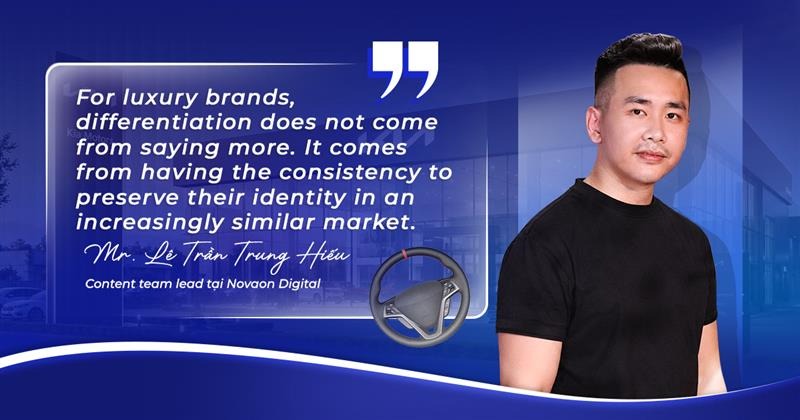
For luxury brands, differentiation comes from the ability to maintain identity and consistency across every content touchpoint.
Source: Novaon Digital
For luxury brands, differentiation does not come from saying more. It comes from being consistent enough to preserve their identity in a market that is becoming increasingly similar. That is also the most valuable brand asset that no technology can replace, including AI.
This is why I believe premium brands need to own a truly strategic Content Guideline. It should not only define writing style. This guideline needs to define the brand’s “taste”: its view of life, storytelling approach, aesthetic standards, and boundaries of expression across every touchpoint.
When every tool can generate similar content, what creates differentiation will no longer be production capability, but consistency in identity. And the Content Guideline is where that identity is preserved.
★★★
IV. Closing Remarks
The Automotive industry is entering a phase where content strategy can no longer continue operating according to old habits. As AI changes the way customers search for and verify information, the market becomes increasingly crowded with new entrants, and buyers expect brands to appear at the right need and the right moment, the communication challenge is no longer about doing more or spending more, but about doing things more precisely at each touchpoint.
From launching a new brand, leveraging summer as a touchpoint to nurture demand, to preserving emotional depth for the premium segment, each stage of the customer journey sets a different requirement. The common thread throughout is that brands need to understand customers deeply enough for content to appear at the right time, with the right emotion and the right message – which is also the experience Novaon Digital has drawn from hands-on work with more than 15 Automotive brands in Vietnam.
For Novaon Digital, Automotive content strategy is not simply about producing content, but about building a system of touchpoints capable of creating trust, nurturing demand, and converting emotion into action. In the AI era, technology can help brands move faster, but strategy, understanding, and identity are what determine whether the brand is moving in the right direction.
Thank you for sharing these insights!