Part 1: The overall FMCG landscape for Lunar New Year 2026 – When cash flow comes from the middle class
According to NielsenIQ, Vietnam’s FMCG market during the 2025 Lunar New Year recorded an impressive 16% growth year-on-year, with shopping peaks concentrated from mid-January to the end of February. This figure not only reflects strong purchasing power but also opens up a golden opportunity for brand communication campaigns in 2026.
Leading product categories in terms of growth:
Five product categories dominated the Lunar New Year market this year, including Confectionery, Beverages, Condiments, Snacks, and Beer – driven by three primary consumption purposes: gift-giving, ancestral worship, and household consumption during family reunions. Notably, Snacks and Beer recorded outstanding growth, fueled by the youth-driven “chill snacking” culture and the demand for traditional Lunar New Year feasts.
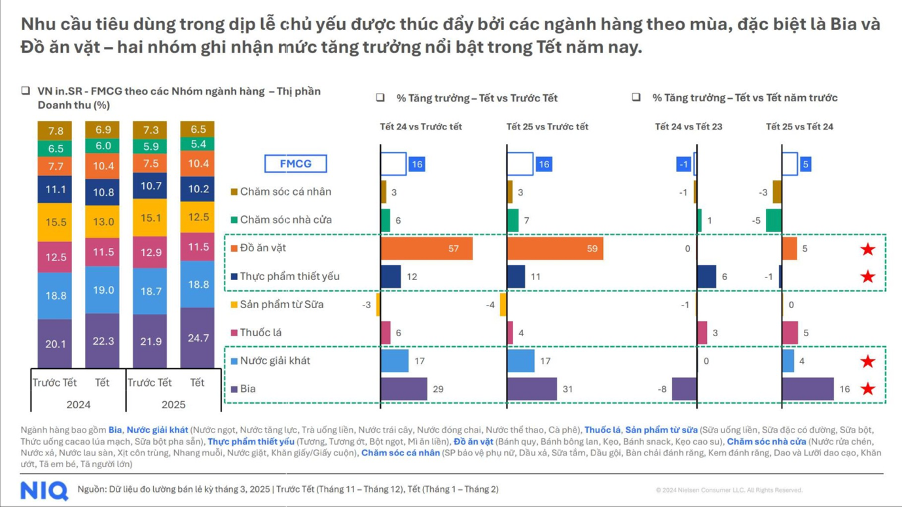
Vietnamese Lunar New Year consumption demand by product category
(Source: NielsenIQ)
Cash flow from the middle-income group – The “backbone” of the Lunar New Year market:
A deeper analysis of consumer profiles shows that 58% of Lunar New Year spending comes from middle-income consumers (VND 7.5–15 million per month), primarily aged 26–50. This group holds strong decision-making power within households, with 89% of households purchasing food and festive decorations, and 50% of young consumers buying gifts for family members and relatives.
Notably, 39% of consumers earning over VND 15 million per month also represent a strong-spending segment, willing to “upgrade” their gift baskets with more premium products – an important signal for premiumization communication strategies, which will be discussed later.
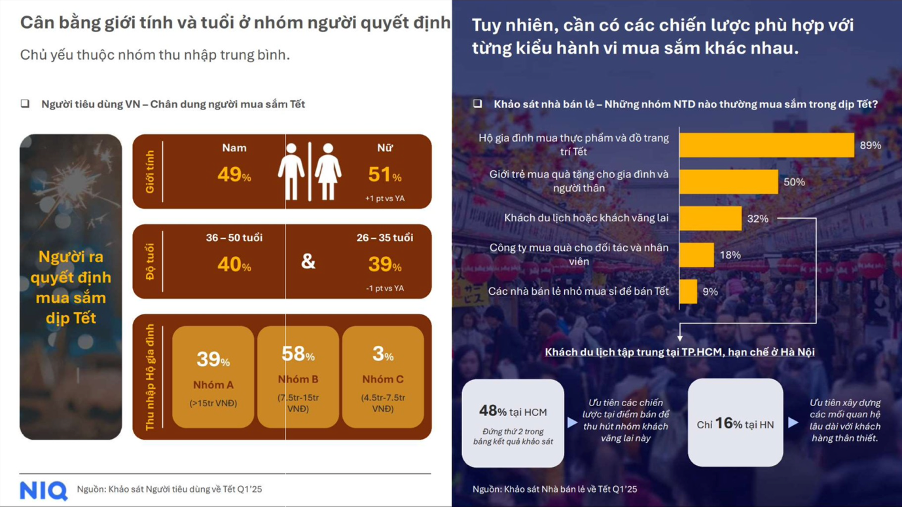
Percentage of customer groups making purchasing decisions during the Lunar New Year
(Source: NielsenIQ)
The “anatomy” of the Lunar New Year gift basket – An interesting paradox: Data shows that 63% of consumers complete all purchases in a single trip at supermarkets, yet 47% simultaneously use e-commerce platforms, mainly to hunt for promotions (65%), discount codes (55%), and brand variety (54%). Notably, women from young to middle-aged groups spend an average of 8.2 hours per week shopping online. This insight indicates that an Omnichannel communication strategy is no longer optional but a prerequisite.
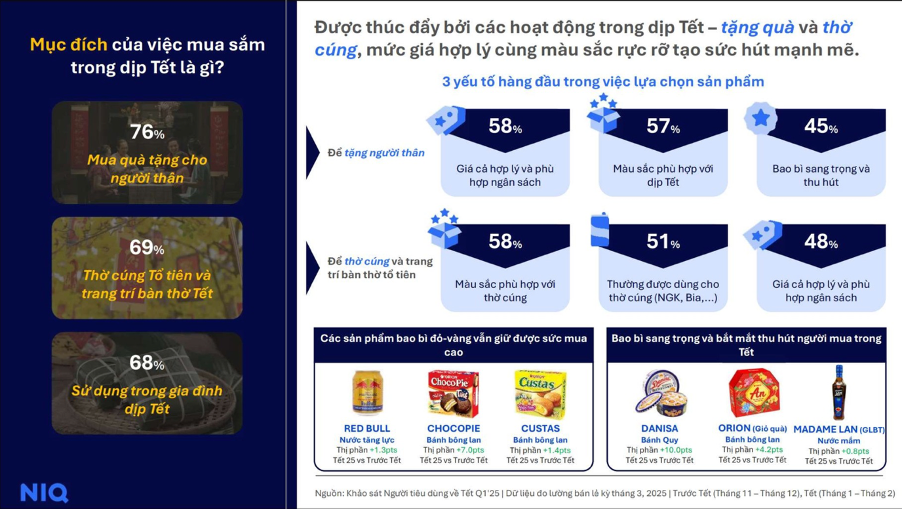
Key factors driving Lunar New Year purchase decisions
(Source: NielsenIQ)
When asked about purchasing purposes, 76% said they buy gifts for relatives, while 69% purchase for ancestral worship. However, product selection criteria differ significantly between these two purposes: for gift-giving, consumers prioritize reasonable pricing (58%), suitable colors (57%), and especially premium-looking packaging (45%); meanwhile, for ancestral worship, suitable colors (58%) and familiar products (58%) are the top factors, with an acceptable price range of VND 200,000–500,000 (accounting for over 83% of respondents).
Part 2: Consumer insights – The key to shaping Lunar New Year 2026 communication strategies
Understanding consumer behavior and psychology is the foundation for building effective communication strategies. According to research from Kantar (2025), the Asian FMCG market is witnessing significant shifts in Lunar New Year shopping behavior, particularly within the middle-income segment. The following core insights serve as guiding principles for communication campaigns:
An interesting tension between “exploration” and “tradition”: While brand loyalty is declining as consumers actively explore new options, in the context of ancestral worship they still prioritize familiar brands such as Tiger, Danisa, and Chinsu. This is the critical point: consumers are not resistant to change, but they need sufficiently compelling reasons – attractive packaging, appealing promotions, or emotionally resonant brand stories.
Price-sensitive yet willing to spend more: The fact that 33% of consumers are attracted by promotions does not mean they are overly frugal. In reality, they are willing to accept higher prices if the product comes from a familiar brand or features premium packaging suitable for gifting. According to NielsenIQ, the premiumization trend during the Lunar New Year is growing strongly in confectionery and beverage categories, as gift-giving is seen as a way to express status and sincerity.
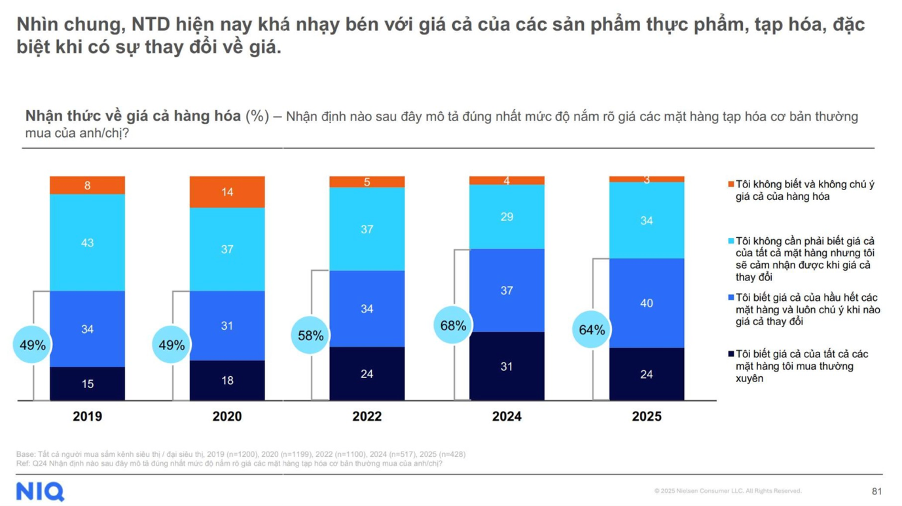
Consumer price sensitivity during the Lunar New Year
(Source: NielsenIQ)
68% overspending beyond initial plans – A golden opportunity for Trade Marketing: This is the most critical insight from the research. Consumers rarely plan purchases in detail, leading to emotion-driven buying decisions influenced by attractive in-store displays and promotions. Kantar (2025) indicates that 68% of Asian FMCG consumers during festive seasons engage in impulse buying when exposed to unexpected promotions or well-designed retail experiences.
Declining excitement – The need for standout moments: Consumers remain open to new products, but overall excitement is lower than before. According to Kantar, 40% of consumers trust recommendations from micro-communities (KOLs/KOCs) more than traditional advertising. This suggests that brands need to create playful, interactive, and authentic experiences rather than simply pushing sales-driven messages.
From these insights, the following four communication strategies can help FMCG brands break through during the Lunar New Year 2026.
Part 3: 4 golden keys – Core communication strategies for FMCG Lunar New Year 2026
Key 1: Gamification Marketing – Eliminating declining excitement
As consumers become increasingly disengaged from traditional advertising, Gamification Marketing transforms brand experiences into an “adventure,” where consumers complete tasks to earn rewards, creating a sense of achievement rather than passively receiving promotions. According to Bain & Company (2025), FMCG brands in China leveraged gamification on Douyin during the 2025 Lunar New Year and recorded 25% higher sales growth compared to traditional promotions.
Gamification is well-suited to the Vietnamese FMCG Lunar New Year market because it directly addresses declining excitement. Instead of one-way sales messages, consumers enjoy interactive experiences, extended brand engagement time, and data collection for future personalized communication.
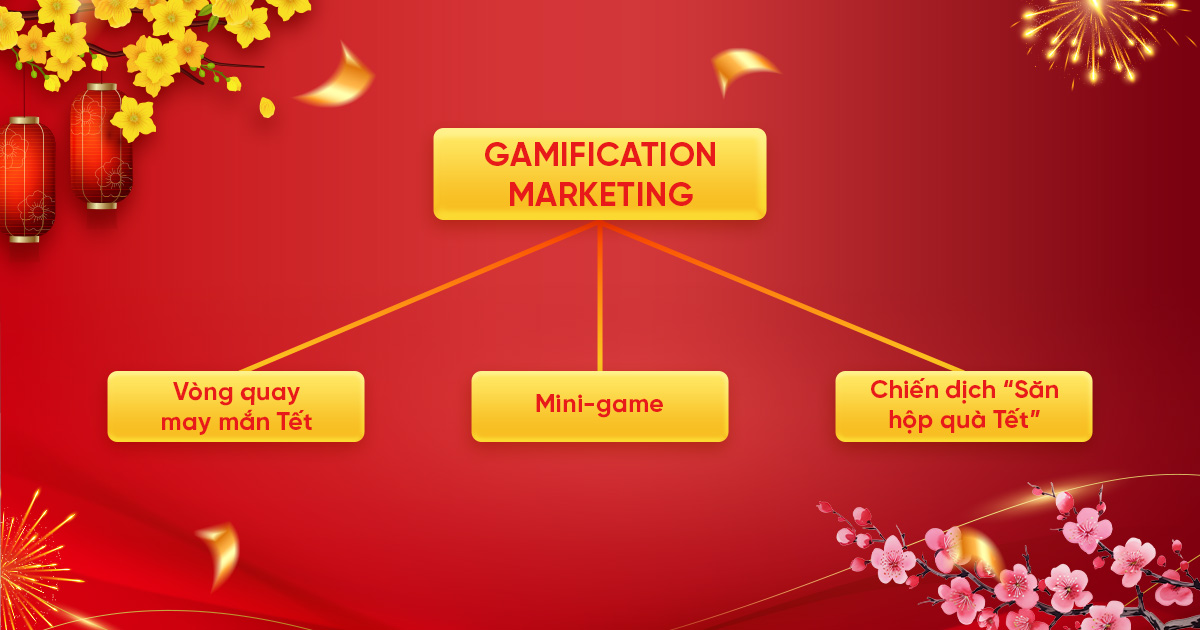
Gamification applications in Lunar New Year communications
(Source: Novaon Digital)
Application formats:
- Lunar New Year lucky spin: tiered rewards (5%–50%) creating a sense of “winning”
- Mini-games: explore new product bundles and receive trial vouchers through online games
- “Hunt for Lunar New Year gift boxes” campaigns: complete challenges to unlock limited-edition festive packaging
Key 2: Online App Marketing – Retaining customers through personalized promotions
With 47% of consumers hunting deals on e-commerce platforms and women spending an average of 8.2 hours per week shopping online, App Marketing becomes a “gold mine” for building long-term customer relationships. According to Bain & Company (2025), Pinduoduo recorded 11% growth in Q1/2025 thanks to its high-frequency personalized app-based promotions.
Apps are not just sales channels but platforms for nurturing customers through exclusive deals, behavioral data collection, and personalized messaging. During the Lunar New Year, when consumers are price-sensitive yet receptive to promotions from familiar brands, apps play a critical role in keeping brands top-of-mind.
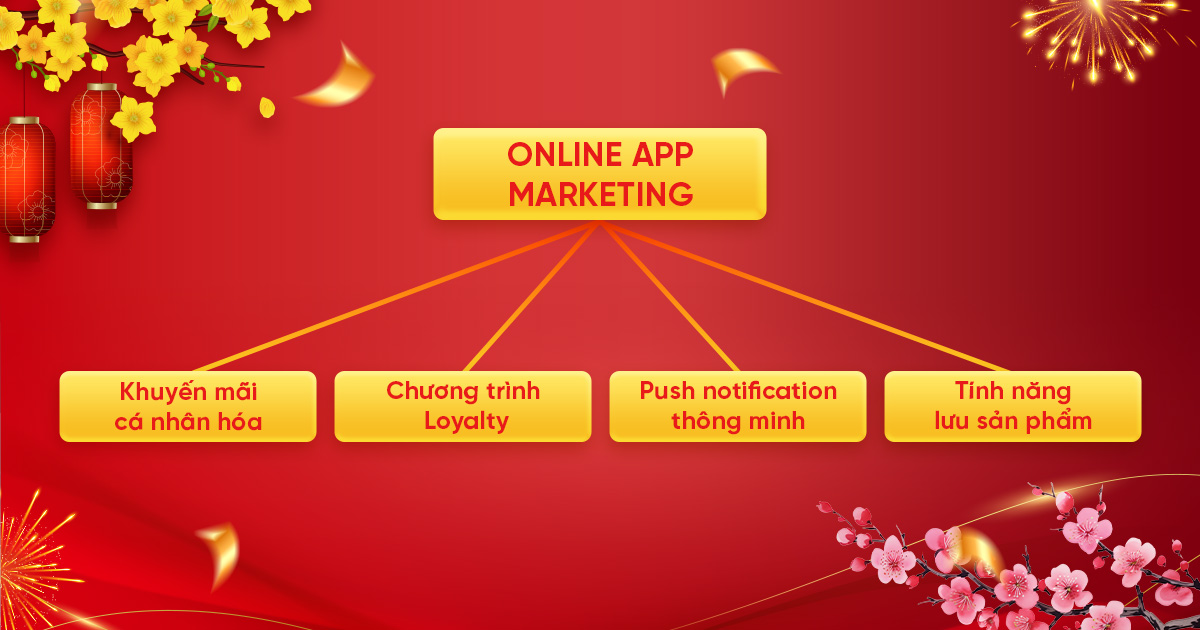
Online App Marketing applications in Lunar New Year communications
(Source: Novaon Digital)
Application formats:
- Personalized promotions: analyzing purchase history to send tailored deals (e.g. “30% off premium confectionery gift baskets” for frequent confectionery buyers)
- Smart push notifications: delivering new products along with discount codes at the right peak moments (mid-January), such as “Try a new dish for the Lunar New Year feast – 40% off”
- “Save favorite gift baskets” feature: allowing users to create wishlists and receive notifications when promotions are available
- Loyalty programs: earning points to redeem vouchers or exclusive gifts, creating strong incentives for repeat purchases
Key 3: Influencer Marketing – Building authentic trust through social proof
The Lunar New Year is highly emotional – consumers buy stories and trust. When KOLs/KOCs share real experiences choosing gifts for parents or offerings for ancestors, the message becomes far more persuasive than traditional TVCs. According to Kantar (2025), 40% of Asian consumers trust recommendations from micro-communities as much as advice from friends.
Influencer Marketing helps validate products through real experiences while telling emotionally resonant stories tied to family and tradition.
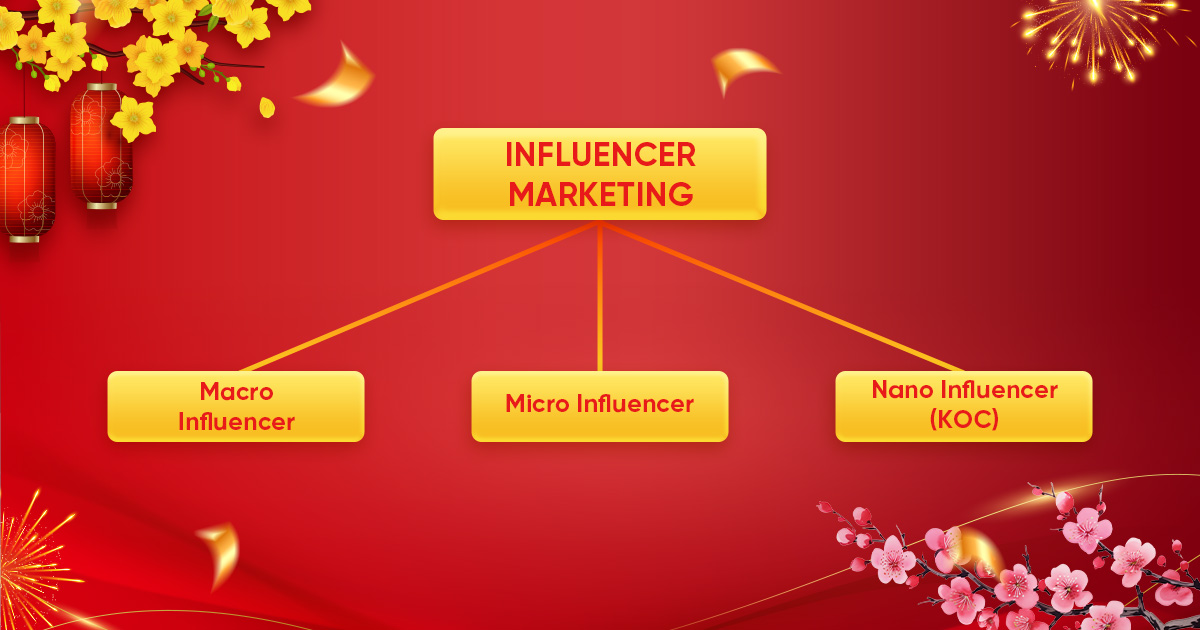
Influencer Marketing applications in Lunar New Year communications
(Source: Novaon Digital)
Three-tier influencer strategy:
- Macro Influencers: TVCs and mega campaigns emphasizing family tradition and premium positioning
- Micro Influencers: in-depth reviews and creative usage guides
- Nano Influencers (KOCs): authentic UGC via hashtags such as #MyLunarNewYearWith[Brand]
Note: Influencer briefs should focus on Lunar New Year storytelling rather than hard selling, emphasizing premium packaging through engaging unboxing moments.
Key 4: Shoppertainment – Turning shopping into entertainment
With 68% of spending exceeding initial plans, Shoppertainment (Shopping + Entertainment) becomes a powerful emotional trigger that stimulates impulse buying. According to Kantar (2025), Shoppertainment campaigns in China delivered 25% higher ROI than traditional advertising due to real-time interaction, flash sales, and emotional stimulation.
Shoppertainment transforms shopping from a “task” into “entertainment,” addressing two key issues at once: consumers are price-sensitive yet easily stimulated by attractive promotions (33%), and 68% of spending exceeds initial plans – meaning they are highly susceptible to emotion-driven purchases when triggered at the right moment.
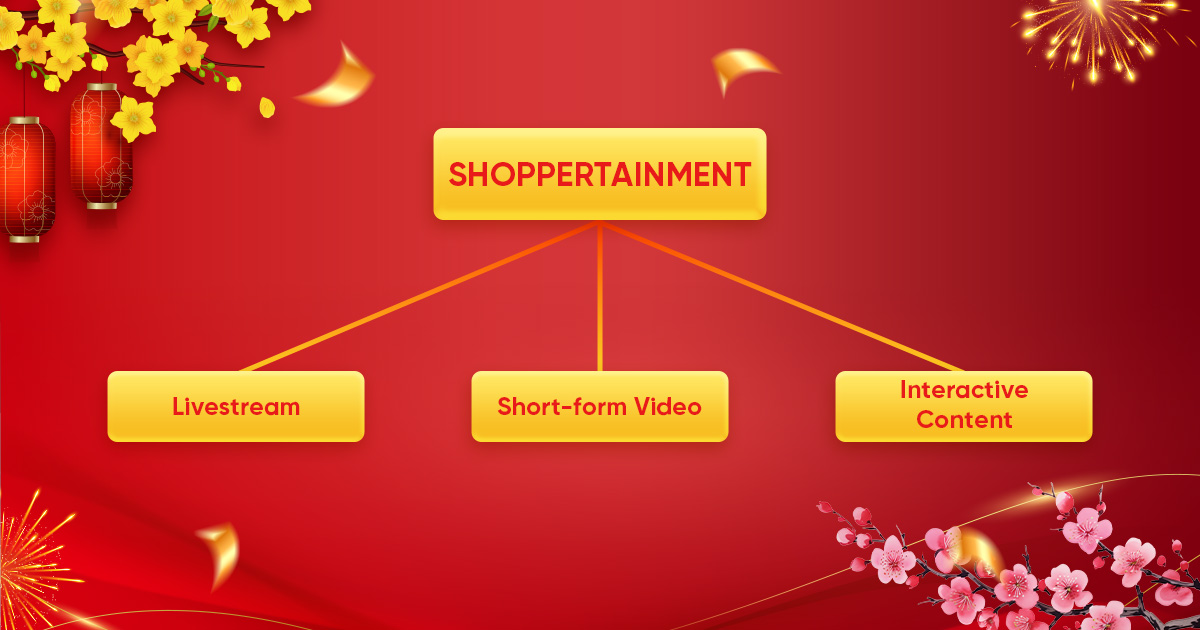
Shoppertainment applications in Lunar New Year communications
(Source: Novaon Digital)
Application formats:
- “Lunar New Year Show” livestreams: mini game shows featuring KOLs, expert talk shows, real-time giveaways, and flash sales with countdown timers.
- Short-form video: series such as “Unboxing Lunar New Year gift baskets,” “Lunar New Year cooking challenges,” hashtag challenges like #CreativeLunarNewYearDishes, with direct purchase links
- Interactive content: quizzes such as “What type of Lunar New Year gift-giver are you?”, snack voting polls, AR filters to “try on Lunar New Year packaging” and receive discount codes
Special campaign: Livestream launches announcing limited-edition Lunar New Year packaging collections, offering exclusive pre-order deals combined with countdown mechanics to create a strong sense of urgency – “buy now or miss out.”
Part 4: Lessons from international campaigns – 4 successful FMCG Lunar New Year communication case studies
Case Study 4: “The Beauty of Nature” – Gucci and its global ambassador strategy during the Lunar New Year of the Year of the Tiger
Ahead of the Lunar New Year of the Year of the Tiger in 2022, Gucci faced the challenge of refreshing its luxury brand image in the eyes of Asian consumers through the “Gucci Tiger” collection. The key challenge was to harmonize the Italian fashion house’s classical heritage with the tiger symbol from Eastern culture, while simultaneously creating explosive appeal to compete during the peak shopping season in China and the region.
To execute this, Gucci selected global brand ambassador Xiao Zhan as the face of the campaign “The Beauty of Nature.” The strategy was deployed in a structured timeline: releasing product image sets three weeks before the Lunar New Year to dominate trending topics, followed by TVCs carrying messages of connection across social media and LED screens at major shopping malls. Xiao Zhan also actively promoted the campaign through short videos and posts on his personal Weibo account, creating direct and powerful engagement with his massive fan community.
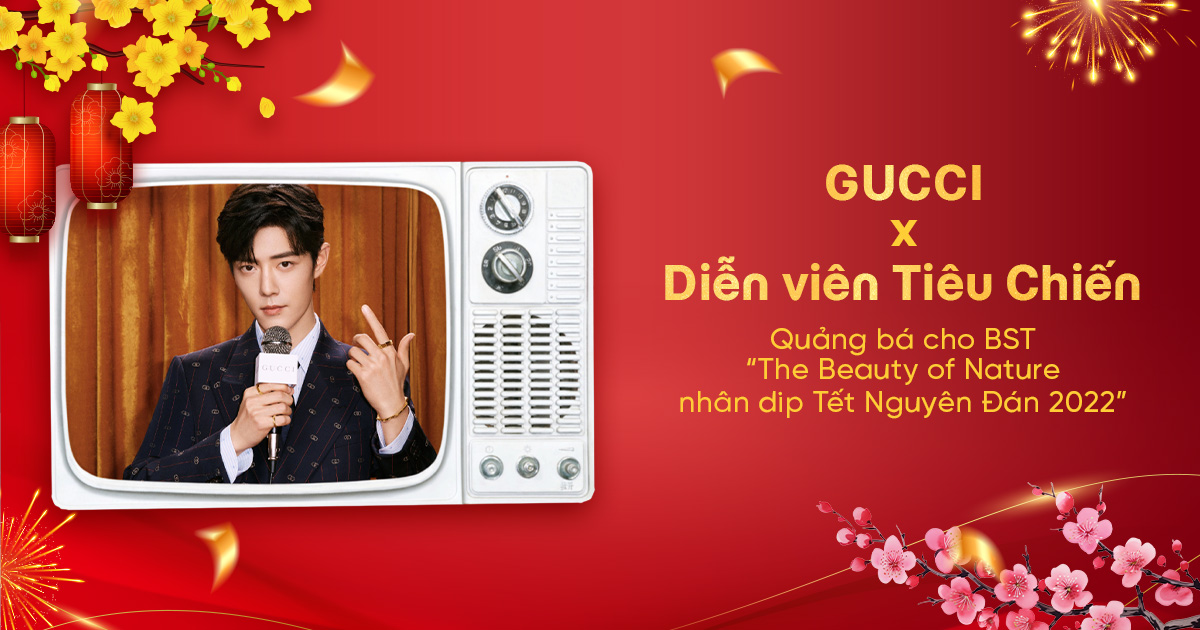
Actor Xiao Zhan accompanying Gucci’s Lunar New Year 2022 campaign: “The Beauty of Nature”
(Source: Novaon)
The campaign achieved remarkable results, with keywords related to the campaign continuously ranking No.1 on Weibo’s trending charts. The influence of the ambassador combined with creative visual strategy led to multiple products from the “Gucci Tiger” collection selling out within just one week of launch. This success demonstrated the effectiveness of combining brand artistry with top-tier celebrity influence to drive both sales and brand positioning during the most important festive season of the year.
Case Study 2: “The 24/7 AI-Stream: A Lunar New Year revenue breakthrough for Reckitt in China”
As part of its revenue growth strategy in emerging markets in 2025, Reckitt successfully implemented the case study “The 24/7 AI-Stream”, transforming AI avatars into a core sales engine in the Chinese market.
The context was the explosive growth of livestream e-commerce, coupled with a major challenge during the Lunar New Year: consumer demand for gift purchases peaked, while real human livestream hosts were in short supply due to the holiday break, alongside extremely high operational costs for holiday staffing. To solve this challenge and maximize cash flow, Reckitt replaced the traditional model with a team of AI-powered virtual hosts capable of livestream selling 24/7 without breaks. These AI avatars were programmed to wear Lunar New Year outfits, introduce special gift bundles from Enfamil or Durex, and close orders with customers at any time, even on Lunar New Year’s Eve.
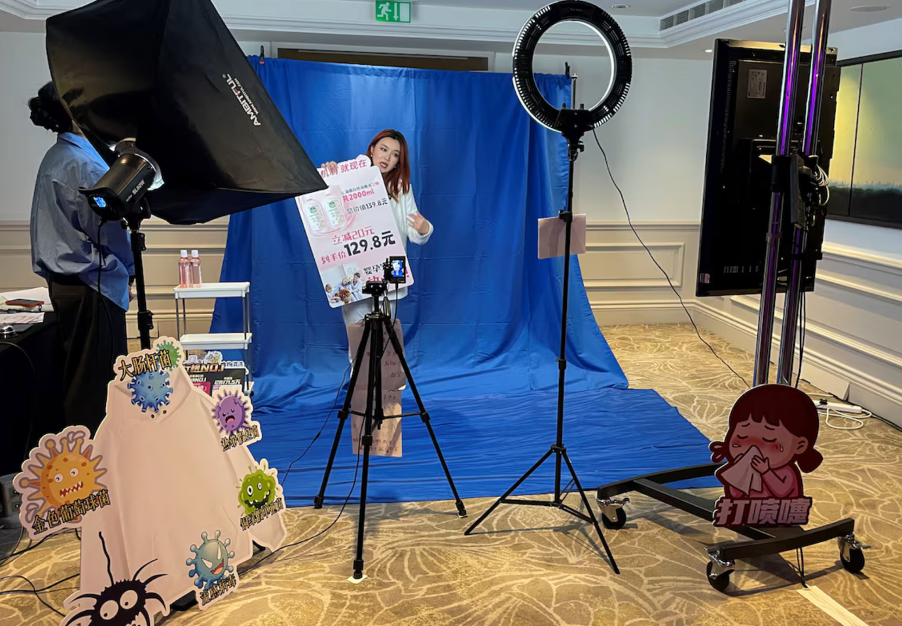
Reckitt applies Shoppertainment combined with AI hosts to drive Lunar New Year sales growth
(Source: Novaon)
By applying a hybrid operating model – using human hosts during peak hours and AI hosts during all remaining time slots – Reckitt maintained continuous presence and recorded revenue growth far exceeding financial analysts’ expectations. As a result, the brand not only fully captured traffic when competitors temporarily paused operations but also saved up to 90% in staffing costs, proving the outstanding effectiveness of AI in driving sales and optimizing profitability in the world’s most populous market.
Case Study 3: “The Digital Connection: Coca-Cola’s Mobile Loyalty ecosystem during the Lunar New Year”
In the highly competitive beverage market during the Lunar New Year, Coca-Cola faced a major challenge in maintaining customer loyalty, as consumers often tended to choose products based on competitors’ instant discounts at the point of sale. The lack of a direct interaction channel made it difficult for the brand to encourage bulk purchases (such as buying cases instead of individual bottles) and limited its ability to collect behavioral data for effective personalized marketing campaigns.
To address this, Coca-Cola leveraged its existing mobile application integrated with a Mobile Loyalty program, allowing users to easily accumulate points by entering codes or scanning QR codes under bottle caps and on product packaging. During the Lunar New Year period, the app became a key demand-driving tool through features such as push notifications reminding users to shop at the right moments, double points policies for case products or gift bundles, and festive vouchers and attractive redemption rewards. These incentives strongly motivated customers to purchase additional products in order to accumulate enough points within the limited festive period.
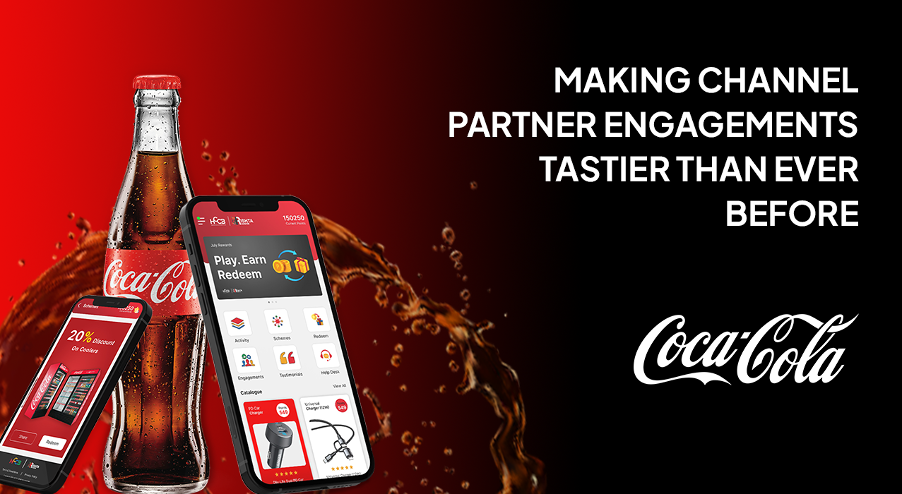
Coca-Cola leverages its online app to boost sales and strengthen loyalty during the Lunar New Year
(Source: Novaon)
Results from this digitalized model enabled Coca-Cola to establish direct and long-term connections with consumers rather than relying solely on retailers. The strategy not only increased average order value (AOV) and repurchase frequency during the Lunar New Year but also helped the brand collect valuable first-party customer data. Retaining customers through the mobile app allowed Coca-Cola to optimize advertising costs and ensure the brand remained constantly top-of-mind through offers delivered directly to users’ smartphones.
Part 5: Expert perspective – Winning the Lunar New Year 2026 through insight-driven strategies
The Lunar New Year 2026 represents a golden opportunity for FMCG brands that know how to leverage consumer insights and deploy communication strategies effectively. The four golden keys – Gamification, App Marketing, Influencer Marketing, and Shoppertainment – are not merely “trends” but strategic solutions that address specific insights: declining excitement, price sensitivity, the need for authentic trust, and emotion-driven purchasing behavior. Applying these strategies correctly enables brands not only to achieve short-term revenue growth but also to build sustainable brand loyalty beyond the festive season.
At Digital Novaon, with 20 years of experience partnering with leading FMCG brands, we deliver comprehensive Brand Experience solutions under the SCT model (Strategy – Creative – Technology). From in-depth consumer insight development and consistent Lunar New Year brand identity across all touchpoints to leveraging Data Analytics for personalized customer experiences, we transform communication campaigns into real growth platforms. Digital Novaon’s Brandformance solutions optimize both brand building and sales performance, ensuring every communication investment delivers clear, measurable ROI.