In 2026, the digital marketing landscape is witnessing two parallel trends: digital platforms continue to offer extensive audience reach, while AI technologies are becoming increasingly integrated into content production. These developments create new opportunities for brands, but also intensify the pressure to capture consumer attention and establish meaningful differentiation.
1. As AI Becomes Mainstream, Creating Distinctive Brand Experiences Emerges as a New Challenge
According to DataReportal’s Digital 2026: Vietnam report, Vietnam recorded 85.6 million internet users and 79 million social media user identities as of late 2025. These figures provide an important foundation for understanding the digital marketing landscape entering 2026.
However, a large digital audience does not necessarily translate into meaningful connections between brands and consumers.
According to HubSpot’s State of Marketing 2026 report, based on a survey of more than 1,500 marketers worldwide, 83.5% of respondents reported increasing expectations to produce more content, while 80% were already using AI for content creation.
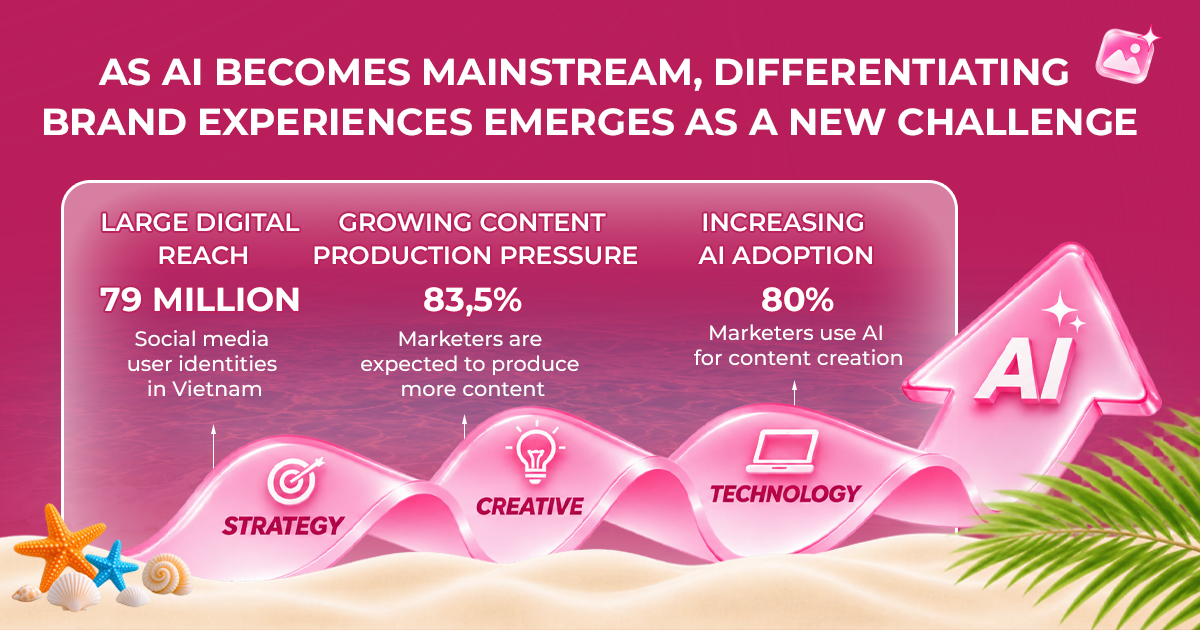
Extensive digital reach, growing content production pressure, and the widespread adoption of AI in marketing
Source: Novaon Digital
As AI expands content production capabilities, competitive advantage is no longer defined solely by content volume. It increasingly depends on the quality of ideas, relevance to target audiences, and the ability to deliver differentiated experiences.
Another noteworthy finding comes from a Bentley University-Gallup study published in August 2026. The research found that 49% of surveyed Americans held negative views toward businesses using AI to create advertisements, while only 19% expressed positive opinions. Although these findings reflect the U.S. market and are not representative of Vietnamese consumers, they highlight an important consideration: using AI does not automatically generate positive brand perceptions.
Against this backdrop, brands face three key challenges in 2026:
- The Differentiation Challenge: How can brands ensure their content and engagement activities stand out amid countless campaigns competing for attention across social media?
- The Participation Challenge: How can brands motivate consumers to actively engage rather than simply complete basic actions in exchange for rewards?
- The Brand Connection Challenge: How can entertaining and personalized experiences effectively communicate brand messages, visual identity, and product value?
These challenges explain why AI Generate Image should be viewed as more than an image-generation tool. When integrated into a strategically driven creative concept, the technology can help brands shift from simply delivering content to designing experiences in which consumers actively participate in the creative process.
2. AI Generate Image: Where Strategy, Creativity, and Technology Come Together to Create Brand Experiences
From Image Generation Technology to Personalized Marketing Solutions
The advancement of Generative AI is expanding the possibilities of brand creativity.
Traditionally, advertising visuals were primarily produced to communicate a consistent message to mass audiences. AI Generate Image, however, introduces the ability to create different visual outputs based on each participant’s preferences and choices.
According to HubSpot’s State of Marketing 2026, 48.57% of surveyed marketers identified the use of AI to create personalized content as one of the leading marketing trends.
Nevertheless, technology alone cannot determine what motivates consumers to participate, which brand differentiators should be emphasized, or how an experience can deliver meaningful value to a brand.
At Novaon Digital, the application of AI Generate Image is guided by the integration of three essential elements: Strategy – Creative – Technology, with the ultimate objective of creating meaningful Brand Experiences for consumers.
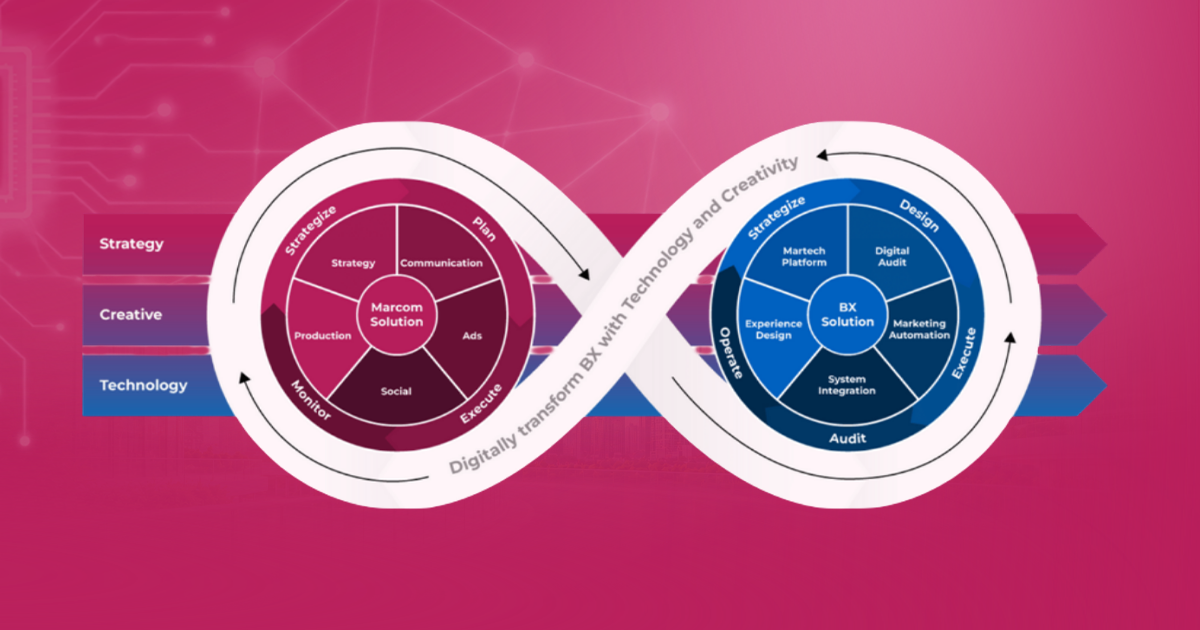
The AI Generate Image approach through the Strategy, Creative, Technology framework
Source: Novaon Digital
Strategy: Starting with Brand Challenges and Consumer Insights
Every AI application should begin with a specific marketing question: Is the brand aiming to increase engagement, strengthen product awareness, or establish new consumer touchpoints?
Based on campaign objectives, target audience analysis helps identify participation motivations, content preferences, and sharing behaviors. Technology should only be selected after the intended value of the experience has been clearly defined.
For example, for consumers who enjoy fashion photography and expressing their individuality, a personalized AI image-generation experience may be more appealing than a luck-based minigame.
Conversely, for brands seeking to introduce product features, AI can be combined with an interactive quiz to integrate product information into the consumer journey.
Creative: Turning Consumer Insights into Ideas That Inspire Participation
If Strategy defines the right problem, Creative provides the reason for consumers to take action.
Rather than using AI to generate visually appealing images with little connection to the brand, creative concepts must fulfill two objectives simultaneously: delivering an attractive output for participants while maintaining a recognizable brand identity.
This can be achieved through visual concepts, artistic styles, product storytelling, or interaction mechanisms tailored to the campaign.
An effective AI Generate Image concept should not only answer the question, “What images can AI create?” but also “Why would consumers want to create and share those images?“
Technology: Transforming Creative Ideas into Interactive Experiences
Technology plays a crucial role in turning creative concepts into functional, interactive experiences.
Depending on the objectives and technical scope of each project, an AI Generate Image solution can be designed around a user journey that includes interacting with an interface, providing personal preferences, processing user inputs, generating images based on a predefined concept, and enabling participants to receive or share their creations.
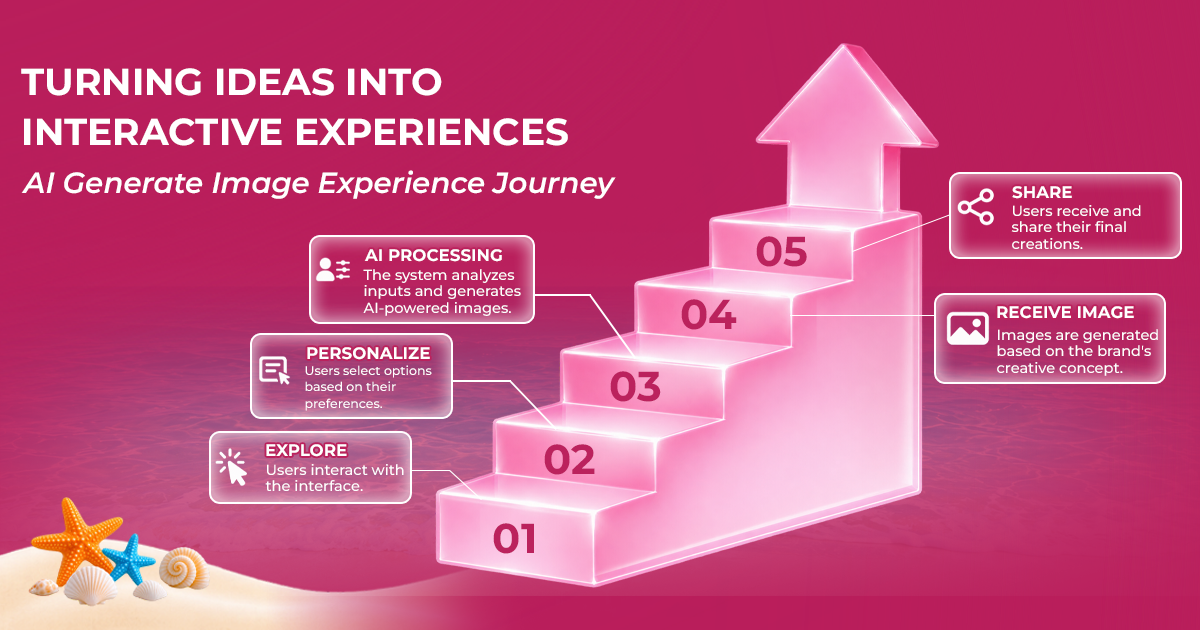
The AI Generate Image Experience Journey: From Discovery and Personalization to AI Image Generation and Sharing
Source: Novaon Digital
The key principle is that technology must serve the creative idea while operating within brand requirements, including image quality, product representation, user experience, and the privacy of user-provided data.
With this approach, AI Generate Image can be applied across various marketing activities, including social media contests, user-generated content (UGC) campaigns, product discovery experiences, interactive events, and seasonal brand activations.
The value of this solution does not lie in completely replacing traditional creative activities, but rather in expanding the range of interactive experiences brands can offer their consumers.
3. CINDY BLOOM x NOVAON DIGITAL: From a Social Engagement Challenge to an AI-Powered Creative Concept
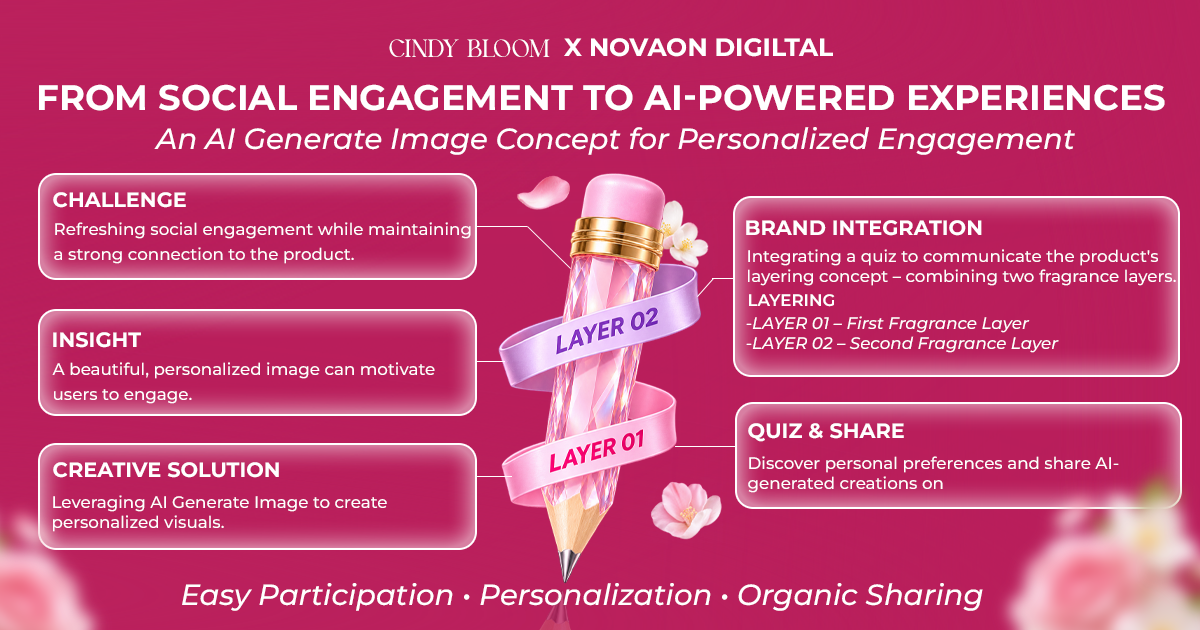
An AI Generate Image Concept for Cindy Bloom’s Social Engagement Campaign
Source: Novaon Digital
Challenge: Refreshing Social Engagement While Maintaining Product Relevance
As part of an integrated marketing communications (IMC) brief for Cindy Bloom, Novaon Digital was tasked with developing a social media activation capable of attracting consumer participation and encouraging meaningful brand engagement.
Conventional minigame formats had already become widely used, making it increasingly challenging to create an activity that stood out.
Meanwhile, a photo contest featuring the brand’s products could introduce participation barriers, as not every potential participant had previously purchased or owned a Cindy Bloom product.
The challenge, therefore, was not simply to introduce a new engagement mechanic, but to develop an experience compelling enough to motivate participation even among consumers who did not yet own the product.
Insight: When a Beautiful Photo Becomes a Motivation to Engage
Cindy Bloom’s target audience consists of women aged 18 and above, primarily students who enjoy photography, fashion, and feminine, romantic aesthetics.
At the same time, the brand’s tone and mood are characterized by softness, dreaminess, floral imagery, and beauty-inspired aesthetics.
The alignment between consumer interests and the brand’s visual identity opened up a new creative direction:
Instead of asking consumers to take photos with the product, why not give them the opportunity to create a beautiful, personalized image inspired by the world of Cindy Bloom?
This insight became the starting point for the AI Generate Image concept.
Creative Solution: Bringing AI Image Generation into the Brand Experience
Building on this consumer insight, Novaon Digital developed a concept that uses AI Generate Image to create personalized visuals while incorporating recognizable brand elements.
Rather than limiting participation to existing product owners, the concept allows users to generate images that reflect their personal styles while remaining aligned with Cindy Bloom’s brand identity.
Participants can then share their AI-generated creations on Facebook as part of the proposed social media contest.
This approach is designed to deliver three key benefits:
- Lower Participation Barriers: Consumers do not need to own the product to take part in the experience.
- Greater Perceived Value: Participants receive personalized visual content that they can use and share.
- Stronger Brand Amplification Opportunities: AI-generated images can incorporate Cindy Bloom’s brand elements, allowing the brand to appear more naturally in user-shared content.
Brand Integration: Beyond Beautiful Images to Communicating the Layering Concept
One of the most notable aspects of the Cindy Bloom project is not simply the use of AI Generate Image, but how the creative team developed a quiz-based mechanism to communicate the product’s Unique Selling Proposition (USP).
Initially, the quiz was conceived as a simple set of questions designed to recommend fragrances based on individual preferences.
However, Cindy Bloom’s products offer a distinctive feature: fragrance layering, which allows consumers to combine different scent layers to create personalized fragrance combinations.
Building on this USP, Novaon Digital developed a two-layer fragrance quiz, enabling participants to explore their personal preferences while becoming familiar with the product’s layering concept throughout the interaction.
As a result, the activity goes beyond entertainment to serve an additional product communication function.
Participants are not only introduced to a creative experience but also given an opportunity to better understand the distinctive product value Cindy Bloom aims to communicate.
From an Interactive Concept to a New Approach to Brand Experience
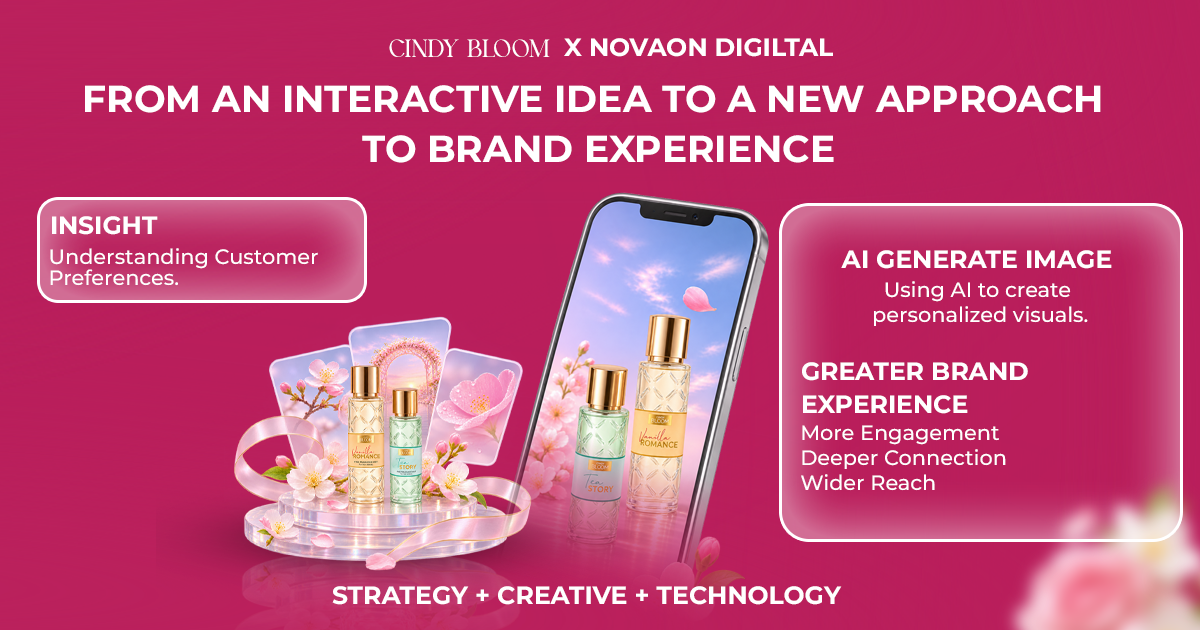
Integrating Strategy, Creative, and Technology to Elevate Brand Experiences
Source: Novaon Digital
The Cindy Bloom concept demonstrates how AI Generate Image can be incorporated into a broader brand experience strategy rather than being used solely as a visual content production tool.
When consumers have a compelling reason to participate, receive something valuable in return, and encounter relevant product messages within the same journey, social media activations can move beyond conventional engagement mechanics.
For Novaon Digital, this represents a promising direction for technology-driven marketing innovation: placing brand challenges at the center, using consumer insights to shape creative concepts, and leveraging AI to deliver experiences that are more relevant to consumers.
It also illustrates the practical integration of Strategy – Creative – Technology: beginning with consumer insights, developing ideas aligned with the brand, and applying technology to expand the possibilities of brand engagement.
Because in the age of AI, the most important question is no longer simply what content a brand can create, but what experiences consumers and brands can create together.
Contact Novaon Digital to explore how AI Generate Image can unlock new creative possibilities for your brand’s marketing campaigns.