The Automotive Industry: When Growth Can No Longer Rely on the Product Alone
The global automotive industry is navigating a period of uncertain growth. While the market remains substantial in scale, the traditional drivers of expansion are showing signs of structural weakening – a trend reflected in a series of market shifts throughout the 2024-2026 period.
For many years, electric vehicles were regarded as the industry’s primary growth engine. However, that momentum has slowed considerably. According to Deloitte, consumer interest in fully electric vehicles across major markets is declining, with a notable shift toward hybrid models as a more pragmatic choice amid ongoing economic uncertainty. In the United States, the majority of electrified vehicles sold in2024 were hybrids rather than fully electric, indicating that consumers remain cautious about a complete transition away from conventional powertrains.
Although global EV sales in 2025 still achieved approximately 20% growth – surpassing 20 million units sold – this figure fell well short of earlier market projections. Reuters attributed part of this shortfall to policy tightening in several countries and persistent consumer concerns regarding charging infrastructure and total cost of ownership. These developments reinforce a broader reality: electric vehicles are no longer sufficient on their own to sustain the industry’s growth trajectory.
Beyond demand-side pressures, automakers continue to face escalating production costs and prolonged disruption across global supply chains. The semiconductor crisis of 2021 erased an estimated USD 210 billion in industry revenue, and many manufacturers have yet to fully restore pre-pandemic output levels. The EV battery supply chain, meanwhile, remains heavily concentrated in a small number of Asian markets, leaving the industry exposed to geopolitical risk and raw material price volatility.
On the consumer side, economic constraints are fundamentally reshaping vehicle purchasing behavior. By the end of 2025, the average price of a new car in the United States had surpassed USD 47,000, while auto loan interest rates remained elevated. As a result, consumers have become increasingly deliberate about large financial commitments – postponing purchases or gravitating toward more flexible alternatives such as hybrids, pre-owned vehicles, or mobility services in lieu of long-term ownership.
The industry itself is undergoing a fundamental transformation: from internal combustion to electrification, from hardware-defined products to software-enabled vehicles, and from standalone purchases to integrated ecosystems encompassing vehicles, services, and data. Competitive advantage is no longer determined by engine power or aesthetic design alone, but by a brand’s capacity to deliver a superior, holistic user experience.
This shift is particularly evident among younger consumer segments. For Generation Z, the automobile is no longer a symbol of status or ownership in the conventional sense. It is viewed as an extension of lifestyle and technology, where experiential value outweighs technical specification. Moreover, the car-buying journey has become increasingly non-linear – fragmented across social media platforms, video content, influencer reviews, and peer-shared experiences.
Taken together, these forces point to a clear strategic imperative: consumers no longer select vehicles based on product attributes alone. They select vehicles based on the experiences those vehicles enable. The challenge for automotive brands, therefore, is not to offer more features, but to be present at the precise moment when a consumer begins to envision those experiences.
Moment Marketing: When Purchase Intent Begins with a Moment
Against a backdrop of rapidly evolving consumer behavior, Moment Marketing is emerging as one of the most nuanced and effective strategic approaches in the automotive sector. Where traditional automotive marketing concentrated primarily on communicating technical specifications, performance credentials, and technological innovation, the decisive factor today is a brand’s ability to appear at the right moment – precisely when a consumer’s latent need begins to crystallize.
In practice, very few consumers begin their purchasing journey with the explicit intention of buying a car. Most decisions are initiated by far more everyday desires: a wish to take the family on a weekend getaway, a plan for a road trip with friends, or simply the pursuit of a fresh experience after a demanding period at work. These are the authentic starting points of automotive buying behavior.
This is the essence of Moment Marketing – understanding not only who the customer is, but what state they are in and when their need is most acute. These “moments” may arise during summer, public holidays, or extended vacation periods, when the desire for travel and mobility intensifies. They may also be triggered by specific behavioral signals: searching for travel destinations, watching travel documentaries or vlogs, or reading accounts of family road trips. Life transitions: marriage, the birth of a child, a change in income or lifestyle, can equally serve as catalysts that prompt consumers to reconsider their vehicle needs.
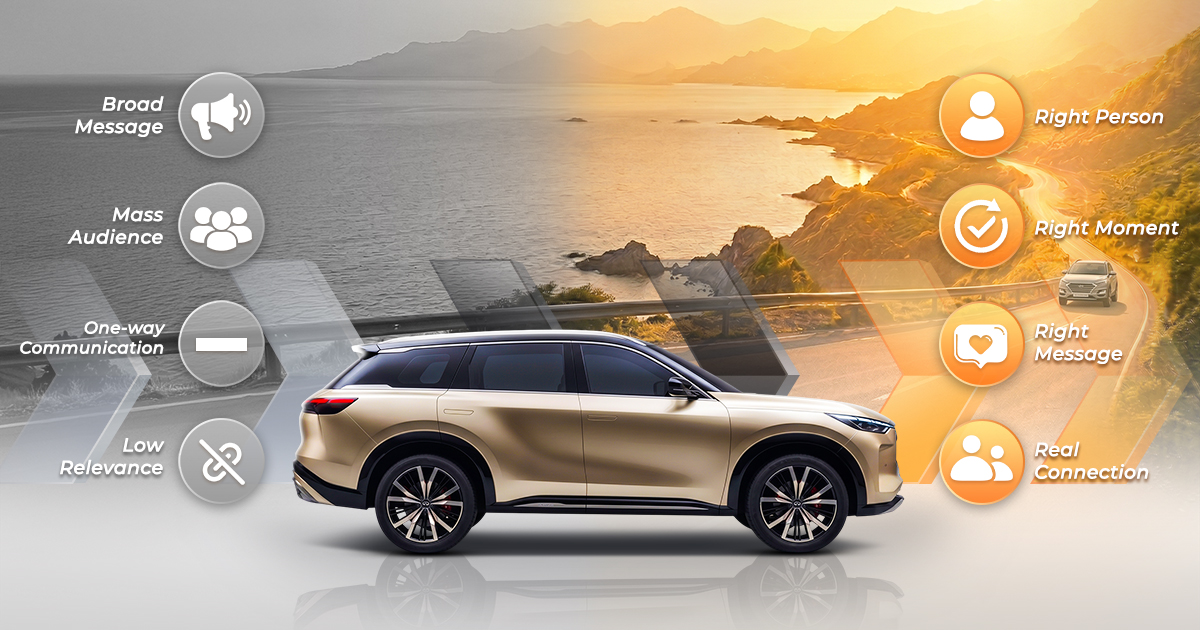
Moment Marketing – The right audience, at the right moment, with the right message.
What distinguishes Moment Marketing is that the brand no longer assumes the traditional role of advertiser. Instead, it positions itself as a natural presence at the moment of need. When a family begins planning a summer trip, they are not simply seeking an SUV with a high towing capacity or superior fuel economy. Their real concerns are more personal: Is the cabin spacious enough for children to rest comfortably on long journeys? Is the vehicle safe enough to provide peace of mind across hundreds of kilometers? Can it reliably accommodate the needs of the entire family throughout the trip?
This understanding is reshaping how automotive brands approach communication. Rather than leading with product features, brands are increasingly constructing narratives anchored in real-life experiences. This shift has also elevated the importance of data and personalized customer engagement. Rather than broadcasting a uniform message to mass audiences, brands are identifying the precise moments when consumer intent emerges – and responding with content calibrated to that specific context. When a user searches for travel destinations or watches a long-distance road trip video, automated systems can surface content that is immediately relevant to their situation.
For Moment Marketing to meaningfully influence purchasing behavior, however, brands cannot rely on emotional messaging alone, or on isolated campaigns. In an environment where consumer attention is easily fragmented, what matters most is the construction of a coherent experience system in which every touchpoint is designed around a specific moment in the customer journey. Three distinct communication solutions can help operationalize this approach.
Solution 1: KOL and Influencer Marketing
One of the most effective approaches involves leveraging key opinion leaders (KOLs) and digital influencers to transform real journeys into content capable of creating genuine emotional resonance. Rather than producing reviews centered on engine specifications or performance data, forward-thinking brands are partnering with prominent digital figures to create content that captures authentic, everyday moments: laughter shared between passengers, relaxed conversation on an open road, and the warmth of family interaction during a long drive. These human details allow consumers to readily envision themselves in the same context – building organic trust and a natural inclination to explore the product further.
Solution 2: Social Media Moment Targeting
Social media platforms play an equally important role in enabling brands to appear at precisely the moment demand emerges. Rather than relying on mass advertising, a Social Media Moment approach focuses on distributing content and display advertising based on real user behaviors in real time.
When a consumer begins researching travel destinations, engaging with travel content, or interacting with summer-themed posts, advertising systems can automatically segment their intent and surface messaging that is contextually aligned. A family in the early stages of trip planning may be reached with content emphasizing interior space, cargo capacity, and comfort for children. A younger, adventure-oriented consumer may instead encounter content centered on the freedom and spontaneity of open-road travel.
In this model, advertising ceases to function as direct selling. It becomes, instead, a message that surfaces naturally within the consumer’s travel planning process – positioning the vehicle not as a product to be purchased, but as a solution that makes the journey more comfortable, convenient, and complete.
Solution 3: Augmented Reality Experience
At the stage proximate to a purchase decision, emotional engagement alone is often insufficient – particularly for family buyers, for whom safety and reliability are paramount considerations. This is where experiential technologies such as augmented reality (AR) begin to demonstrate their strategic value.
Rather than relying solely on brochures or showroom consultations, consumers can engage directly with the brand through AR applications that simulate a family driving journey or a summer road trip on their personal devices. Through scenarios such as long-distance driving, in-car family dynamics, and on-road situation management, users can explore a vehicle’s safety features, performance characteristics, and practical utilities within a realistic travel context.
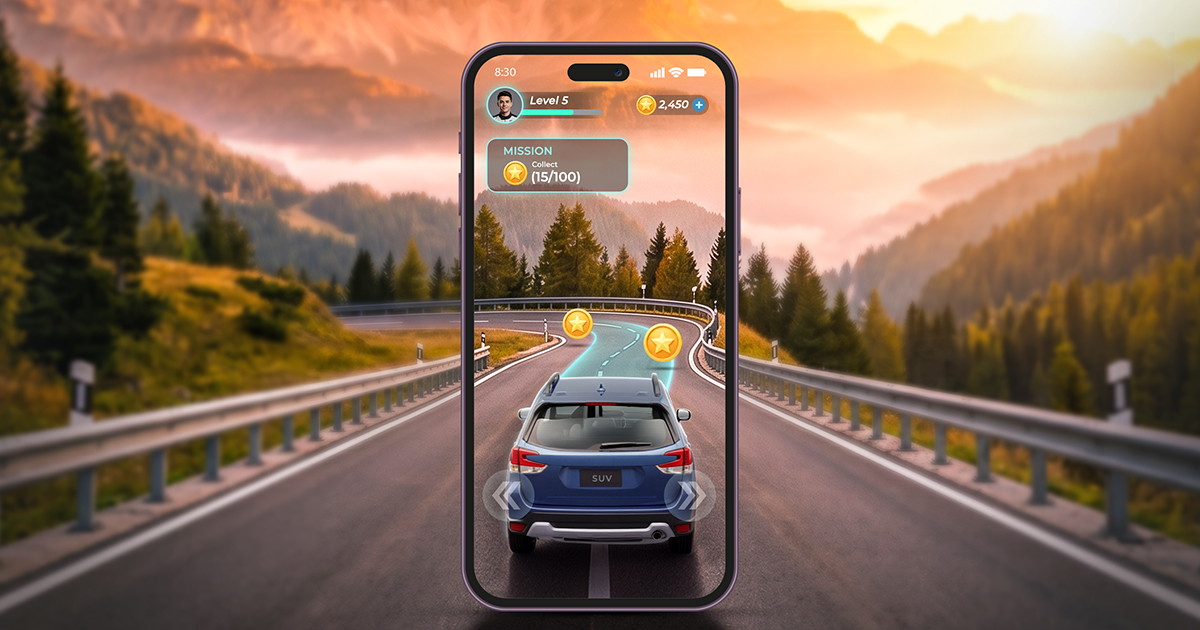
AR Experience allows customers to experience driving directly on their smartphones.
These immersive experiences bridge the gap between initial emotional interest and final purchase decision – helping consumers develop a concrete and confident understanding of how the vehicle will serve their lives.
Critically, Moment Marketing does not function as a collection of discrete activities. KOL content inspires the consumer’s journey; social media targeting ensures brand presence at the moment of emerging demand; and experiential technology reinforces confidence immediately prior to the purchase decision. Together, these elements form an integrated system that guides consumers from initial emotional engagement through exploration and, ultimately, to a definitive purchasing action.
In a market where competitive advantage increasingly resides in experience rather than product specifications, the capacity to construct such a seamless Moment Marketing system is becoming a defining strategic asset for automotive brands.
Representative Case Studies
Toyota – Employee Advocacy Model
Toyota reoriented its communication strategy from conventional product advertising toward an Employee Advocacy model, empowering its own employees and sales consultants to become authentic brand advocates. Rather than emphasizing technical specifications, the resulting content focused on family journeys, personal driving experiences, and real-world usage scenarios. Executed through the Onfluencer platform, the campaign generated nearly 940,000 interactions and helped Toyota cultivate a more credible and accessible content ecosystem.
Subaru × JNTO – “Enjoy My Japan”
Subaru partnered with the Japan National Tourism Organization (JNTO) to launch the “Enjoy My Japan” campaign, employing narrative storytelling to connect the brand with themes of travel and exploration. Rather than directly promoting the vehicle, the campaign followed a Subaru enthusiast on a cross-country journey through Japan in a WRX STI – evoking a sense of freedom, discovery, and emotional connection with each landscape encountered along the route. The campaign effectively repositioned the Subaru vehicle as a companion in the pursuit of exploration, rather than merely a mode of transportation. The film was subsequently screened at Subie Fest California, a flagship event within the Subaru community in the United States.

The video was showcased at Subie Fest California, one of the largest events for the Subaru community in the United States.
Expert Perspective: When Touchpoints Become a Competitive Advantage
In a market where products are increasingly homogenized, the competitive advantage will belong to brands that most effectively understand and respond to consumer emotions. Automotive marketing is evolving from broad reach toward timely, contextually relevant engagement – from one-way communication toward a personalized experience architecture built around the individual consumer journey. The ability to tailor content to specific behavioral signals will be the decisive factor in earning consumer trust within a purchasing process that is, at its core, deeply emotional.
Beyond product promotion, Moment Marketing represents a demonstration of empathy. When a brand appears at precisely the right moment – addressing a specific concern or fulfilling a particular aspiration – it establishes an emotional connection that transcends transactional exchange. Brands that are able to consistently capture these pivotal touchpoints will be those that define the next era of automotive marketing.
During summer, when travel demand reaches its annual peak, this principle becomes especially powerful. Technical specifications recede into the background, giving way to vivid imagery of shared journeys and collective experiences. Consumers at this moment are not seeking a vehicle with a specific horsepower rating. They are seeking a vehicle capable of carrying the joy, comfort, and peace of mind of the people they love most.
The car must be associated with the moments that matter: a serene camping trip beside a mountain stream, or an emotionally resonant journey home. In those scenes, the vehicle is not the protagonist – it is the dependable enabler that allows every experience to unfold seamlessly. By embedding themselves naturally within these meaningful, everyday moments, automotive brands can find a more human and enduring path into the lives of their customers.