To achieve this, brands must simultaneously design compelling reasons for customers to engage, seamless ways to access value, and meaningful experiences that extend beyond initial product usage.
1. Bank-Finance During the Festive Season: When Transaction Growth Does Not Guarantee Brand Preference
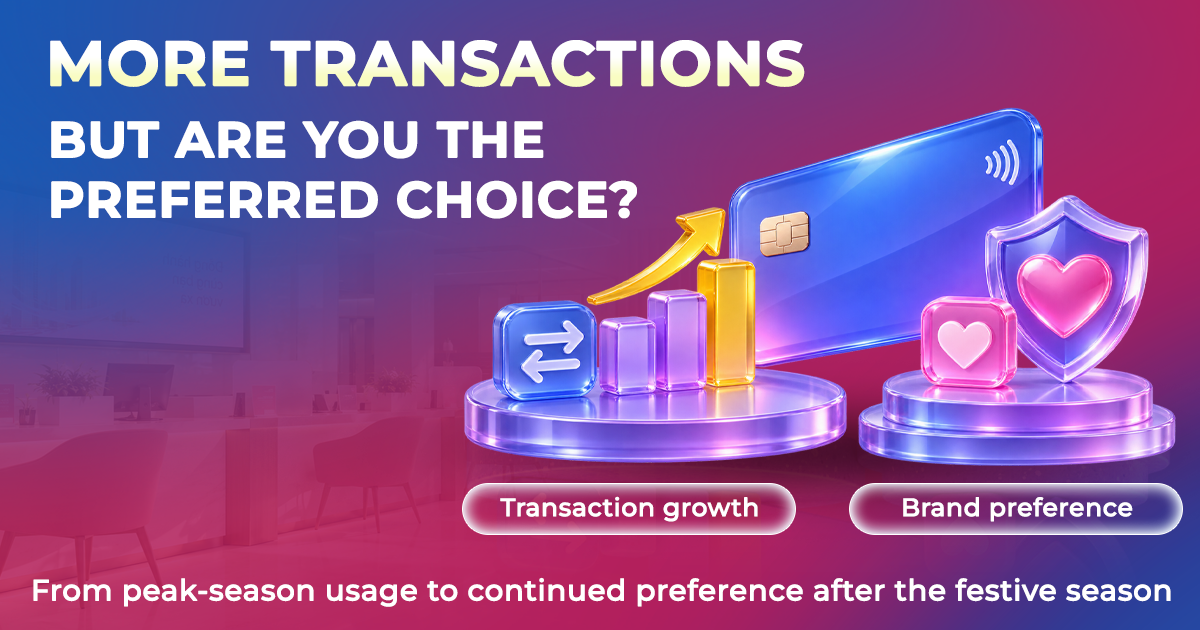
Transaction growth during the festive season does not necessarily translate into sustained brand preference beyond the peak period
Source: Novaon Digital
According to data from the State Bank of Vietnam, as reported by VietnamPlus on October 14, 2026, Vietnam recorded more than 21 billion cashless transactions in the first eight months of 2026, representing a 34.56% year-on-year increase in transaction volume. This expanding scale creates significant opportunities for financial services to become integrated into everyday activities, from shopping and travel to gifting and money transfers.
However, overall market growth does not necessarily indicate how effectively individual brands are capturing these opportunities. A campaign may generate registrations without driving first-time transactions, or stimulate promotional spending without sustaining usage beyond the peak period. Media reach, product engagement, and business value must therefore be connected within a unified measurement approach.
In its 2026 payments outlook, Visa highlights rising expectations for fast, secure, and convenient digital experiences across channels. For festive marketing, this implies that the value communicated through campaign content must remain consistent as customers explore, register for, and use financial products.
The critical gap lies between what a brand leads customers to expect and what they actually experience. When an advertisement directs customers to an offer that is difficult to locate, eligibility requirements that are unclear, or rewards that are difficult to track, acquisition investments may lose effectiveness within the conversion journey itself.
Brand preference should therefore be evaluated through multiple dimensions: customer consideration, successful product experiences, and the likelihood of continued selection beyond the festive peak. Transactions provide behavioral signals, but understanding genuine brand preference also requires examining customer perceptions and tracking usage over time.
This article focuses on payment cards, transaction accounts, and digital wallets to illustrate how the framework can be applied within the Bank-Finance sector.
2. Festive Experience Framework: Three Capabilities Shaping One Connected Journey
The Festive Experience Framework begins by defining the value customers expect to receive and the behaviors brands aim to encourage.
Strategy identifies relevant customer needs and business objectives. Creative builds motivation and engagement. Technology enables customers to access, utilize, and track their benefits.
Rather than operating independently, these three capabilities must be designed in parallel, with customer journey data providing the foundation for continuous optimization and performance evaluation.
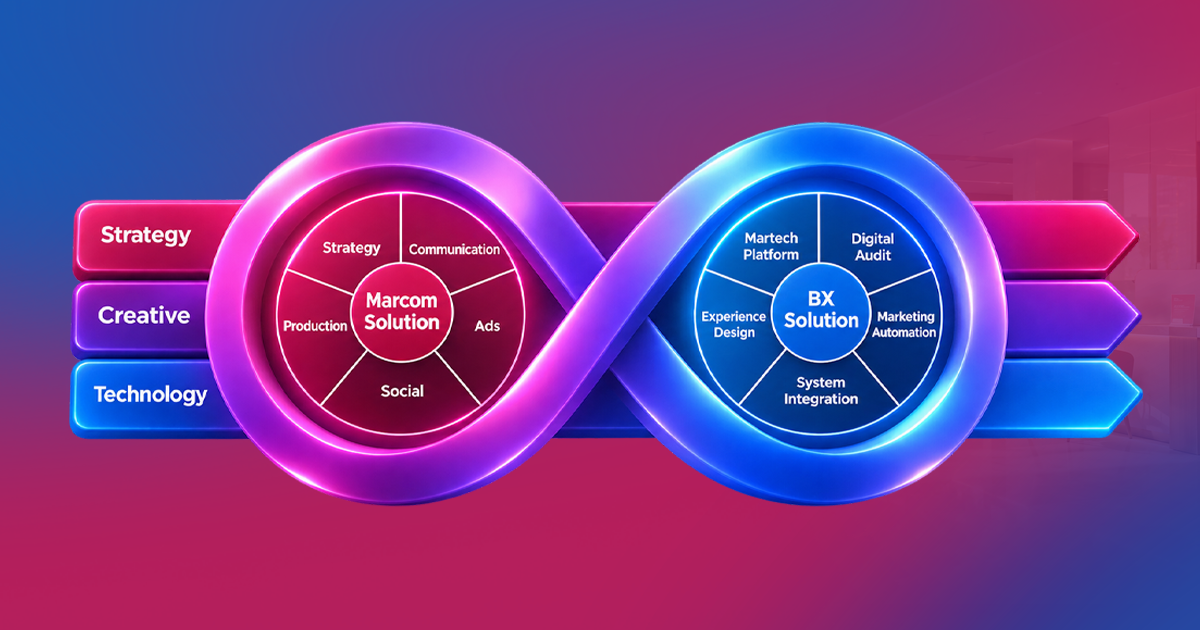
The integration of Strategy, Creative, and Technology connects communication solutions with brand experiences
Source: Novaon Digital
Strategy: Defining the Brand’s Role Across Financial Needs
Strategy begins by identifying the festive-season needs that financial products are best positioned to fulfill, such as budgeting, shopping payments, travel bookings, gifting, and money transfers to family members.
Each occasion should be evaluated against the brand’s product capabilities, partner ecosystem, and market positioning.
The next step is determining the specific behaviors to encourage. Activating first-time transactions, re-engaging inactive customers, and increasing transaction frequency among existing users represent distinct objectives.
Behavior-based segmentation enables brands to identify the underlying barriers: customers may not recognize the benefits, understand how to use the product, or encounter a sufficiently relevant need.
A well-defined strategy should clearly establish the target audience, relevant moments of need, desired customer behaviors, and value proposition.
These elements provide the foundation for selecting campaign messages, participation mechanisms, and budget allocations while defining performance evaluation criteria before execution.
Creative: Turning Financial Benefits into Experiences Worth Engaging With
Creative enables brands to connect financial services with familiar festive aspirations, such as caring for family, sending meaningful wishes, exchanging gifts, and spending quality time with loved ones.
The creative concept must demonstrate how the product contributes to these aspirations while offering customers a meaningful way to participate.
For campaigns centered on sharing, money transfers or digital lucky-money features can become integral parts of the experience. For shopping-related benefits, content should help customers recognize the value offered and understand how to access it.
Content creators, interactive activities, and gamification should all guide customers toward a specific product-related action.
Banktainment, the combination of banking and entertainment, illustrates this approach.
An analysis by the Vietnam Banks Association highlights how event-related privileges can connect brand image with digital product experiences. The strategic value lies in engaging relevant communities and delivering practical benefits, creating opportunities to strengthen brand consideration and encourage product usage.
Creative becomes persuasive when emotional engagement is supported by tangible benefits that customers can actually experience.
Consistency must therefore extend from campaign messaging to product interfaces, user guidance, and reward fulfillment, ensuring that every touchpoint reinforces a compelling reason to choose the brand.
Technology: Connecting Experiences Through Behavioral Data and Feedback
Technology plays a critical role in addressing friction throughout the customer journey, from directing users to the appropriate product features and recording registrations to communicating transaction status and enabling reward tracking.
Experience design must accommodate different user scenarios, including customers who already have the application, those who have not installed it, and those who are not currently logged in.
Data and automation enable brands to tailor customer engagement based on behavioral signals, within the boundaries of permitted data usage.
Customers who have completed transactions should receive timely confirmations and relevant support. Those who have not completed the process should receive guidance tailored to the specific step where they encountered difficulties.
AI can further support information retrieval and clarification of offer conditions, provided that reliable data sources and appropriate control mechanisms are in place.
Delivering these capabilities requires coordination among marketing, product, technology, operations, and external partners.
Before communicating a promise to customers, all stakeholders must align on service delivery capabilities, tracking mechanisms, and responsibilities for resolving potential experience disruptions.
3. Connected Experience: Turning Every Touchpoint into a Step Toward Customer Value
A Connected Experience emerges when each touchpoint helps customers move closer to their desired value while providing relevant information to support the next stage of their journey.
Across five stages – Awareness, Consideration, Engagement, Transaction, and Loyalty – the objective is to maintain continuity between customer needs, engagement motivations, and actual product experiences.
Each stage should clearly define the value delivered to customers, the actions being supported, and the signals used to evaluate performance.
This approach connects Media, Activation, Digital, and MarTech within a unified customer journey, while helping brands identify where customer interest is interrupted before it translates into measurable outcomes.
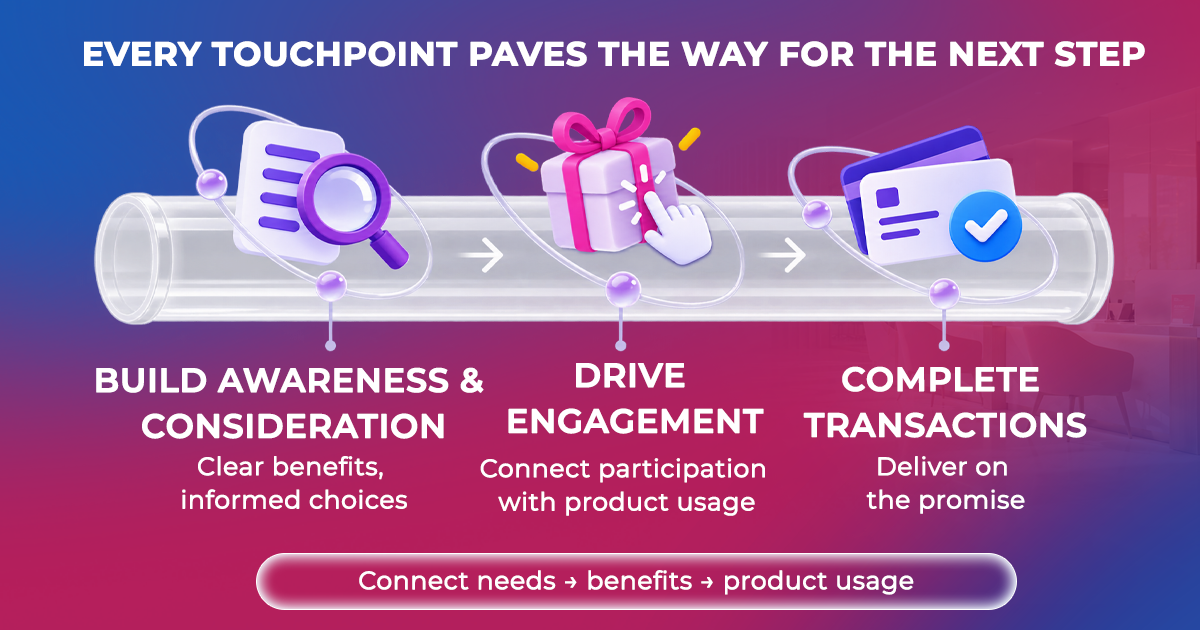
Connecting customer benefits and actions from awareness to transaction
Source: Novaon Digital
Awareness and Consideration: From Compelling Messages to Accessible Benefits
At the awareness stage, campaign content should help customers understand how financial services can support their immediate plans and priorities.
Media determines the most relevant engagement contexts, Strategy defines the customer benefits, and Creative communicates compelling reasons to explore further.
The destination following an advertisement must consistently explain the benefits initially introduced.
Eligibility criteria, registration requirements, transaction limits, participating partners, and reward timelines should be easy to locate and consistent across campaign content, landing pages, and applications.
For time-sensitive festive promotions with limited reward allocations, brands must clearly communicate promotional periods, eligibility conditions, and reward availability.
This transparency allows customers to make informed decisions based on their shopping or travel plans.
Registration progression rates, abandoned steps, and recurring support inquiries can help identify conversion barriers.
When customers drop off at this stage, teams should reassess both the relevance of the benefits and how the information is presented before increasing media investment.
Engagement: Turning Participation Motivation into Product Experiences
Following a game, interactive activity, product exploration, or registration, users should clearly understand what they have received, where their benefits can be accessed, and how to redeem them.
This progression must be incorporated into the creative concept from the beginning.
VPBank’s involvement as co-organizer and principal sponsor of the BIGBANG World Tour in Hanoi in 2026 provides an illustration.
According to VnExpress on October 21, 2026, Mastercard cardholder benefits connected early ticket access with payment promotions for artist merchandise.
Another initiative, reported by VTV on September 9, 2026, linked opportunities to receive concert tickets with registration through VPBank NEO, credit card applications, and qualifying spending.
The appeal of the entertainment event therefore created opportunities for continued engagement through financial products.
From the framework’s perspective, Strategy identifies the relevant community and customer needs; Creative establishes the motivation to participate; and Technology facilitates registration and payment.
Fans’ enthusiasm for their favorite artists creates the initial reason to engage, while tangible product value provides the foundation for continued consideration of the bank.
The key lesson for festive campaigns is to design customer benefits alongside the next product-related action. The effectiveness of customer acquisition and retention must subsequently be validated through data.
Transaction: From Successful Payment to Delivering on Brand Promises
At the transaction stage, customers need to complete their intended actions, understand processing status, and track the benefits they are entitled to receive.
During the festive season, the deadline for qualifying transactions and the expected reward fulfillment date must be clearly distinguished so customers can plan their usage accordingly.
For cashback programs that require post-transaction reconciliation, the expected processing timeline and tracking methods should be easily accessible.
For incomplete transactions, notifications should clearly indicate the next steps required.
Brand experience also extends to problem resolution after payment.
Customer support channels should have access to relevant information, reducing the need for customers to repeatedly explain their issues.
Successful transaction rates, reward fulfillment times, and support requests should be monitored collectively.
These indicators help brands assess how effectively they are delivering on their promises and identify touchpoints that require prioritized improvements.
Loyalty: Sustaining Value Beyond the Festive Peak
After the peak period, customer engagement should continue by addressing needs that emerge from festive spending activities, such as reviewing expenses, tracking remaining benefits, and managing upcoming payment obligations.
Content related to expense management, payment reminders, or ongoing benefits should be selected according to actual product usage and customer behaviors.
This allows brands to remain useful even after the immediate motivations for shopping and gifting have passed.
Post-campaign engagement should be planned before the campaign concludes.
Data collected throughout earlier journey stages can inform content personalization and engagement frequency, while post-campaign monitoring helps evaluate continued product usage.
A Connected Experience becomes complete when the brand maintains a meaningful reason to remain present beyond the initial moment of engagement.
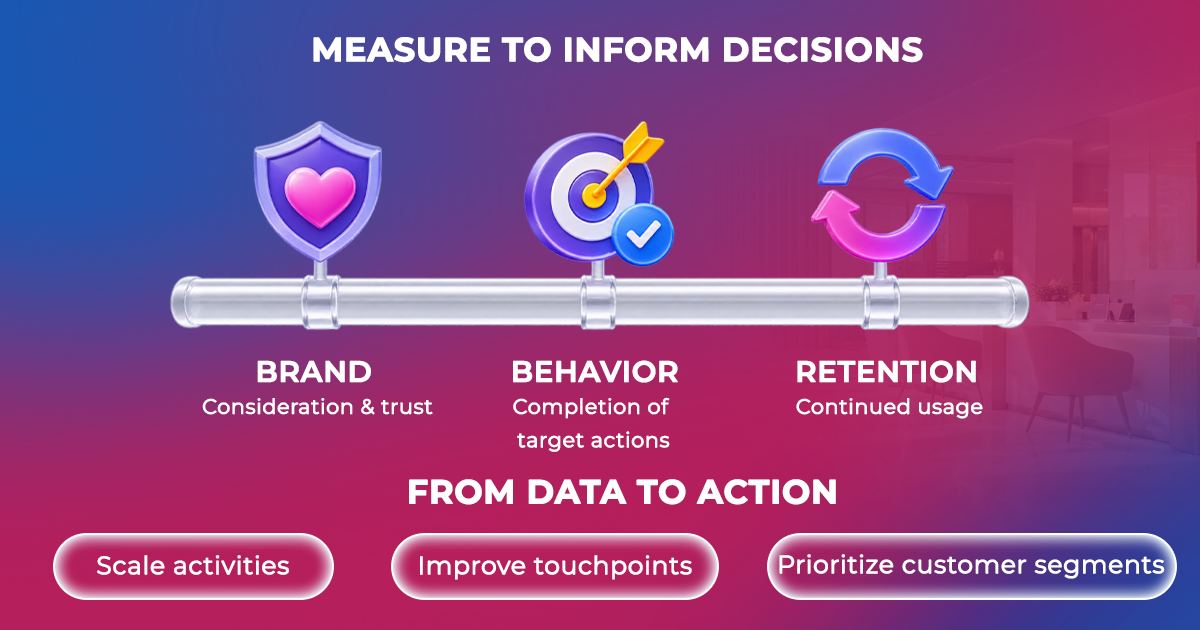
Measuring brand performance, customer behavior, and retention to guide investment decisions
Source: Novaon Digital
From Connected Experience to Business Impact: Measuring Value Across the Journey
Measurement should help brands determine which activities deserve greater investment, which touchpoints require improvement, and which customer segments offer opportunities for continued engagement.
Business Impact should therefore be assessed across three dimensions: brand consideration and trust, completion of targeted customer behaviors, and sustained product usage after the campaign.
These indicators must be interpreted together to support decision-making.
When campaign content attracts attention but customers abandon the journey before registration, brands should examine their messaging, eligibility conditions, and user experience.
When transactions increase during promotional periods but decline afterward, brands need to reassess the value offered beyond the incentive and the effectiveness of follow-up engagement.
For community-driven activities, discussions and user-generated content should be evaluated alongside brand engagement and product usage before additional budgets are allocated.
To identify incremental impact, brands may employ appropriately designed control groups. Before-and-after comparisons should account for seasonality and concurrent marketing activities.
Cost evaluation should encompass media investment, customer benefits, and implementation expenses while distinguishing between activation costs and the costs of acquiring customers who continue using the product.
The true value of measurement lies in translating results into actionable decisions: refining audience strategies, improving conversion experiences, and allocating resources to activities with demonstrable contributions to business outcomes.
4. Viettel Money: Connecting the Spirit of Sharing with In-App Experiences

Viettel Money x Novaon Digital
Source: Novaon Digital
The “A Peaceful Tết – Sharing Love” campaign, launched during Lunar New Year 2022, serves as a Novaon Digital reference case demonstrating how communications can be connected with product experiences.
At a time when the pandemic disrupted shopping, lucky-money traditions, and family gatherings, Viettel Money faced the challenge of introducing its digital financial ecosystem in a competitive market, attracting new users, and sustaining engagement among existing customers.
To address these challenges, Novaon leveraged the festive spirit of sharing and connection, developing content around Tết shopping, lucky-money traditions, and the transition toward a new normal.
The Onfluencer solution, powered by AI and Big Data, supported the selection of influencers aligned with target audiences and brand personality.
Content distributed across Facebook and TikTok was adapted to creators’ individual styles and relevant usage contexts, making the messaging more relatable while highlighting the practical benefits of Viettel Money’s services.
Influencer activities directed audience attention toward two in-app games.
Among them, “Lucky Money of Love” connected opportunities to receive lucky money with app visits and financial activities such as topping up accounts, transferring money, and recharging mobile credit.
Festive emotions were therefore translated into opportunities for product interaction, creating a connection between the communication narrative and actual service experiences.
The campaign recorded positive results in reach, engagement, and organic app installations.
From the Strategy, Creative, Technology (SCT) perspective, Strategy identified the need for connection, Creative developed the narrative and participation incentives, and Technology supported campaign execution, while the application provided the environment for product experiences.
The key takeaway for the Festive Experience Framework is the importance of designing product usage opportunities alongside communication concepts.
Measurement mechanisms should also be established to track progression from participation to transactions and long-term engagement, providing a more comprehensive evaluation of Business Impact.
5. Conclusion
Winning customers during the festive season requires more than generating initial interest. Brands must enable successful product experiences and continue delivering value as customer needs evolve.
Every touchpoint should fulfill a clearly defined role in delivering this overarching brand promise.
The Festive Experience Framework integrates Strategy, Creative, and Technology to establish a Connected Experience: Strategy identifies the right value proposition, Creative inspires engagement, and Technology enables the customer journey to be delivered effectively.
Business Impact is validated through changes in brand consideration, product usage behaviors, cost efficiency, and the ability to sustain customer relationships.
When experience design and business performance evaluation are aligned around shared objectives from the outset, festive campaigns are better positioned to contribute to the long-term growth of Bank-Finance brands.