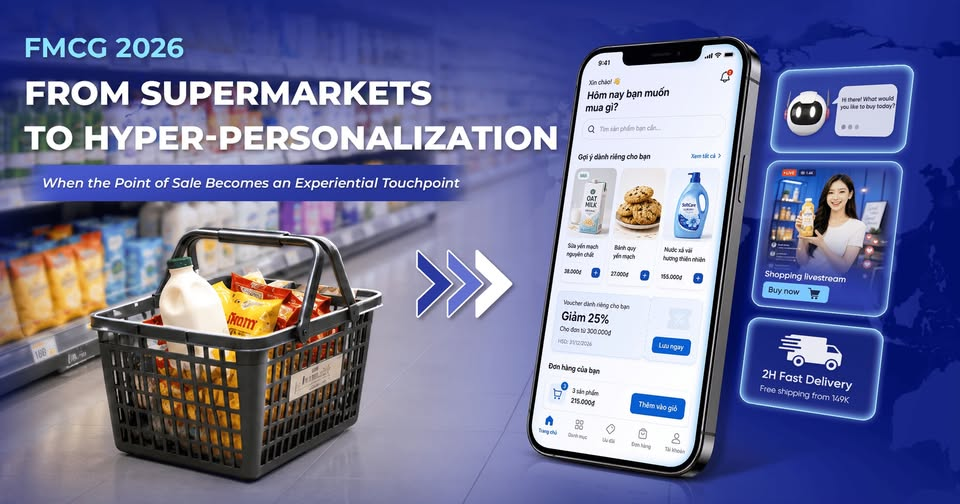
1. Market Context: FMCG Enters a New Competition Across Every Retail Touchpoint
The FMCG purchase journey no longer starts at the supermarket
In Vietnam, the FMCG industry is witnessing a clear shift in the shopping journey. Consumers no longer approach products only at supermarkets, convenience stores, or traditional grocery stores. Instead, their journey now begins from multiple touchpoints such as TikTok, e-commerce platforms, livestreams, delivery apps, review communities, or content from KOCs.
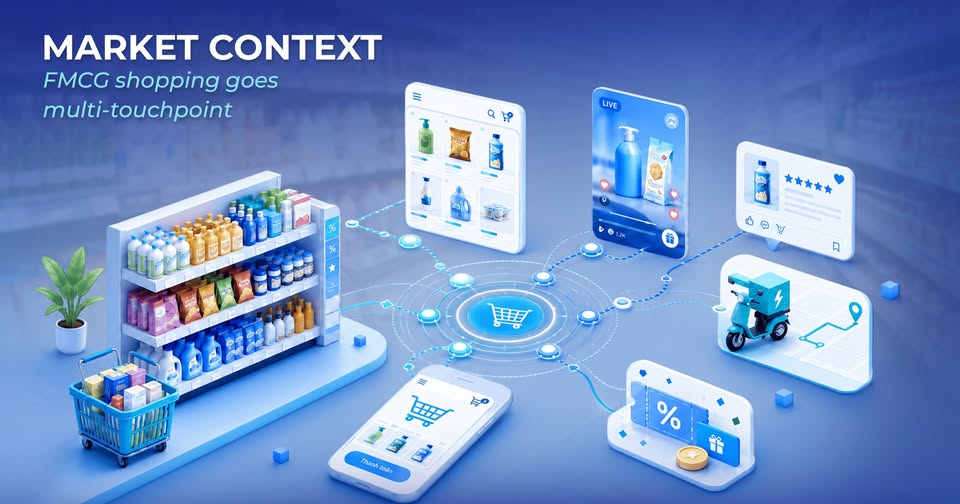
The FMCG shopping journey is shifting from fixed points of sale to a multi-touchpoint ecosystem.
Source: Novaon Digital
This shift can be clearly seen through the growth of e-commerce and social commerce. According to the e-Conomy SEA 2025 report by Google, Temasek, and Bain, Vietnam’s digital economy is forecast to reach USD 39 billion in GMV in 2025, up 17% year-on-year; among which, e-commerce continues to be one of the key growth drivers. From a social commerce perspective, Vietnam’s market is projected to reach approximately USD 5 billion in 2025, growing by more than 25% year-on-year, driven by the development of influencer marketing, livestream selling, and integrated shopping features on social platforms.
This means the “point of sale” in FMCG is no longer a fixed location, but an omnichannel ecosystem where content, communication, and transactions take place almost simultaneously.
Mass communication is gradually losing effectiveness
FMCG has always been a category with high communication frequency, a large number of products, and brand differentiation that is not always clearly defined. In a context where consumers are exposed to too many advertisements, promotions, livestreams, and reviews every day, generic messages are becoming increasingly difficult to remember.
NielsenIQ stated that entering 2025, FMCG businesses in Vietnam need not only to meet current consumer demand, but also to connect their marketing strategy with customer experience and leverage omnichannel selling. This shows that competition no longer lies only in communication reach, but in the ability to create more relevant experiences at each touchpoint.
The challenge is no longer whether a brand appears frequently enough, but whether it appears in the right context. A one-size-fits-all message will struggle to drive conversion if it is not connected to specific needs, timing, and purchase behaviors.
Consumers are buying more by context than by habit
After Covid, Vietnamese consumers have become more accustomed to digital shopping, fast delivery, and hunting for deals on online platforms. They may buy an FMCG product because they see a review that matches their needs, because a livestream offers a good promotion, because an app recommends it at the right time, or because they need the product delivered on the same day.
Data from YouNet ECI, cited by Cimigo, shows that Vietnam’s online shopping market reached USD 8.5 billion in the first half of 2025 and is projected to grow at a CAGR of up to 35% during 2024–2028. This reflects the strong expansion of digital shopping channels and shows that purchase decisions are increasingly influenced by multiple online touchpoints before conversion.
As a result, purchase behavior is becoming more flexible and harder to predict. In FMCG, a purchase decision can happen very quickly, but it is often influenced by many smaller touchpoints beforehand.
Social commerce and quick-commerce blur the line between communication and sales
The growth of TikTok Shop, livestream commerce, e-commerce platforms, and quick-commerce is making FMCG communication no longer separate from sales. A short video can create demand, a KOC can reinforce trust, a livestream can close orders, and a delivery app can complete the experience in a short period of time.
For TikTok Shop specifically, data from Metric.vn cited by Vietdata shows that in Q1/2025, TikTok Shop’s revenue in Vietnam grew by nearly 113.8% year-on-year, increasing its market share from 23% to 35%. At the same time, the total revenue of the four platforms Shopee, TikTok Shop, Lazada, and Tiki reached VND 101.4 trillion, up 42% year-on-year. This is a clear signal that content-to-commerce is becoming an important growth driver in the digital retail ecosystem.
Therefore, FMCG marketing is no longer only about creating awareness through advertising. It must participate directly in the purchase journey, from recommendation and consultation to demand activation and conversion acceleration.
Conclusion: These changes show that FMCG in Vietnam is entering a new competitive landscape. Brands not only need to be present across multiple channels, but also need to know how to “touch” each consumer at the right moment, with the right need, and in the right purchase context.
This is the foundation driving the shift from supermarkets to hyper-personalization, where marketing is no longer just mass advertising, but becomes a dynamic experience across every retail channel.
2. Trends Shaping Personalized Shopping Experiences in FMCG 2026
Trend 1: AI Recommendation & Hyper-personalization – Recommending the right product at the right time
AI recommendation refers to the use of AI to suggest products, bundles, promotions, or content that are relevant to each user based on their behavior and shopping context. As this develops further, the trend becomes hyper-personalization, meaning the experience is personalized at a more detailed level: the right person, the right channel, the right time, and the right need.
In FMCG, this strategy can be implemented through product recommendations on e-commerce platforms, personalized vouchers on retail apps, repurchase reminders, bundle suggestions based on consumption habits, or dynamic content tailored to different customer segments.
An international example can be seen in PepsiCo, when the brand launched two D2C platforms, PantryShop.com and Snacks.com, during a period of strong growth in online shopping demand. These two platforms not only helped PepsiCo sell snacks and beverages directly, but also created additional data on consumer preferences, habits, and needs, enabling the brand to better understand shoppers and optimize future product recommendations.
The impact of this trend is that it helps brands “touch” consumers in the moments with the highest purchase potential. If FMCG brands used to compete through shelf visibility, in 2026, they will need to compete through their ability to understand consumption contexts and activate demand at the right time.
Trend 2: Data-driven Content – Marketing based on behavior and needs
Data-driven content is the way brands use behavioral data to build content that is relevant to each consumer segment, instead of using one generic message for the entire market. In FMCG, data can come from search behavior, purchase history, repurchase frequency, social interactions, e-commerce shopping carts, or feedback from livestreams.
The implementation lies in breaking down the purchase journey into specific contexts: consumers who are newly aware of the product need content that opens up demand; those who are considering need reviews, comparisons, or KOC validation; those who have purchased before need bundles, repurchase offers, or reminders at the right time.
This strategy helps brands address the declining effectiveness of mass communication, as content is no longer only used to create awareness, but directly supports conversion. In a context where FMCG consumers buy quickly but are easily distracted, data-driven content helps brands appear closer to the actual need and reduce communication waste.
Trend 3: Social Commerce – Turning content, communities, and livestreams into points of sale
Social commerce is the trend that combines content, social interaction, and transactions within the same journey. In FMCG, this is clearly reflected through TikTok Shop, livestream selling, KOC reviews, affiliate content, social challenges, and smaller consumer communities.
Implementation is not simply about bringing products onto social platforms, but about turning social into a shopping touchpoint. Influencers and nano KOCs help build trust through real experiences; livestreams support consultation, demonstration, promotion launches, and real-time order activation; quick-commerce can shorten the gap between demand generation and product delivery.
This trend addresses the challenges of trust and conversion in an oversaturated advertising environment. Consumers do not only hear the brand speak; they see the product in real usage contexts, receive validation from the community, and can buy immediately when the need arises.
Trend 4: Omnichannel Retail – Connecting shopping experiences from online to offline
Omnichannel retail is a strategy that connects multiple retail channels into a seamless journey, in which consumers can discover products on social media, watch reviews from KOCs, purchase on e-commerce platforms, receive offers from retail apps, or continue buying at physical stores.
Implementation is not simply about being present across many channels, but about clearly defining the role of each touchpoint. Social media creates demand, KOCs reinforce trust, livestreams drive conversion, e-commerce supports fast purchases, retail apps personalize offers, while supermarkets and physical stores maintain consumption habits.
This strategy helps FMCG brands solve the problem of a purchase journey that is no longer linear. As consumers continuously move between online and offline, brands need to ensure a consistent experience, connected data, and channel-specific messaging. This is the foundation for FMCG to shift from channel-based selling to building personalized shopping experiences across the entire retail ecosystem.
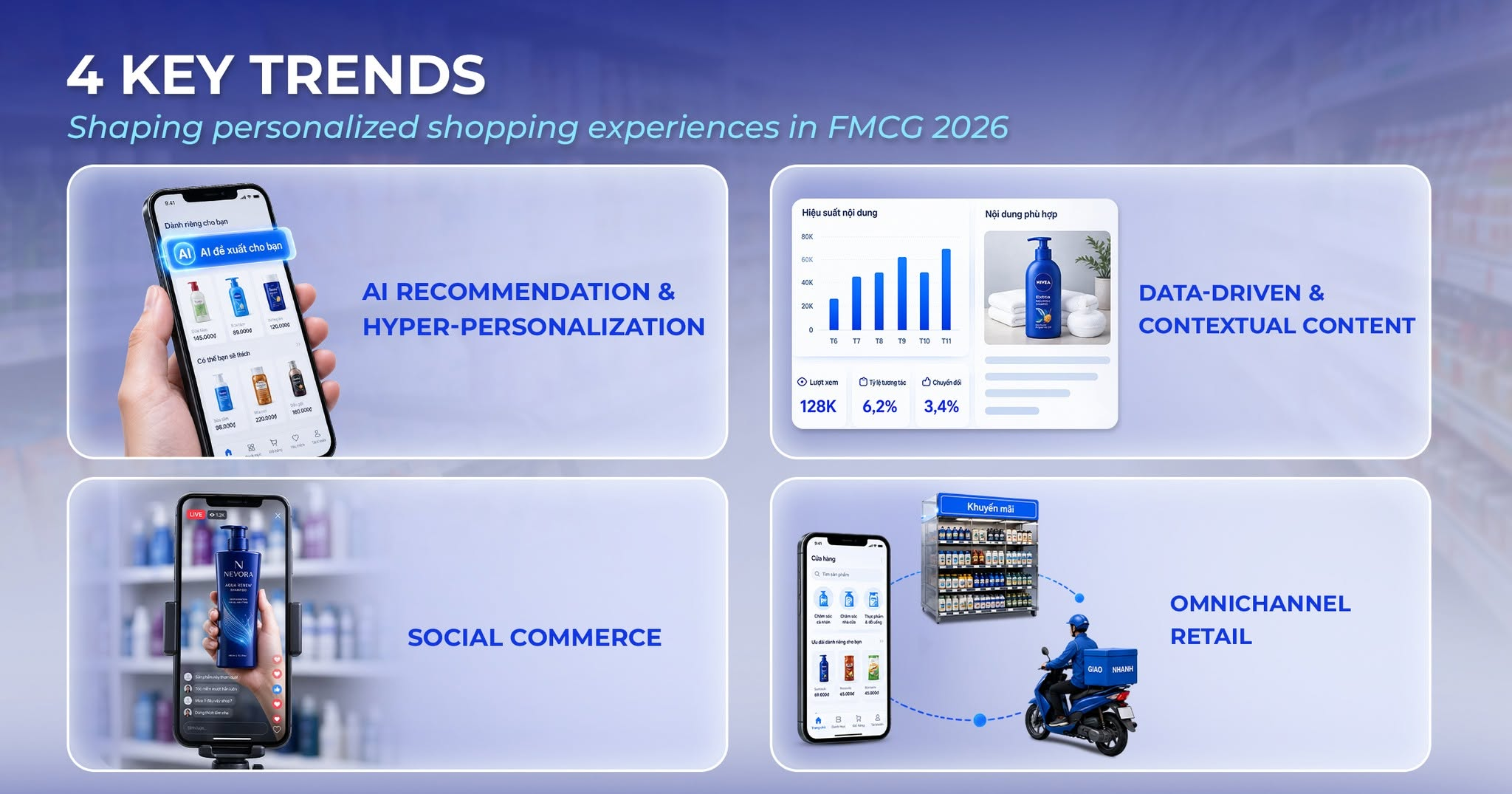
Trends shaping personalized shopping experiences in FMCG 2026
Source: Novaon Digital
3. Representative Case Studies: When FMCG Turns Every Touchpoint into a Personalized Shopping Experience
Unilever P/S – Personalizing consultation and conversion through Messenger Marketing
In the context of an increasingly competitive electric toothbrush market in Vietnam, P/S needed to find a way to attract target customers for its electric toothbrush product line, as consumers were showing growing interest in smart and convenient personal care products. At the same time, selling on e-commerce platforms also faced several barriers, such as declining external traffic to marketplaces, high “add-to-cart” costs, and limited customer data, making post-purchase care and repurchase activation more difficult.
To address this challenge, the campaign implemented Meta Messenger Marketing combined with a chatbot as a direct interaction channel with consumers. Instead of only driving users to the point of sale, P/S built conversation flows based on customer interests, combining chatbot, customer service, payment systems, logistics, and reporting to create a seamless consultation – sales – care process. This approach helped Messenger become not only a message response channel, but also a personalized touchpoint where customers could learn about the technology, product benefits, and receive support throughout the purchase journey.
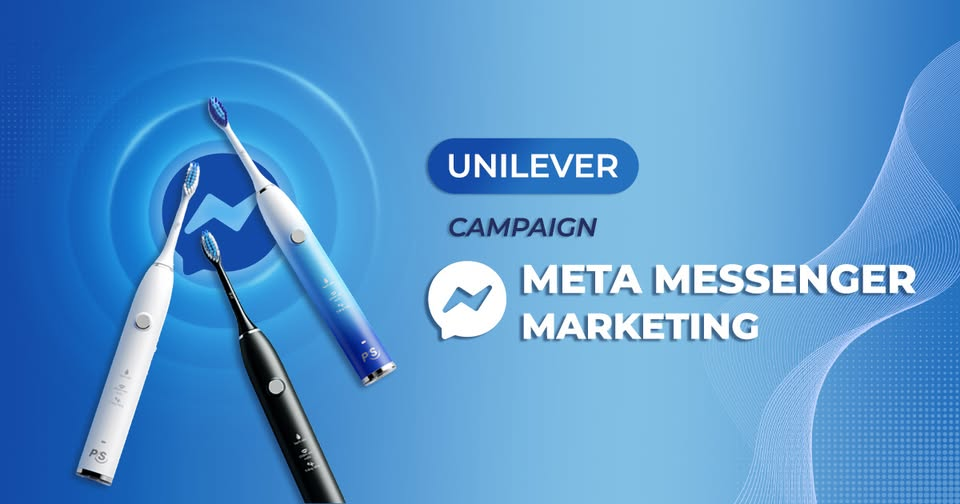
Unilever P/S applied Meta Messenger Marketing to personalize consultation and drive conversion.
Source: Novaon Digital
Long Hải – Fresh Yogurt Jelly: When social commerce turns a new snack into a multi-channel experience
In the context of a highly competitive snack market and rapidly changing consumption behavior among young consumers, Long Hải launched its Fresh Yogurt Jelly product with the goal of increasing awareness, expanding its customer base, and boosting consumption during the year-end 2024 to early 2025 period. The brand’s challenge was not only to introduce a new product, but also to generate demand across multiple sales channels, from modern trade, general trade to e-commerce.
The campaign chose an approach based on the insight of “childhood memories”, combined with a refreshing, convenient product experience suitable for various consumption moments. From the concept #BringMemoriesBack, Long Hải deployed a content ecosystem including social content, KOL sharing, KOC/community reviews, social challenges, and livestreams on TikTok/Facebook. In particular, KOCs in the food, food review, and lifestyle categories helped generate authentic reviews, while the “Ring Chuông Vàng” livestream turned entertainment content into a shopping touchpoint, with the shopping cart attached throughout the live session.
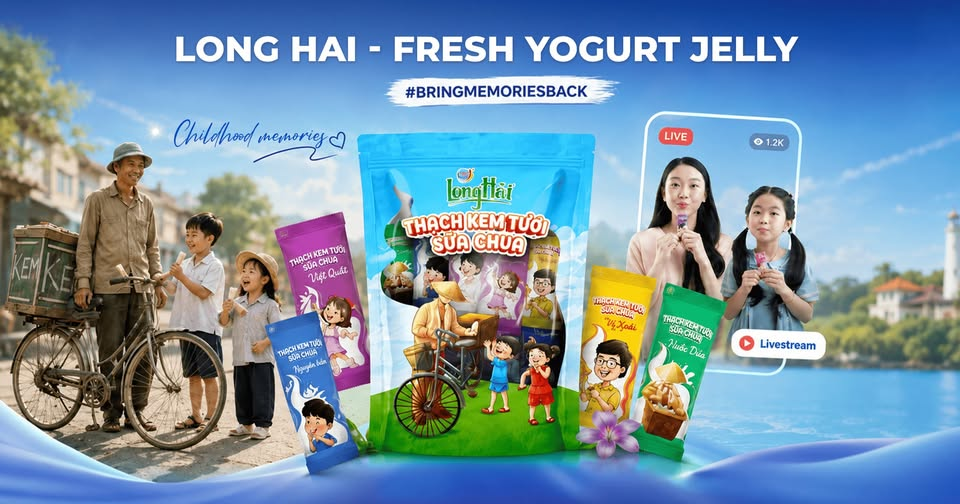
Long Hải’s campaign “Thạch Ngon siêu Hút, ‘Ring’ tuổi thơ về” brought childhood memories into the social commerce experience.
Source: Novaon Digital
4. Conclusion
In 2026, as the FMCG purchase journey expands from supermarkets and e-commerce to social commerce and livestreams, personalized experience becomes an important direction for brands to remain relevant in each consumption moment. In this context, brands need to shift their marketing mindset:
Understand the purchase context accurately: Brands should not only know who consumers are, but also understand what need they are buying for, where they are buying, and at what moment.
Connect content with conversion: Social content, KOCs, livestreams, chatbots, and e-commerce need to be designed as a seamless journey, instead of separate activities.
Turn every retail channel into an experiential touchpoint: From online to offline, each channel needs to have a clear role in creating demand, building trust, and driving purchase.
To accompany this shift, Novaon Digital provides a Brand Experience solution ecosystem for the FMCG industry, combining Strategy, Creative, and Technology to help brands build personalized, seamless, and higher-converting experiences across every retail touchpoint.