As brands plan for 2027, the FMCG market offers considerable opportunities while demanding more precise investment decisions. The expansion of e-commerce, creative content, and technology provides more ways to reach customers. At the same time, shoppers are weighing product benefits, prices, and credibility more carefully.
Against this backdrop, Novaon Digital introduces “FMCG BrandCom Outlook 2027,” bringing together four areas: the FMCG market landscape in 2026; consumer behavior and insights; the Value-led Brandformance approach; and case studies from Vietnam and international markets. Throughout the report, the focus remains on how communication can clarify value, build brand preference, and support growth.
1. The FMCG Market: Understanding Growth by Consumer Need and Sales Channel
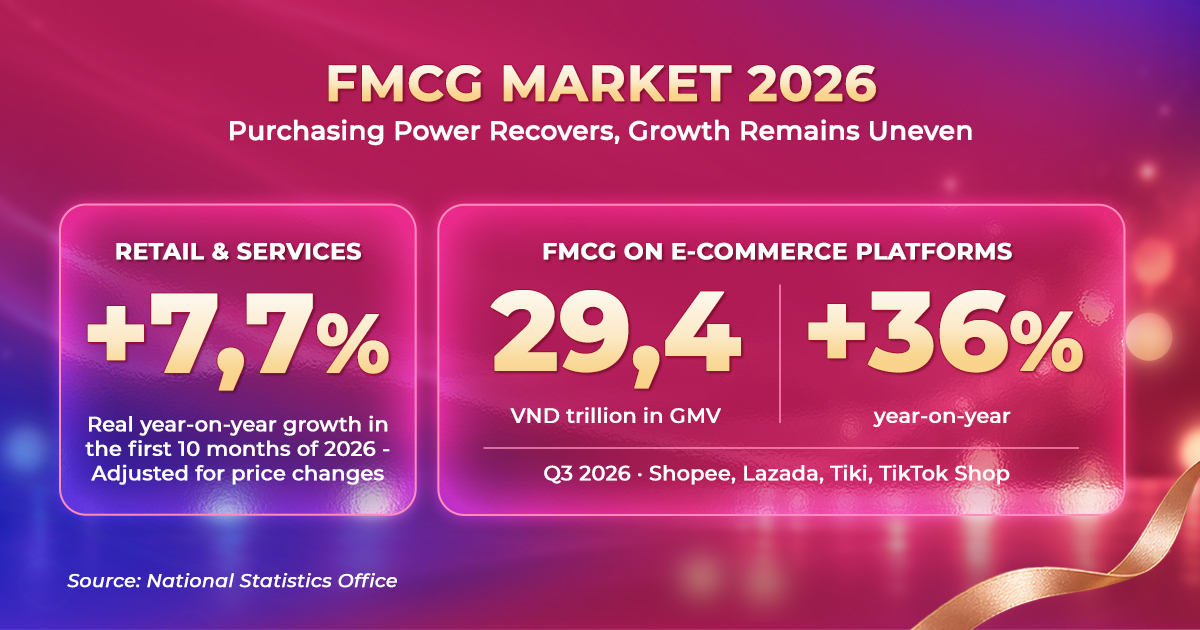
Purchasing power recovers, while growth varies across consumer needs and sales channels.
Source: Novaon Digital
According to the National Statistics Office, total retail sales of goods and consumer service revenue in the first ten months of 2026 reached approximately VND 6,618.9 trillion, up 13.5% year-on-year. After adjusting for price changes, growth stood at 7.7%. These figures indicate a continued improvement in overall purchasing power.
However, the broader retail picture does not fully reflect developments within FMCG. Worldpanel by Numerator’s Vietnam FMCG Outlook 2026 reports downward pressure on in-home FMCG purchase volumes in both urban and rural areas. This calls for a closer examination of individual categories, product benefits, and usage occasions, rather than assuming that recovering consumption creates equal opportunities for every brand.
In e-commerce, YouNet ECI data shows that FMCG gross merchandise value (GMV) across Shopee, Lazada, Tiki, and TikTok Shop reached VND 29.4 trillion in Q3 2026, up 36% year-on-year. This points to the growing strength of digital channels. Nevertheless, platform growth should be assessed alongside new customer numbers, sales volumes, and performance across all channels to determine whether a brand is expanding demand or benefiting from a shift in where consumers place their orders.
These developments suggest a priority for 2027 planning: identify the needs consumers remain willing to pay for, then select the products, messages, and channels best suited to addressing them. For communication, this means establishing a clear hypothesis about the reason to buy before scaling campaign reach.
2. Shoppers Evaluate Value Throughout the Journey
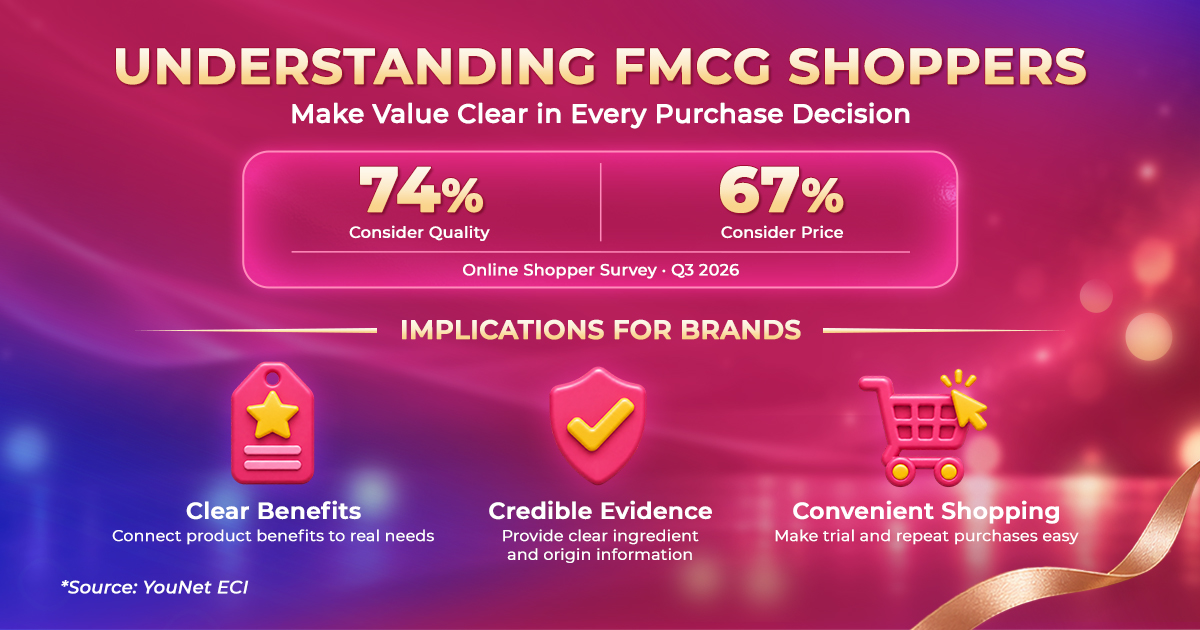
Understanding FMCG shoppers helps brands clarify benefits, strengthen trust, and make shopping more convenient.
Source: Novaon Digital
YouNet ECI’s Q3 2026 online shopper survey found that 74% of respondents considered product quality, while 67% considered price. The presence of both factors in purchase decisions highlights the need for brands to explain clearly what consumers receive in return for their spending.
In FMCG, this value is often experienced in specific situations. A convenient meal needs to fit the consumer’s available time and portion requirements. A personal care product needs to demonstrate its benefits, explain how to use it, and provide credible reasons to trust it. A larger pack size needs to make the cost per use clear while meeting the household’s actual needs.
The report explores themes such as health, multiple benefits, personalization, and convenience through the tasks shoppers are trying to accomplish. First-time buyers need reassurance about suitability and an opportunity to try the product. Shoppers replenishing their supplies need to find the same product and reorder easily. Environmentally conscious consumers need a simple way to participate that helps turn intention into action.
Understanding consumers therefore requires identifying both what motivates them to buy and what makes them hesitate. Once the barrier is clear, a brand can choose a specific response: provide additional evidence, demonstrate usage, adjust pack sizes, or simplify the purchase process. This is the foundation for more useful communication at each touchpoint.
3. Value-led Brandformance: Connecting Brand Value with Reasons to Buy
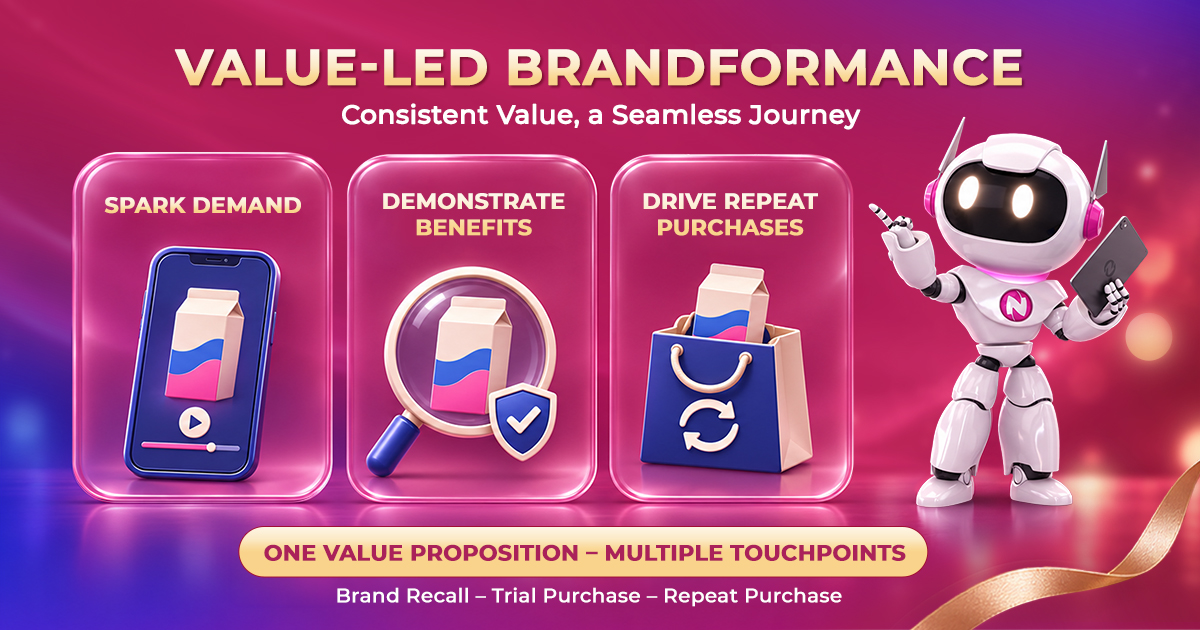
Value-led Brandformance connects product value across the journey from awareness to purchase and repurchase.
Source: Novaon Digital
Building on market developments and shopper behavior, “FMCG BrandCom Outlook 2027” develops the Value-led Brandformance approach: start with verifiable practical benefits, communicate those benefits consistently throughout the journey, and evaluate both brand impact and business results.
For example, a video promoting a lunch product for busy days could begin with the challenge of having limited time. A creator could demonstrate preparation and realistic portion sizes. The product page could explain pack options, pricing, and trial offers. After customers have tried the product, subsequent content should provide relevant opportunities to replenish it. The same benefit is explained according to what shoppers need to know at each stage.
This consistency helps prevent situations in which content attracts attention but leaves viewers unable to connect it with the product, or advertising promises an experience that the product page fails to explain clearly. It gives the brand a stronger basis for being remembered in connection with a specific need, while supporting sales through a reason to choose that has already been established.
The report also considers measurement in relation to purchase cycles. Awareness may improve before consumers need to buy, while a promotion may generate trial purchases without demonstrating the potential for repeat purchases. Correct brand recall and an accurate understanding of product benefits should therefore be assessed alongside trial, repeat purchases at regular prices, and incremental profit. This perspective helps brands evaluate the quality of growth beyond the campaign’s initial burst of attention.
4. Four Complementary Approaches: Addressing the Barriers Holding Back Purchases
Alongside Value-led Brandformance, the report examines Creator & Community, Connected Commerce, AI & Brand Discovery, and Cultural Experience. Each plays a distinct role, and the way they are combined should follow the problem the brand is trying to solve.
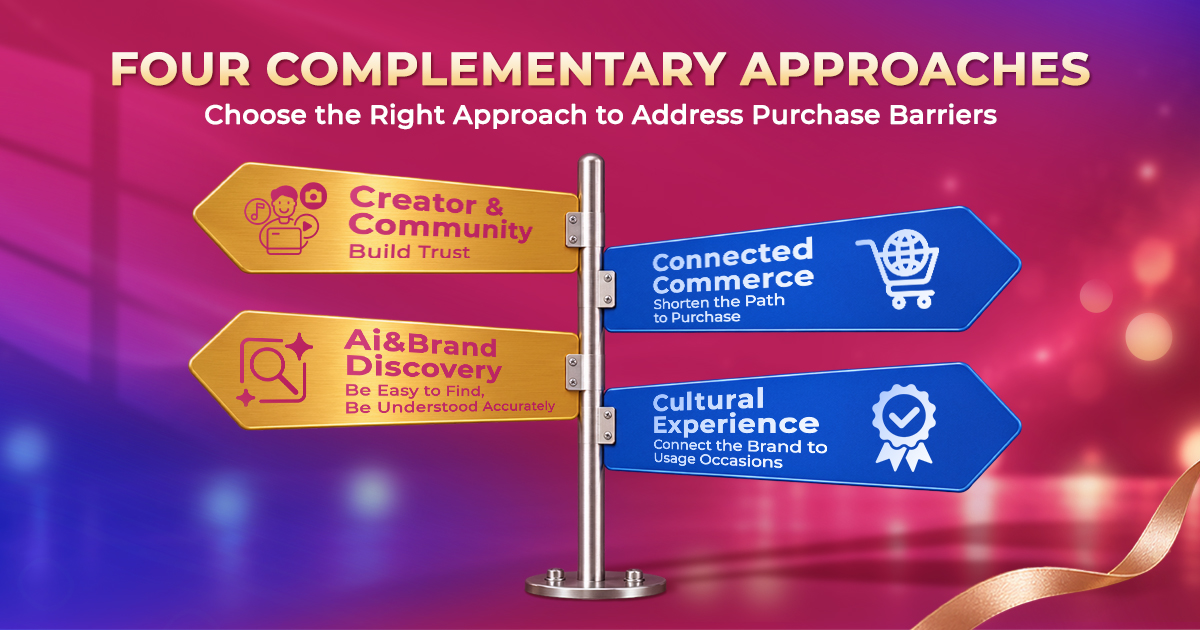
Four FMCG communication approaches help brands choose solutions for specific purchase barriers.
Source: Novaon Digital
Creator & Community: Building Trust Through Credible Product Experiences
When shoppers understand a product’s promise but remain unconvinced, creators and communities can demonstrate how it works in everyday life. An authentic usage situation, an easy-to-follow demonstration, or an answer to a relevant concern can help consumers assess whether the product suits them.
From this perspective, creator selection should reflect relevance to the shopper, the usage occasion, and the ability to explain product benefits. Discussion quality, understanding of product functionality, and trial behavior should be considered alongside reach.
Connected Commerce: Maintaining Momentum from Interest to Action
Engaging content can bring shoppers to a product page, but the journey can break down when a link leads to the wrong product, pack options are difficult to navigate, pricing information is inconsistent, or stock is unavailable.
Connected Commerce focuses on linking content with the practical conditions required to buy. Videos, storefronts, offers, inventory, and retail locations need to work together so consumers can find the right option and complete their purchases conveniently. In FMCG, this connection also extends to the next purchase, when customers need to reorder a familiar product.
AI & Brand Discovery: Preparing Information So Brands Can Be Found and Understood Accurately
For 2027 planning, the report recommends monitoring brand visibility when consumers search by need, such as a quick lunch or a product suited to a particular personal care situation. This requires clear, consistent product information across touchpoints, including names, ingredients, benefits, pack sizes, and usage instructions.
Brands should assess both whether they appear in relevant queries and whether the information returned is accurate. Discoverability is valuable when shoppers understand the product correctly and can continue exploring or make a purchase.
Cultural Experience: Bringing Brands into Meaningful Moments
Culture provides a context that makes brand value more relatable. A break during a busy Tết schedule, a conversation between generations, or a playful moment with a cookie can all become starting points for an experience.
What matters is the brand’s meaningful role within that moment. When products and distinctive brand assets are integrated into participation, the experience has greater potential to build brand associations and create usage occasions. Cultural trends should therefore be selected according to their fit with the brand’s identity and growth objectives.
5. Five Case Studies: Different Ways to Bring Brand Value to Life
How can a familiar promise be given a fresh perspective? What makes consumers want to participate in a brand’s story? And when technology, community, or culture becomes the creative material, what keeps the experience connected to product value?
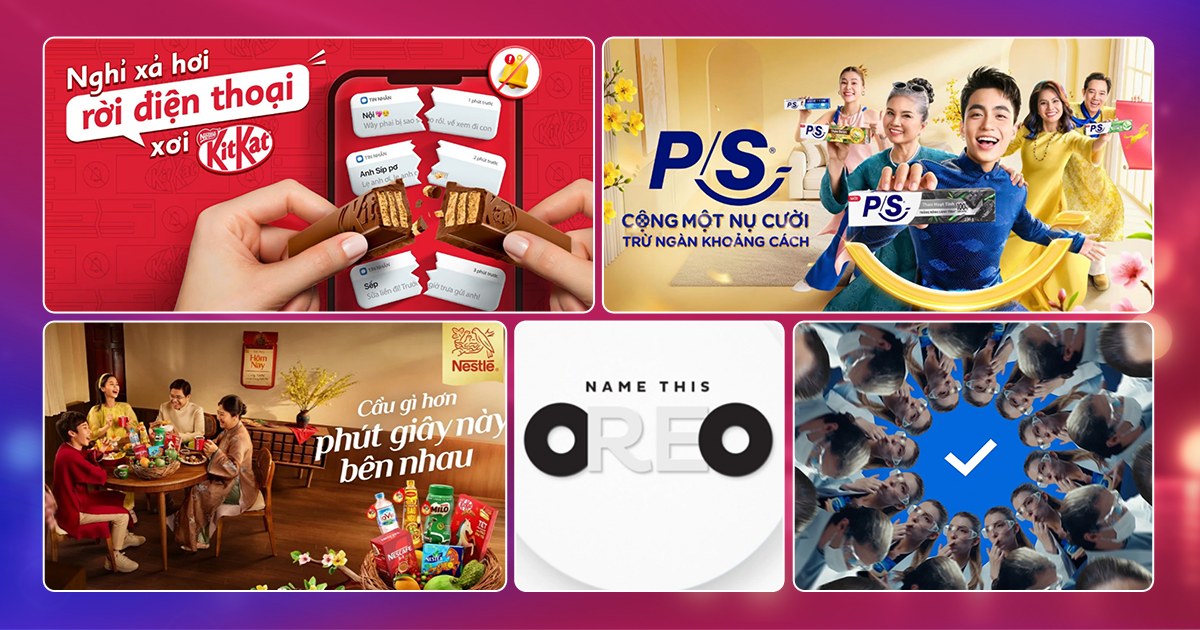
Different approaches to bringing brand value closer to consumers
Sources: BSI Awards, Ogilvy, VML, Brands Vietnam
The Vietnamese and international case studies featured in “FMCG BrandCom Outlook 2027” offer different ways to answer these questions. Through varied situations and approaches, the report explores how brands can uncover opportunities in shoppers’ everyday lives, turn value into experiences, and connect touchpoints through a consistent central idea.
Behind every campaign are decisions about insight, the product’s role, and how to encourage consumers to act. The report’s analysis helps readers explore the logic behind these decisions and find relevant ideas for their own brand challenges.
6. Closing Thoughts
“FMCG BrandCom Outlook 2027” proposes a needs-based starting point for planning: In which situations does the brand want to be chosen? What still makes shoppers hesitate? What evidence do they need to make a decision? Clear answers provide a more concrete basis for selecting creators, content, technology, and sales channels.
Through Value-led Brandformance, value is expressed from the communication promise through to product usage and opportunities to repurchase. This provides a foundation for building long-term brand associations while evaluating business performance across purchase cycles.
Explore Novaon Digital’s complete “FMCG BrandCom Outlook 2027” for market perspectives, shopper insights, an execution framework, and case studies to inform your brand communication planning for 2027.