In the digital era, the car-buying journey no longer begins at the showroom, and purchasing decisions are no longer driven solely by technical specifications or promotional offers. As consumers actively search for information, compare options, and form brand perceptions through a series of online touchpoints, automotive manufacturers face the challenge of transforming attention into trust, trust into test-drive experiences, and ultimately, into purchase decisions. This is where Brandformance emerges as a strategic approach, connecting the power of brand building with conversion effectiveness throughout the entire customer journey.
The New Automotive Buyer: When the Car-buying Journey No Longer Begins at the Showroom
When the car – buying journey no longer begins at the showroom
The market is growing, and car-buying behavior is being reshaped. Vietnam’s automotive market is entering a new phase of development, where increasing demand for vehicle ownership is accompanied by significant changes in how consumers access information, evaluate products, and make purchasing decisions.
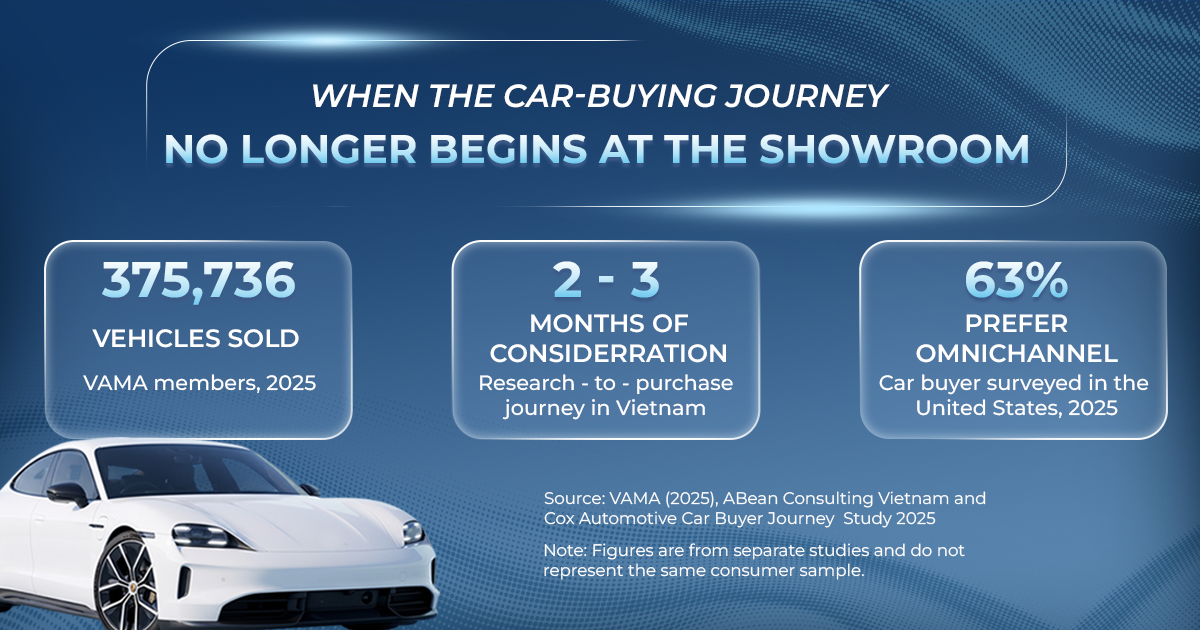
According to the Vietnam Automobile Manufacturers’ Association (VAMA), total vehicle sales among its member companies reached 375,736 units in 2025, an increase of 10.5% compared to 2024. Notably, sales in December 2025 reached 47,067 units, up 49% year-on-year, reflecting strong purchasing demand toward the end of the year. These figures represent VAMA members only and do not reflect the entire Vietnamese automotive market. (According to vietnamnews.vn)
However, changes in the market extend beyond the number of vehicles sold. More importantly, the process of forming car-buying decisions is taking place across an increasingly diverse ecosystem of touchpoints, ranging from search engines, social media, review videos, and user communities to brand websites and dealership networks.
Research by ABeam Consulting Vietnam on car-buying behavior in Vietnam indicates that the journey from initial research to purchase decision typically takes approximately 2–3 months, excluding an additional 2–4 weeks of waiting for vehicle delivery. During the research stage, Google is the primary online channel, while safety, fuel consumption, and driving experience are the three key factors influencing vehicle selection. (According to ABeam Consulting Vietnam)
These findings demonstrate that showrooms continue to play an important role in the car-buying journey but are no longer the only place where customer perceptions are shaped or demand is initiated. Before physically interacting with a product, buyers may have already developed a shortlist of brands under consideration, formed certain expectations, and even developed a preference for a particular vehicle model through digital experiences.
This trend is also reflected in developed markets. In the 2025 Car Buyer Journey Study, published in January 2026, Cox Automotive reported that 75% of car buyers in the United States used third-party websites during the shopping process; 63% considered a combination of online and in-person activities to be the ideal experience, while only 7% completed the entire car-buying process online. (Cox Automotive Inc)
From Product Competition to Experience Competition
From a communications perspective, changing car-buying behavior presents Automotive brands with three major challenges.
First, the pressure to differentiate in a market saturated with product-focused messages. When multiple brands emphasize design, technology, performance, comfort, and safety, technical specifications, although important, struggle to create a distinctive competitive advantage unless they are connected to specific customer needs and usage contexts.
Second, the fragmentation between brand-building activities and conversion-driven initiatives. A campaign may generate millions of impressions, positive engagement, and high brand awareness, but these results do not necessarily translate into customers with genuine purchase intent. Conversely, advertising activities focused on collecting customer information may generate a large volume of registrations of inconsistent quality, placing pressure on sales advisors and dealership networks.
Third, the gap between communications experiences and actual purchasing experiences. Consumers may be attracted by a brand video, explore products through a website, and register for a test drive, only to encounter inconsistent information or slow response processes at the dealership. Each point of disruption risks weakening the trust that the brand has invested in building.
In particular, for high-value products with long consideration cycles, such as automobiles, conversion cannot simply be understood as the act of leaving contact information. A test-drive registration is valuable when the customer has genuine interest, receives appropriate consultation, and has the opportunity to experience the product under favorable conditions.
Therefore, the core challenge is not simply to increase the number of people who know about the brand, but to design a consistent journey in which brand emotions are continuously reinforced and every interaction has the potential to bring customers closer to the decision to purchase.
2. Beyond Product Communication: When Features Need to Be Translated into Experiential Value
When features need to be translated into experiential value
In a market where driver-assistance technologies, safety systems, smart connectivity, and vehicle performance are increasingly becoming common competitive standards, possessing outstanding features does not necessarily translate into differentiation in consumer perception.
The challenge for brands is not only to accurately communicate what a vehicle can do, but also to help customers envision the value that the vehicle can bring to their lives.
An advanced driver-assistance system can be introduced through a range of technical specifications, but for buyers, the more memorable value may be the peace of mind they feel when traveling with their families. Energy efficiency is not simply about fuel or electricity consumption, but also about greater control over operating costs. A spacious interior is not measured solely by dimensions, but also by the comfort it provides during long journeys.
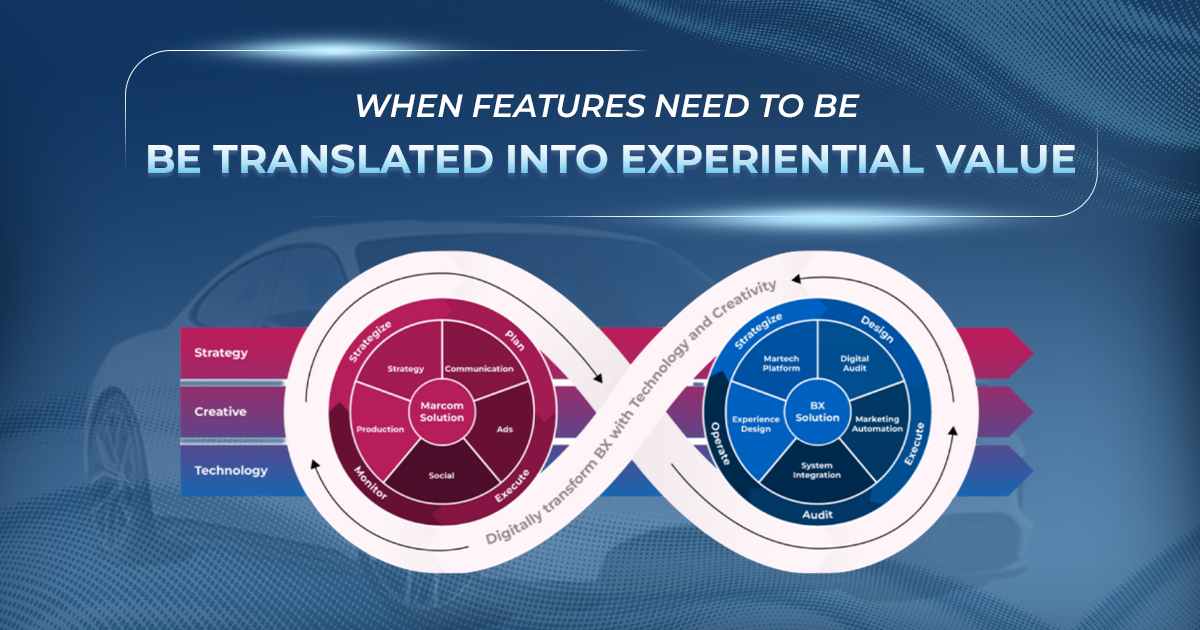
This represents a shift from Product-centric Communication (communication centered on the product) to Experience-led Brandformance (Brandformance driven by experience): using the product’s practical values as creative material while connecting the emotions generated to specific customer actions.
To realize this approach, Automotive brands need to coordinate three core capabilities: Strategy – Creative – Technology, where strategy identifies the motivations behind customer choices, creative transforms product benefits into compelling experiences, and technology connects the journey from media interactions to conversion.
01. Human-centric Value Proposition: Human-centered Value Positioning
Human – centric value proposition
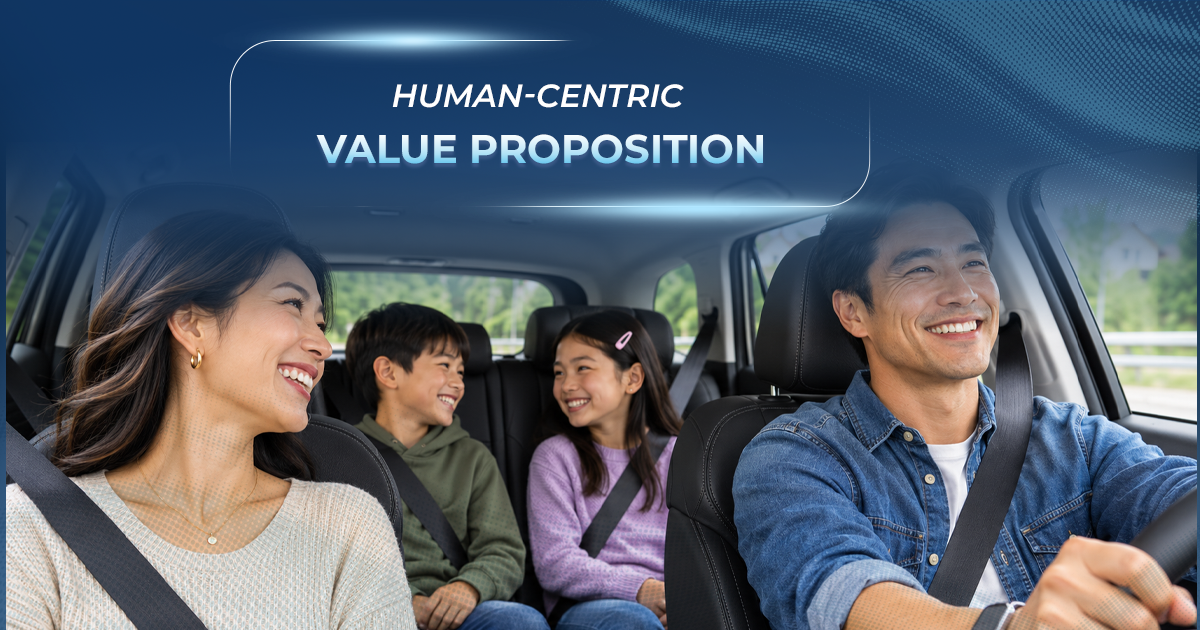
Manifestation: Brands shift their focus from technical advantages to the practical and emotional values that their products create for different customer segments.
For young urban consumers, a car may represent lifestyle, independence, and freedom of mobility. For young families, the vehicle becomes a space for connection, where safety and comfort take priority. For business customers, durability, operating costs, and the ability to optimize time may play decisive roles.
These differences in needs require brands not only to segment customers by demographics, but also to identify the deeper motivations driving ownership decisions.
Implementation approach: First, brands need to develop a segmentation system based on usage needs, purchase motivations, and barriers to choice, using consumer research, search data, social listening, and insights from sales teams.
On this basis, each customer segment is connected to an appropriate set of values and messages. For example, the same safety feature can be communicated through the peace of mind it offers parents or the confidence it provides first-time drivers. These values are then translated into specific content and experiences at each stage of consideration.
Importantly, personalization should not fragment brand identity. Even when messages appear in different contexts, they should consistently reflect a unified brand promise.
02. Experience-led Storytelling: Brand Storytelling Through Experiences
Brand storytelling through experiences
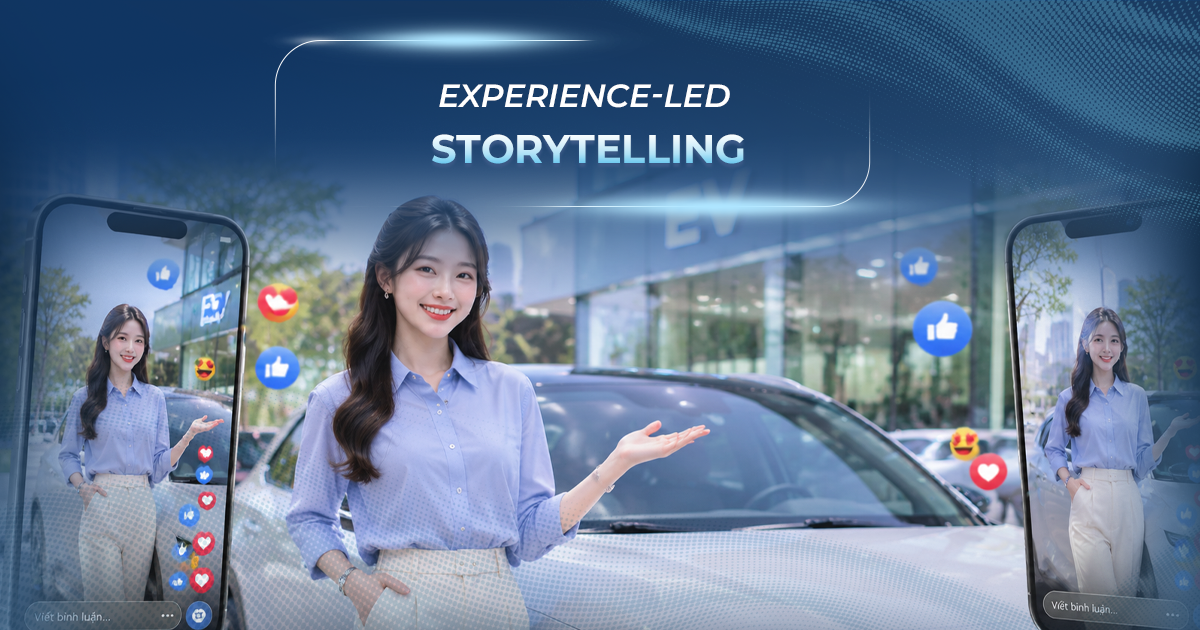
Manifestation: Instead of placing the product at the center of every message, brands develop stories in which the vehicle serves as an enabler of experiences, addresses needs, or accompanies customers through memorable milestones.
A campaign may explore a young person’s journey toward independence, the moment a family embarks on its first trip, or the autonomy of a business owner in managing their work. In these stories, product features do not disappear but are naturally demonstrated through real-life usage situations.
This approach allows customers to perceive value before processing specifications, thereby establishing a clear association between the brand and their personal needs.
Implementation approach: Brands can develop a central Creative Platform as the overarching content framework throughout the campaign, then extend it into formats suited to each touchpoint.
Brand Film and Hero Video serve to convey emotional messages, build awareness, and strengthen brand preference. Short-form videos, authentic reviews, and experiences shared by KOL/KOCs and vehicle owners further demonstrate product benefits. Interactive content, explanatory videos, and livestream activities can address concerns related to performance, features, costs, and ownership policies.
Notably, Storytelling should not end with views or engagement. Content that generates interest needs to be connected to appropriate conversion points, such as exploring vehicle variants, requesting consultation, or booking a test drive, helping sustain emotional engagement through the consideration and action stages.
03. Intent based Content Ecosystem: Building a Content Ecosystem Based on Purchase Intent
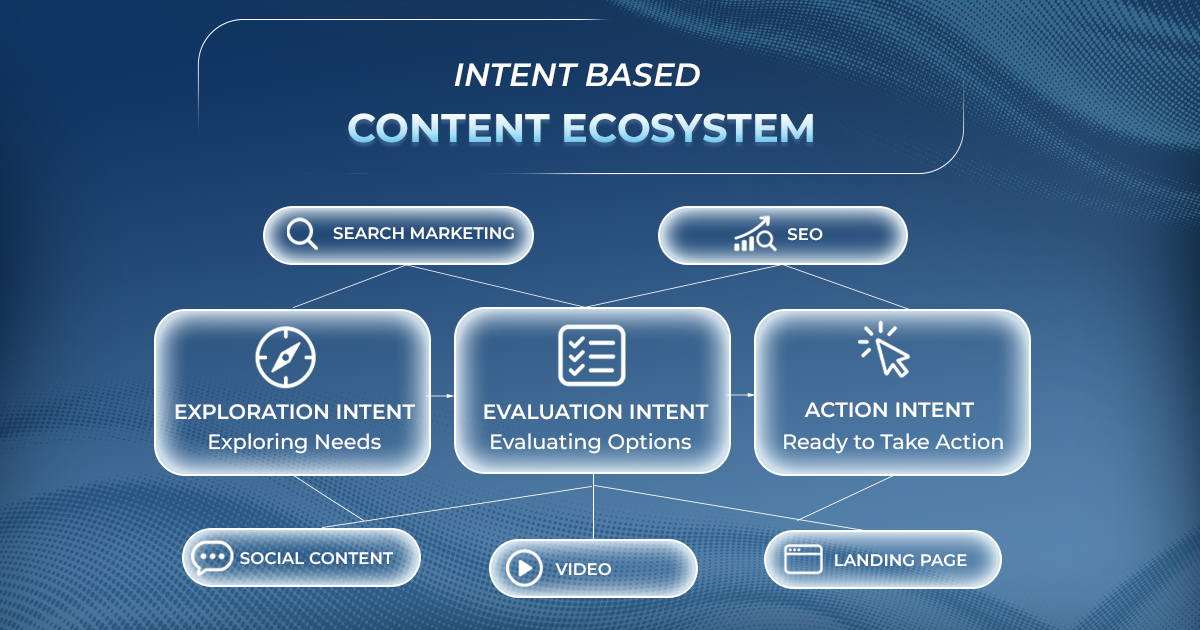
Building a Content Ecosystem Based on Purchase Intent
Manifestation: Content is developed based on customers’ needs and purchase readiness rather than being allocated solely by communication channel.
Someone searching for “SUV suitable for families” has different information needs from someone searching for “cost of using a hybrid vehicle over five years” or “book a car test drive near me.” Although all may be potential customers, they are at different stages and require corresponding messages.
Implementation approach: Brands can design a content ecosystem around three primary intent groups: Exploration Intent, Evaluation Intent, and Action Intent.
At the exploration stage, content should focus on usage contexts, lifestyle inspiration, and the brand’s differentiated value. As customers begin comparing options, content needs to delve deeper into feature benefits, cost of ownership, vehicle variants, and experiences from real users. For customers demonstrating high purchase intent, information about pricing, promotions, vehicle availability, financing, and test-drive schedules should be provided clearly and accessibly.
In parallel, brands can combine Search Marketing, SEO, Social Content, Video, and Landing Page to increase visibility at moments when customers are actively seeking information.
An effective content ecosystem does not simply produce more content, but delivers the right information at the right stage of the decision-making process.
04. Immersive Product Experience: Personalizing the Product Exploration Experience
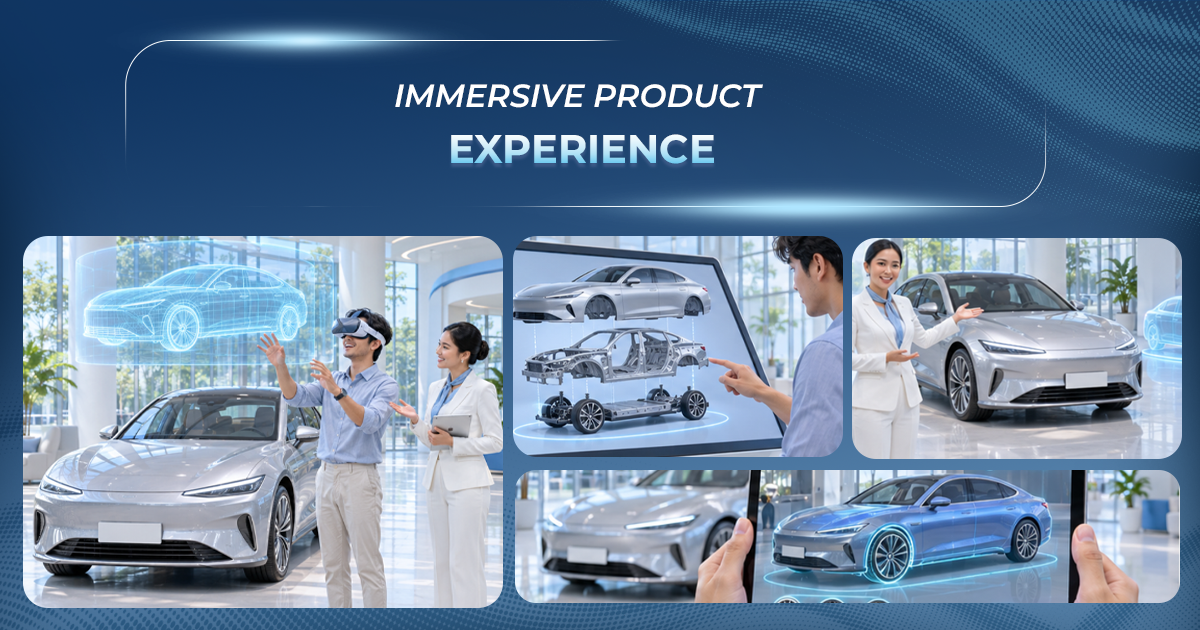
Personalizing the Product Exploration Experience
Manifestation: Product experiences extend beyond the showroom through digital tools, allowing consumers to proactively explore and interact with vehicles before taking a physical test drive.
Experiences such as online vehicle configuration, 360-degree interior views, feature simulations, and exploration of personalization options can help bridge the gap between information and actual experience.
In particular, for vehicles incorporating new technologies, visual tools can make benefits that are difficult to imagine more tangible and accessible.
Implementation approach: Brands can apply 3D, AR/VR technologies, or Interactive Landing Page solutions to develop product exploration experiences that align with campaign budgets and objectives.
Customers can select vehicle variants, colors, and configurations, explore interior spaces, or learn about individual features through simulated scenarios. After completing the experience, the system can recommend next steps, such as saving a configuration, requesting a quotation, or booking a test drive for the specific variant they are interested in.
Interaction data from these tools, when collected with appropriate consent, can help brands identify customer interests to personalize subsequent consultations and content.
However, digital experiences need to be designed with clear objectives. Technology delivers value when it helps customers understand the product and move closer to a purchasing decision, rather than merely creating visual effects.
05. Data-driven Lead Nurturing: Nurturing Potential Customers Through Data
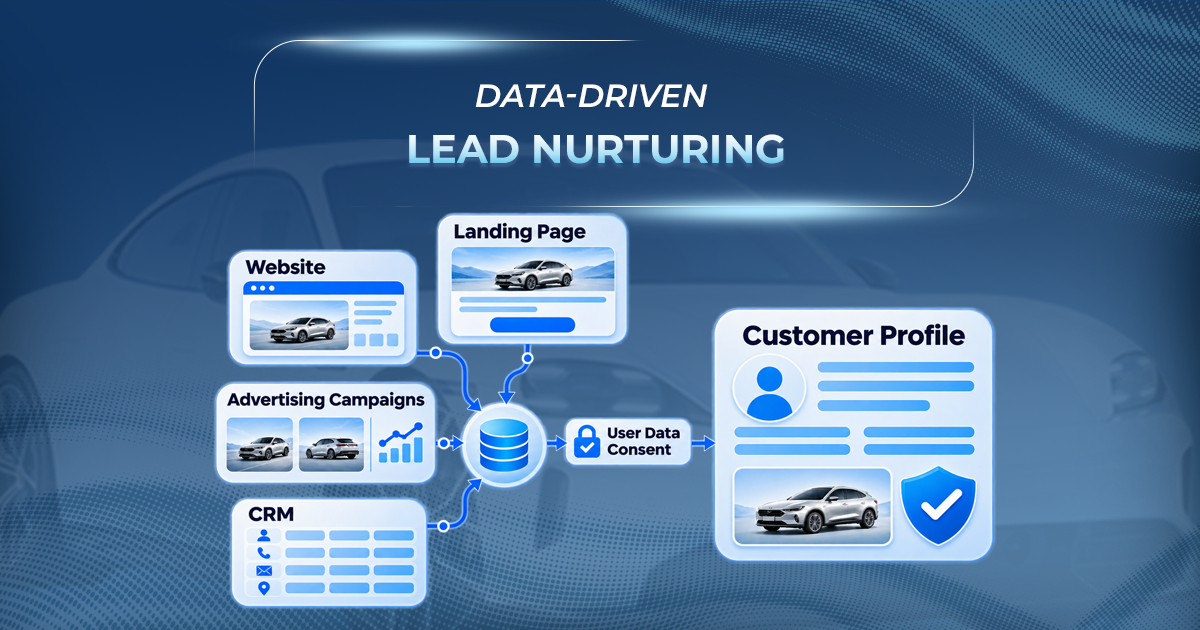
Nurturing Potential Customers Through Data
Manifestation: Instead of treating all registrations as equivalent sales opportunities, brands use data to understand interest levels, identify needs, and develop appropriate engagement journeys for individual customers.
Someone who has just watched a vehicle introduction video may not yet be ready to speak with a sales advisor. Conversely, a customer who has repeatedly visited pricing pages, searched for dealerships, and reviewed financing information may be approaching a purchase decision.
These differences require conversion strategies to segment and nurture demand rather than merely optimizing the volume of contact information collected.
Implementation approach: Brands can connect data from websites, landing pages, advertising campaigns, and CRM systems to build customer profiles based on data they are authorized to use.
From there, Lead Scoring models help prioritize customers based on relevant signals, while Marketing Automation supports the implementation of behavior-based engagement sequences, such as sending comparison materials when customers show interest in multiple variants or suggesting test-drive appointments after they have conducted in-depth research.
Retargeting activities should also be designed progressively, transitioning from inspirational content to addressing concerns and encouraging action.
To assess actual lead quality, brands should combine criteria from marketing and sales departments, tracking not only the number of leads but also successful contact rates, valid appointments, actual test-drive attendance, and sales opportunities.
06. Online-to-Offline Conversion: Connecting Online Conversions with Dealership Experiences
Manifestation: The customer journey is designed to flow continuously from digital environments to showrooms, reducing disruptions that commonly occur when data and handover responsibilities between brands and dealerships are not synchronized.
If digital activities help generate interest, the showroom experience provides an opportunity for brands to translate communicated values into direct customer perceptions.
Research by ABeam Consulting Vietnam indicates that most surveyed car buyers typically visit a dealership of each brand approximately 2–3 times, while the majority take only one test drive of their chosen model. This highlights the need to optimize the quality of each appointment, particularly the test-drive experience.
Implementation approach: Brands need to develop a simple online test-drive booking process that allows customers to select their preferred dealership, vehicle model, and time slot. Registration data should be forwarded to the appropriate person in charge, accompanied by mechanisms for appointment confirmation and reminders before the experience.
At the showroom, sales advisors need to understand customers’ needs, preferred variants, and previously provided information, avoiding the need for customers to repeat their entire research process.
After the test drive, the CRM system continues to record customer feedback, remaining concerns, and sales opportunity status to support subsequent follow-up activities.
In terms of measurement, effectiveness should be monitored at a minimum of three levels: Test Drive Booking (test-drive registration), Test Drive Attendance (actual test-drive participation), and Sales Conversion (conversion into a transaction). This provides a basis for distinguishing the effectiveness of demand generation from that of sales operations.
Novaon Digital Expert Perspective: From Individual Campaign Effectiveness to Full-Journey Value – Six Touchpoints Shaping the Brand Experience
In the increasingly competitive Automotive industry, campaign effectiveness can no longer be evaluated solely through individual results such as impressions, engagement, or cost per lead. With a decision-making journey involving multiple touchpoints across both digital environments and dealership networks, what matters more is the ability to connect these activities into a unified experience.
From the strategic perspective proposed for Novaon Digital, Brandformance should be approached as a customer journey management system rather than simply a method of combining brand advertising and conversion advertising.
Within this system, each touchpoint serves a different role: building awareness, evoking emotions, establishing trust, encouraging consideration, activating experiences, and developing post-purchase relationships. These touchpoints are connected through a consistent brand message and an appropriate data system, helping businesses gain a clearer understanding of the customer journey and the contribution of each communication activity.
From Impressions to Test Drives, the measure of success is not only how many people a brand has reached, but also how many customers have genuinely been inspired, persuaded, and become willing to experience the value the brand delivers.
In an Automotive landscape increasingly shaped by experience, the brand with the competitive advantage is not necessarily the one with the greatest visibility, but the one capable of connecting emotions, data, and actions into a consistent journey, from the first touchpoint to the purchase decision and the experiences that follow.