From entering the workforce, starting a family and buying a home to having children, investing and preparing for retirement, every milestone in life brings a different set of financial needs. Banking and Finance communications can therefore no longer stop at introducing products; they must provide customers with timely, relevant support throughout their financial journey.
For many years, banks have primarily approached customers through Product Marketing, promoting cards, loans, savings plans, insurance, interest rates, incentives and app features. However, as financial behaviour becomes increasingly intertwined with each stage of life, the limitations of this approach are becoming more apparent. Customers are no longer interested only in what a bank is selling; they want to know whether that product can address their financial needs at the present moment.
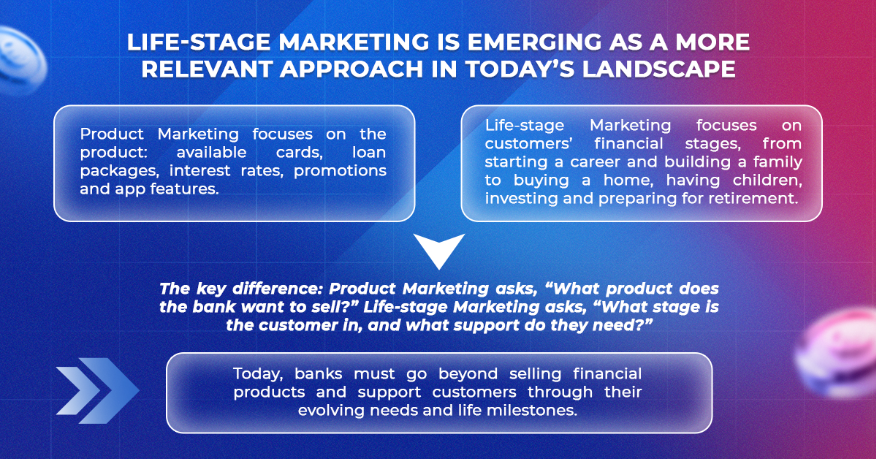
Defining Product Marketing and Life-stage Marketing: A More Suitable Direction in the New Context
Source: Novaon Digital
Product marketing traditionally takes an offering-centric view, promoting specific bank tools—from credit cards and loan options to app perks and interest rates. The primary flaw in this model is its inward focus on what the institution is trying to push. Life-stage marketing, on the other hand, pivots to the customer’s personal journey. By tailoring messaging to critical milestones—such as entering the workforce, building a family, purchasing real estate, investing, or preparing for retirement—banks address what the user actually needs at any given moment. Ultimately, adopting a life-stage approach isn’t just a tweak in marketing language; it reflects a broader industry shift where banks must evolve from simple product sellers into holistic financial guides for life’s big moments.
- The Current Landscape: Banks No Longer Simply Sell Financial Products
Recent studies show that financial consumers increasingly expect banks to understand their individual needs, provide seamless experiences and offer support that reflects their specific circumstances. According to the Accenture Banking Consumer Study 2025, 46% of customers feel pressured because they sometimes have to accept products that serve the bank’s interests rather than their own needs. This finding indicates that trust, personalisation, customer service and competitive value are the key factors influencing customer advocacy, rather than isolated product incentives alone.
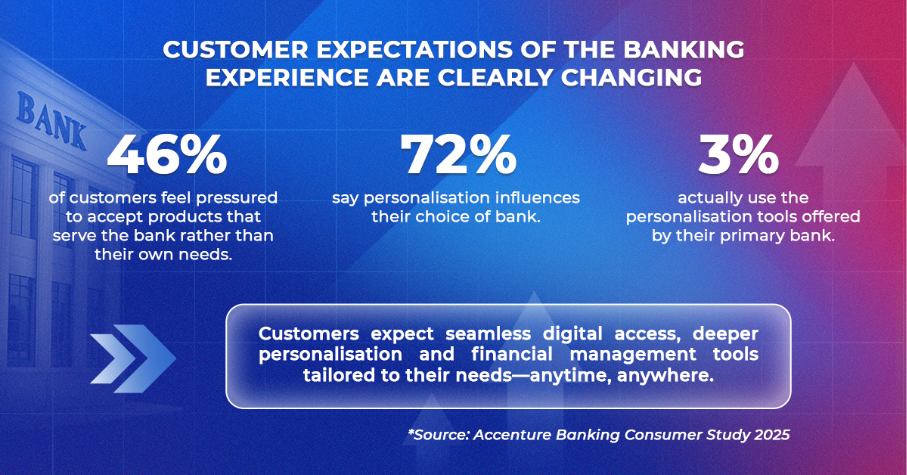
Consumer behavior survey in the Banking & Finance sector shows distinct shifts
Source: Novaon Digital
According to the Accenture Banking Consumer Study 2025, 72% of customers say that personalisation influences their choice of bank, yet only 3% actively use the personalised tools offered by their primary bank. This gap reveals a significant shift in expectations surrounding the banking experience: customers need seamless digital access, deeper personalisation and financial management tools tailored to their individual needs, whenever and wherever they need them.
- In your view, which life milestones tend to generate the clearest financial needs among customers?
In my view, financial needs do not emerge randomly. They are usually triggered when customers enter stages involving changes in their roles, responsibilities or life goals. Milestones such as entering the workforce, getting married, buying a home, having children or preparing for retirement require customers to make new financial decisions and seek appropriate solutions.
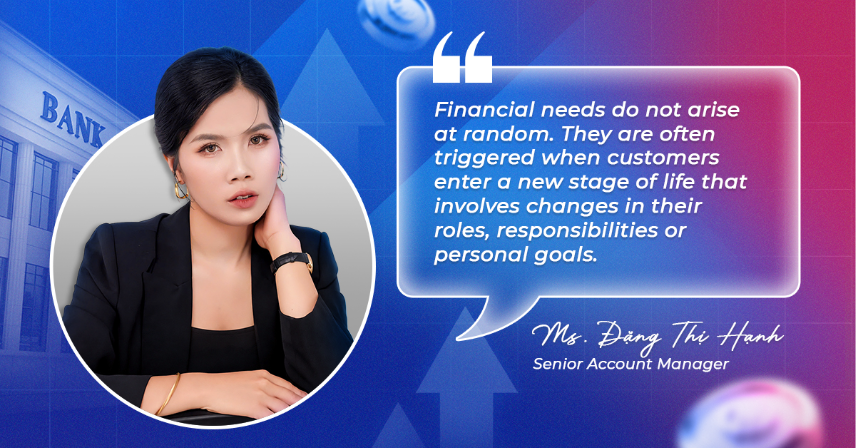
The origins of financial needs according to Ms. Hanh’s perspective
Source: Novaon Digital
More importantly, however, people of the same age do not necessarily have the same needs. Two customers may both be 35 years old but find themselves at entirely different stages of life: one may have recently started a family and need a mortgage, while the other may already own assets and be more interested in investment or wealth management. Rather than segmenting customers primarily by age or product, banks therefore need to understand the particular “moment” each customer is experiencing and their current financial objective.
- From the perspective of a Senior Account Manager, do Banking and Finance clients currently place greater emphasis on product sales or on building long-term customer journeys?
This strategic pivot naturally changes how marketing is executed on the ground. Instead of isolated campaigns built around single product pushes, banks are reorganizing their operations around life-stage orchestration. Success no longer hinges on a single conversion metric; it is defined by a brand’s ability to remain relevant as a customer’s financial priorities evolve over time.
To operationalize this approach, institutions are focusing on three core imperatives:
- Contextual Data Integration: Unifying transactional and behavioral data to anticipate life events (such as getting married, buying a home, or starting a business) before the explicit need for a product arises.
- Value-First Engagement: Shifting messaging from product features to tailored financial guidance, ensuring that digital touchpoints feel advisory rather than purely transactional.
- Iterative Journey Design: Continuously refining post-conversion onboarding and activation loops to prevent drop-off and foster organic cross-selling.
Ultimately, product marketing and life-stage marketing are not mutually exclusive—they are complementary layers of a modern growth system. Product features provide the immediate solution, but life-stage relevance builds the long-term enterprise value. The banks that thrive in this new landscape will be those that master the art of turning transactional interactions into enduring financial partnerships.
- When Product Messages Become Indistinguishable and Lack Emotional Connection
One of the greatest challenges in Banking and Finance communications is the high degree of similarity among financial products offered by different banks. Messages built around attractive interest rates, cashback, fee waivers, fast card approval or easy access to loans appear everywhere, making it difficult for brands to establish clear differentiation in customers’ minds.
Digitalisation has made banking services less personal and increasingly transactional. According to the Accenture Banking Consumer Study 2025:
- 73% of customers use financial services from institutions other than their primary bank.
- 58% of customers purchased a financial service or product from a new provider within the previous 12 months.
- 33% of customers use digital banks.
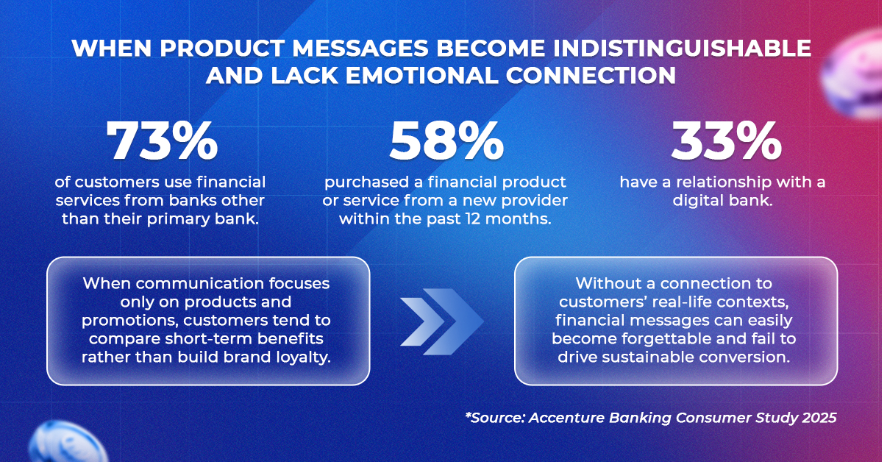
Assessing how digitization has made banking services less personal and more transactional
Source: Novaon Digital
When communication focuses exclusively on products and incentives, customers are more likely to compare banks based on short-term benefits rather than develop a lasting connection with a brand. This is particularly evident for high-consideration products such as mortgages, investments, insurance and wealth management, where customers need more than information: they need trust, guidance and the confidence that their circumstances are genuinely understood.
Without being placed within the customer’s specific life context, financial communication can easily become forgettable and struggle to generate sustainable conversion.
- The Shift from Product Marketing to Life-Stage Marketing: Becoming a True Financial Partner
By reframing communication around life milestones, banks elevate themselves from transaction processors to indispensable finBy reframing communication around life milestones, banks elevate themselves from transaction processors to indispensable financial companions. Life-Stage Marketing fundamentally shifts the core strategic question from “Which product can we push today?” to “Which life chapter is the customer entering, and how can we enable their success?”
This philosophy transforms standard financial offerings into meaningful narrative touchpoints:
- Mortgages become curated pathways to first-home ownership.
- Credit Cards evolve into adaptive tools for navigating career starts, family expansion, or global travel.
- Wealth & Protection Products serve as clear stepping stones toward milestones like funding a child’s education or securing a comfortable retirement.
Executing this empathy-driven approach bridges the gap between functional utility and emotional resonance. Operationally, it relies on an integrated ecosystem—orchestrating granular customer analytics, dynamic content, CRM automation, and performance channels—to ensure every touchpoint reinforces a long-term advisory bond rather than a one-off sale
- How should banks communicate with customers at different stages, such as entering the workforce, starting a family, buying a home, having children, investing or retiring?
The core priority for financial institutions is turning the theory of Life-Stage Marketing into a concrete operational framework. This requires an immediate reversal of the initial question: rather than starting with “What product are we trying to sell?”, banks must ask “What life stage is the customer navigating, and what financial obstacle are they trying to overcome?”
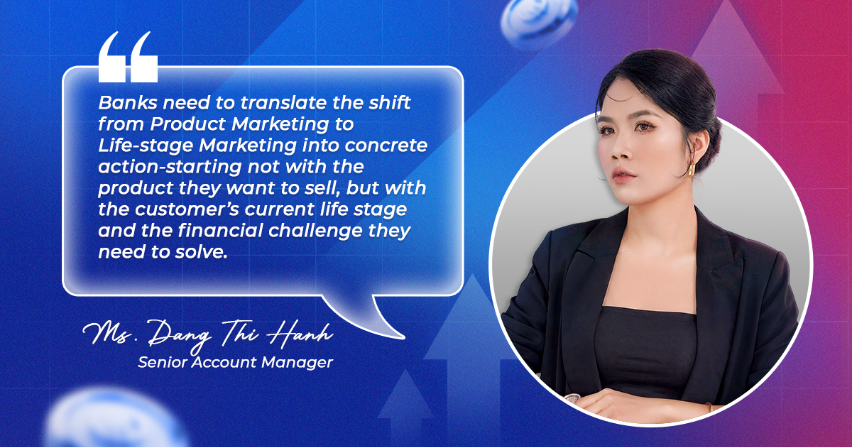
Mindset shift toward Life-stage Marketing in the Banking & Finance sector
Source: Novaon Digital
When communicating with young professionals, for instance, the focus shifts from pushing credit cards and salary accounts to helping them master income management and build healthy credit habits. For new families, the dialogue moves beyond individual savings products toward co-building a resilient household financial foundation. In the homebuying phase, banks can expand their role past standard mortgage rates to actively guide customers through property affordability checks, documentation, and tailored repayment strategies. Similarly, products for parents are linked directly to long-term goals like education funds and family protection, while solutions for wealth accumulators and retirees center on strategic asset allocation and retirement readiness.
Ultimately, while the underlying financial instruments remain the same, anchoring them to personal milestones transforms cold product features into relatable, empathetic guidance—enabling banks to step up as trusted financial partners for life.
- How should an effective Life-Stage Marketing campaign combine branding and performance marketing?
To execute an effective Life-Stage Marketing campaign, financial institutions must abandon the traditional divide between branding and performance marketing, designing them instead as a continuous, unified ecosystem. In this framework, branding establishes trust and emotional resonance, while performance channels convert that credibility into measurable user action.
During a first-time homebuyer’s journey, for instance, branding sets the foundation by storytelling around readiness, stability, and peace of mind rather than simply competing on mortgage rates. Once that connection is established, performance marketing guides the user down the funnel—capturing interest through targeted consultation requests, streamlining loan applications, and driving post-conversion onboarding. This conversion phase relies heavily on behavioral data, dynamic personalization, CRM integration, and cross-channel retargeting.
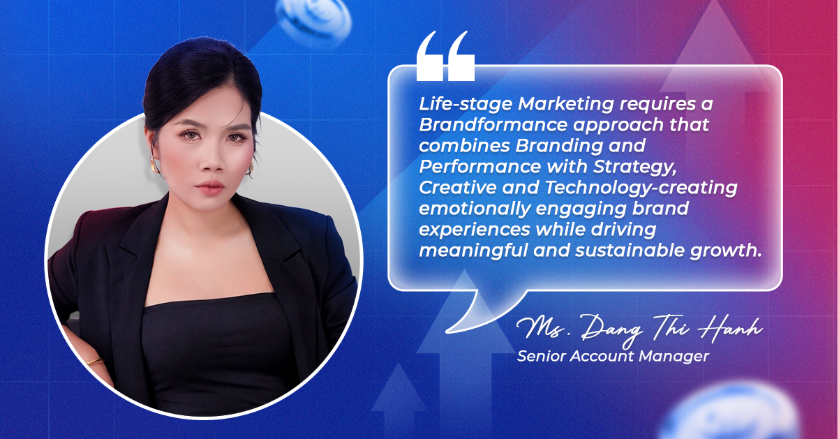
How to integrate Life-stage Marketing with Novaon Digital’s SCT model
Source: Novaon Digital
Pure branding risks building positive sentiment without driving conversion, while isolated performance marketing yields short-term leads at the expense of long-term loyalty. By combining both under a “Brandformance” framework—integrating Strategy, Creative, and Technology (as seen in Novaon Digital’s SCT model)—banks can deliver emotionally engaging milestone experiences that consistently drive sustainable business growth.
4. Future Opportunities and Challenges for Banking and Finance Communications: Building Long-Term Customer Partnerships
In the future, a bank’s competitive advantage will no longer depend solely on its products or promotional incentives, but on its ability to understand customers at different stages of life. As customer data becomes richer and is combined with AI, banking apps, super apps, CRM and automation, banks will have more tools with which to personalise financial journeys, engage customers at the right moment and deliver content that addresses specific needs.
This presents an opportunity for banking communications to move away from short-term campaigns and towards a long-term content ecosystem in which the brand continuously supports customers from awareness, consideration and conversion to repeat usage and loyalty. However, the challenges will also become greater: data remains fragmented, messaging is often inconsistent across channels, and full-funnel effectiveness is difficult to measure without an integrated strategy.
- How will the role of an agency evolve as banks increasingly require longer-term communication strategies?
As banks pivot toward sustained customer journeys, agencies can no longer function as mere campaign executors; they must evolve into long-term strategic growth partners. Implementing Life-Stage Marketing demands a deep comprehension of holistic customer lifecycles, behavioral analytics, and overarching business targets to construct end-to-end communication ecosystems rather than relying on short-term, fragmented campaign spikes.
From Novaon Digital’s perspective, an agency’s core value lies in unifying consumer insights, brand strategy, content, media, CRM, and performance marketing—powered by data and AI to deliver hyper-personalization at scale. By mapping precise financial needs to specific life stages, agencies empower banks to guide users seamlessly from initial inquiry and registration to active usage and long-term retention.
- Looking ahead, what is the most important thing banking brands must do to remain customers’ preferred choice and build long-term loyalty?
The ultimate imperative for financial institutions is to meet customers precisely where they are in their lives with contextually relevant value. Modern consumers do not want a bank that endlessly pushes financial products; they seek a partner that supports them as they receive their first salary, start a family, purchase a home, raise children, invest, or plan for retirement.
To win lasting loyalty, banks must master three foundational capabilities: accurately anticipating customer needs, delivering timely communication, and ensuring a seamless post-conversion experience.
Ultimately, the shift from Product Marketing to Life-Stage Marketing represents more than a strategic communication update—it is a fundamental evolution in how banks integrate into their customers’ lives. By showing up at the right moments with genuine value, financial institutions transform routine conversions into enduring brand trust.
Cre: Novaon Digital