I. The Current Landscape and the AI Marketing Paradox in the FMCG Customer Journey
According to reports by MMA and Decision Lab, 89% of Vietnamese enterprises have integrated AI into their marketing strategies. Within the FMCG sector, AI is demonstrating clear value at the operational level: automating creative production, optimizing media buying, and personalizing messaging for specific micro segments. A prime example is Nestlé’s use of Google AI to deliver 50,000 personalized Lunar New Year greetings, which resulted in a 23% increase in brand favorability.
However, a paradox is emerging: most businesses are stalled at the “more, faster, cheaper” stage, overlooking the emotional layer where FMCG purchasing decisions are truly formed. While hundreds of content variations are distributed continuously, the lack of a unified experience architecture often leads to increased reach at the expense of emotional resonance.
Forward thinking brands are pivoting: shifting from “AI for productivity” to “AI for empathy.” As Dr. Soumik Parida from RMIT Vietnam observes, the true power of AI lies not in creative automation, but in its ability to elevate storytelling and deepen customer engagement.
AI is only effective when guided by a Brand Experience (BX) mindset. AI acts as an amplifier; it scales what the brand already possesses. If the BX foundation is weak, AI merely scales fragmentation.
To understand how this philosophy is applied in practice, we spoke with Mr. Nguyen Huu Tai, Account Director at Novaon Digital. A strategic communications expert with over 13 years of experience in the FMCG industry, Mr. Tai has collaborated with major brands including Vinamilk, Kido Group, Nutifood, Want Want, and Kewpie.
Question 1: From your perspective working directly with FMCG brands, how is the application of AI in creative production transforming the customer brand experience?
Answer:
AI is actively driving business growth for pioneering FMCG brands, particularly at the operational level. In the dairy and beverage sectors, AI analyzes regional and temporal purchasing behavior to adjust messaging based on context: emphasizing energy in the morning and family care in the evening. We are seeing higher CTRs, improved conversion rates, and reduced media costs. This is a significant leap forward.
However, after years of working directly with FMCG labels, I have identified a critical limitation. FMCG is an industry driven by rapid decision making and consumer emotion; shoppers do not deliberate for long. They choose based on habit and accumulated brand memory. Therefore, brand strength does not reside in a single piece of content, but in an emotional structure repeated consistently enough to build familiarity.
The Impact of AI on Brand Experience from a Content Production Perspective
Source: Novaon Digital
The underlying issue is that most brands utilize AI to optimize individual touchpoints rather than designing a unified experience architecture. Hundreds of content variations are generated continuously, each optimized according to its own isolated metrics. Consequently, while brand visibility becomes more frequent, recall rates do not increase proportionally. Engagement may rise, yet emotional depth fails to follow.
AI empowers brands to achieve broader coverage, but coverage is not synonymous with building memory. When a purchasing decision occurs in a matter of seconds, the advantage always belongs to the brand that has previously secured “top of mind” status, not necessarily the brand that appeared most frequently in the past week.
Question 2: In your opinion, how should AI be leveraged to help FMCG brands understand and connect more deeply with their customers?
Answer:
I believe we must re evaluate the role of AI within the FMCG sector. If AI remains limited to producing content faster and in greater volume, it will fail to create deeper connections. The true revolution begins only when AI evolves from a content production tool into an experience architect.
Firstly, AI can “breathe life” into digital media assets if it is integrated into creative thinking from the very beginning. A TVC or short form video should no longer be a static, fixed version; it can be adjusted based on consumption context, geography, timing, or prior behavior. When content accurately reflects the viewer’s real life circumstances, it becomes more vivid and relatable, moving beyond a mere advertisement optimized for metrics.
Secondly, hyper personalization should not be interpreted as the mechanical creation of thousands of different versions. The key is to build a scalable creative system where every variation adheres to the same aesthetic standards and brand positioning. While AI can process data and deliver the right message to the right segment, the visual structure, tone of voice, and core emotional resonance must be designed with consistency from the outset. Personalization must sharpen the brand identity, not dilute it.
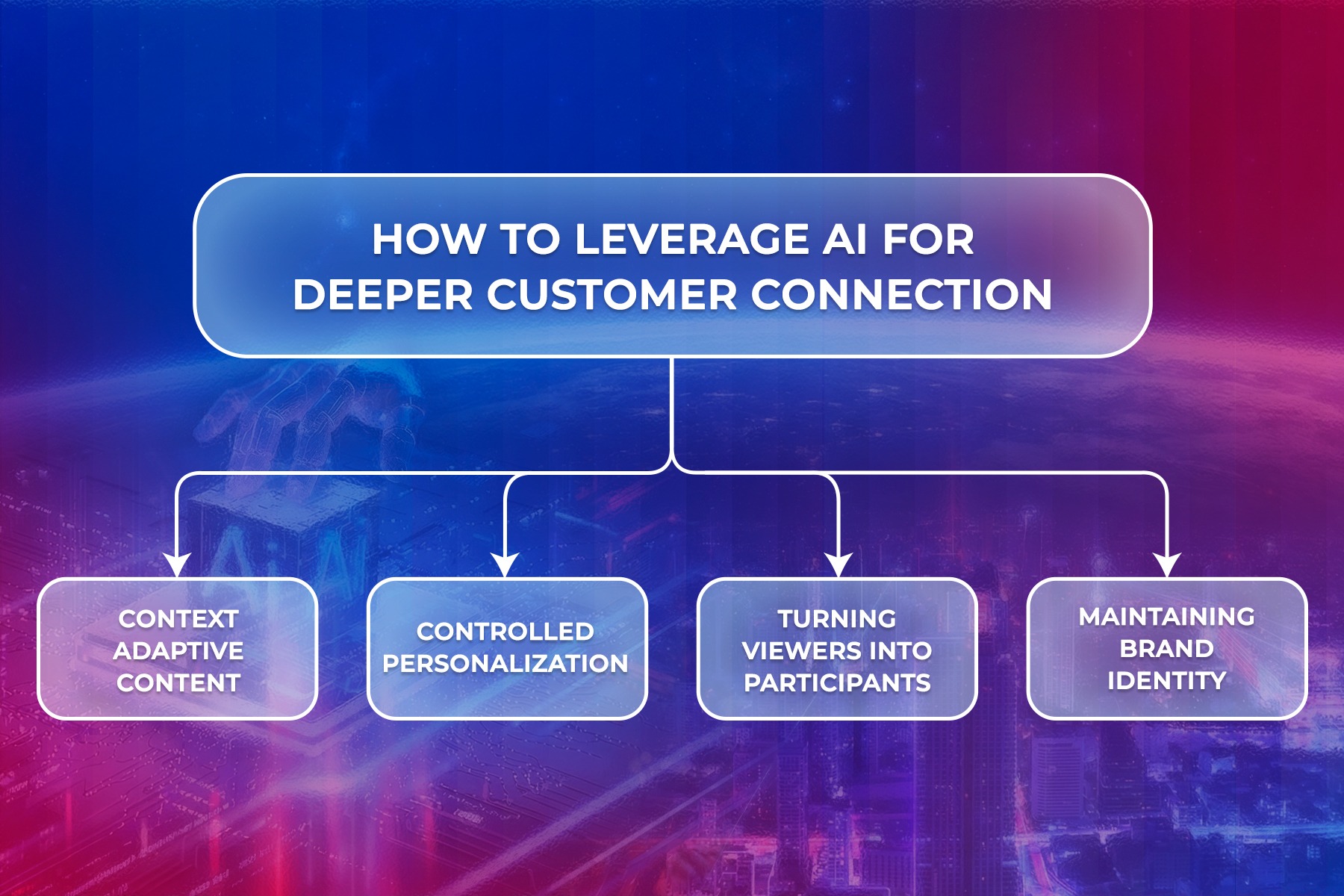
Four Strategic AI Applications for Deeper Consumer Connection: Insights from Mr. Nguyen Huu Tai
Source: Novaon Digital
Thirdly, AI enables the transformation of passive content into interactive experiences. Packaging can now trigger personalized mini games; a social campaign can respond dynamically based on user choices; and AR applications can project products directly into a consumer’s physical space. When consumers participate rather than merely observe, they do more than memorize a message—they form a personal experience with the brand.
Finally, to prevent these efforts from becoming a fragmented content matrix, brands require a robust identity protection mechanism. AI can afford to be flexible at the level of expression, but it must remain steadfast at the level of positioning. Every variation must anchor back to the same value system and core emotional driver. Without this layer of control, personalization risks dismantling the very brand equity we aim to build.
When AI is assigned its proper role, it does more than help a brand understand the consumer—it ensures the brand appears at the right moment, within the right context, and with the right emotional resonance. In the FMCG sector, where purchasing decisions are instantaneous, this precision is what creates a genuine connection.
II. The FMCG Content Revolution: Transitioning from Production Tool to Experience Architect through Brand Assets
While the initial phase of AI adoption in FMCG focused on cost efficiency, the next wave is completely redefining the narrative. The most fundamental shift is the ability to transform brand assets from static to dynamic states. A single concept can now be adjusted for geography, timing, user behavior, and consumption cycles—generating thousands of variations within 48 to 72 hours, a process that previously took weeks.
Coca-Cola serves as a definitive case study. Their 2023 “Masterpiece” campaign utilized Stable Diffusion AI to breathe life into works by Van Gogh, Vermeer, and Turner, turning every TVC frame into a unique visual experience. Following this, the “Create Real Magic” platform empowered consumers to generate their own AI brand assets, garnering over 120,000 interactions in just 11 days. Media assets are no longer a one way broadcast; consumers are now active co creators.

Coca-Cola’s international AI-driven “Masterpiece” campaign generated significant engagement and resonance among global consumers.
Source: Novaon Digital
In Vietnam, this trend is manifesting through various formats: virtual brand ambassadors, GenAI video, interactive AR packaging, and context aware emotional chatbots. The common thread is that a brand asset is no longer a fixed product approved once; it is a content system capable of adapting to each individual user.
However, as scale increases to thousands of variations, the primary risk is not technical, it is brand dilution. The solution is not to limit AI, but to establish an immutable set of principles regarding core emotion, visual language, and tone of voice. This ensures AI remains flexible in delivery while staying loyal to the positioning. When this framework is correctly established, hyper personalization sharpens the brand’s image in the eyes of the consumer rather than blurring it.
Question 3: Given current AI technological advantages, could you share specifically how FMCG brands should transform media assets into personalized interactive experiences, particularly within today’s Social-first campaigns?
Answer:
In a Social-first environment, content cannot remain a one way broadcast. It must possess the ability to respond and adapt to each user. Otherwise, the brand is simply struggling to cut through an already saturated information stream.
AI facilitates the transition of media assets from a static to a dynamic state. Instead of a single fixed video for the entire market, brands can design an “open” content architecture. Here, messaging and imagery are adjusted based on real time data such as location, access time, or prior interaction behavior.
For instance, in the beverage industry, the same campaign could display differently during a sweltering afternoon in the South versus a cool evening in the North. The viewer no longer feels they are watching a mass market advertisement; they perceive content that is relevant to their immediate circumstances.
The Evolving Role of Content in the AI Era
Source: Novaon Digital
However, the differentiator is not merely changing images or text. The true power lies in real time transformation. When a user finishes a video, interacts with a post, or participates in a mini game, the system can instantly adjust the subsequent content they encounter. Consequently, the communication journey becomes a continuous feedback loop rather than a series of fragmented touchpoints.
In a Social-first context, where algorithms prioritize content that drives retention and deep interaction, AI optimizes not only distribution but the internal experience of the content itself. Content is no longer something to be viewed; it is something to be inhabited and responded to.
When designed correctly, every customer feels they are the protagonist of the brand story. In the FMCG sector, where product differentiation is increasingly narrowing, this sense of “exclusivity” is exactly what creates a sustainable competitive advantage.
Question 4: In practical implementation, how can FMCG brands maximize AI’s large scale media production capabilities while ensuring that each personalized asset remains consistent with a brand identity built over many years?
Answer:
Real Connection does not stem from personalizing as much as possible, but from personalizing within the right context while maintaining a consistent emotional journey. There are three core elements to achieving this.
First, shift from informational personalization to contextual personalization. Rather than just swapping text based on age or gender, AI must understand where the customer is in their day, their mood, and their consumption cycle. For the same product, a nutritional message for the morning is entirely different from a family dinner message.
Second, balance AI and human intelligence. If left entirely to algorithms, brand messaging becomes cold and disjointed. AI handles data processing and scalability, while humans safeguard the emotion, storytelling, and brand spirit.
Third, construct a seamless emotional journey. Many FMCG organizations optimize individual channels according to isolated KPIs, which creates localized performance but fractures the overall experience. AI must act as a cross platform data connection layer, ensuring consumers do not just see personalized content but experience a coherent brand narrative.
When these three elements are synchronized, AI ceases to be a mass production machine and becomes a platform that helps the brand appear in the right context, uphold its identity, and nurture emotions throughout the journey.
III. Real Connection in the AI Era: The Secret to Scaling Emotional Impact for FMCG Brands via Media Assets
When AI can produce content at an unlimited scale, the real question is no longer “how to create more” but “how to ensure each asset resonates with the right emotion, for the right person, at the right time.” This is a challenge that technology alone cannot solve.
The most critical shift is moving from demographic personalization to Contextual Intelligence, understanding not just who the consumer is, but where they are in their day, what they are feeling, and what they need. When AI correctly interprets that context and adjusts assets in real time, the brand no longer “interrupts” the consumer’s life but appears as a natural part of it.

Novaon Digital applies AI in a campaign to create a personalized photography experience with NOBO for employees.
Source: Novaon Digital
However, the power of data is only realized when guided by human intuition. AI processes behavioral signals and scales operations, but humans must define the narrative, maintain the core emotional driver, and ensure every asset carries the brand spirit. Optimizing for data precision at the cost of emotional warmth is a trap many brands currently fall into.
Ultimately, no real connection is formed without a consistent emotional journey. When each channel pursues its own KPIs, consumers see multiple pieces of content from the same brand, yet each touchpoint tells a different story, silently eroding the very brand memory being built. In its proper role, AI serves as the cross platform data bridge, turning disjointed touchpoints into a seamless journey.
Real Connection does not come from a single viral campaign; it comes from an emotional structure built sustainably, consistently, and continuously over time.
Question 5: A common concern is that AI will make communication content feel less authentic. In your view, what truly creates a “Real Connection” with customers, and what role does AI play in that journey?
Answer:
The issue does not lie with AI itself, but in the fact that many brands use AI as a shortcut to bypass the most crucial step: consumer empathy.
Real Connection does not come from a tool. It comes from the ability to perceive where consumers are in their lives, what they need, and what they are feeling. An authentic message is not defined by whether it was written by a human or an AI, but by whether it makes the viewer feel “this was made for me.”
I often use this analogy: AI is like a highly sophisticated speaker system that amplifies sound to millions of people with high precision. But if what you feed into the microphone is a hollow message devoid of real emotion, no matter how modern the speakers are, the listener will still sense the soul-lessness. AI amplifies what a brand already possesses, both its strengths and its weaknesses.
Before investing in any AI tool, a brand must answer a fundamental question: where does empathy sit within our strategy? If the answer is vague, AI will only distribute that vagueness at a larger scale.
IV. The Future of Communication Professionals and the Role of Agencies in an AI-First Era
The trend of FMCG corporations building in-house AI teams is becoming inevitable, helping brands master speed, optimize costs, and secure data. Yet a paradox remains: when AI tools are “democratized,” differentiation no longer lies in the technology but in strategic thinking. Internal teams, despite their deep product knowledge, can suffer from blind spots due to a narrow perspective. This is where Agencies redefine their role: no longer as production houses, but as experience architects helping brands maintain consistency across the entire customer journey.
The traditional “campaign based” model is giving way to Adaptive Marketing, where brands operate as continuous learning systems: capturing market signals, adjusting content in real time, and blurring the lines between campaign phases and daily operations.
To achieve this, the foundation must be built in the correct order. The most common mistake today is pouring budgets into AI tools before data infrastructure is ready. AI is only as smart as the data it is fed; if data is fragmented, AI simply optimizes errors at a faster rate. Simultaneously, staff training must go beyond teaching how to use a tool to fostering an AI-first mindset: content creators who understand data, and data analysts who understand brand emotion.
Ultimately, as AI becomes a shared asset, the core question is no longer about choosing between In-house or Agency, but rather: “What unique value are humans contributing that AI cannot yet replace?” This is the very challenge we wanted to hear Mr. Tai’s perspective on.
Question 6: When FMCG brands build their own in-house AI content capabilities, they essentially hold an automated production tool. In that context, what is the core value that keeps Marketing experts from being replaced?
Answer:
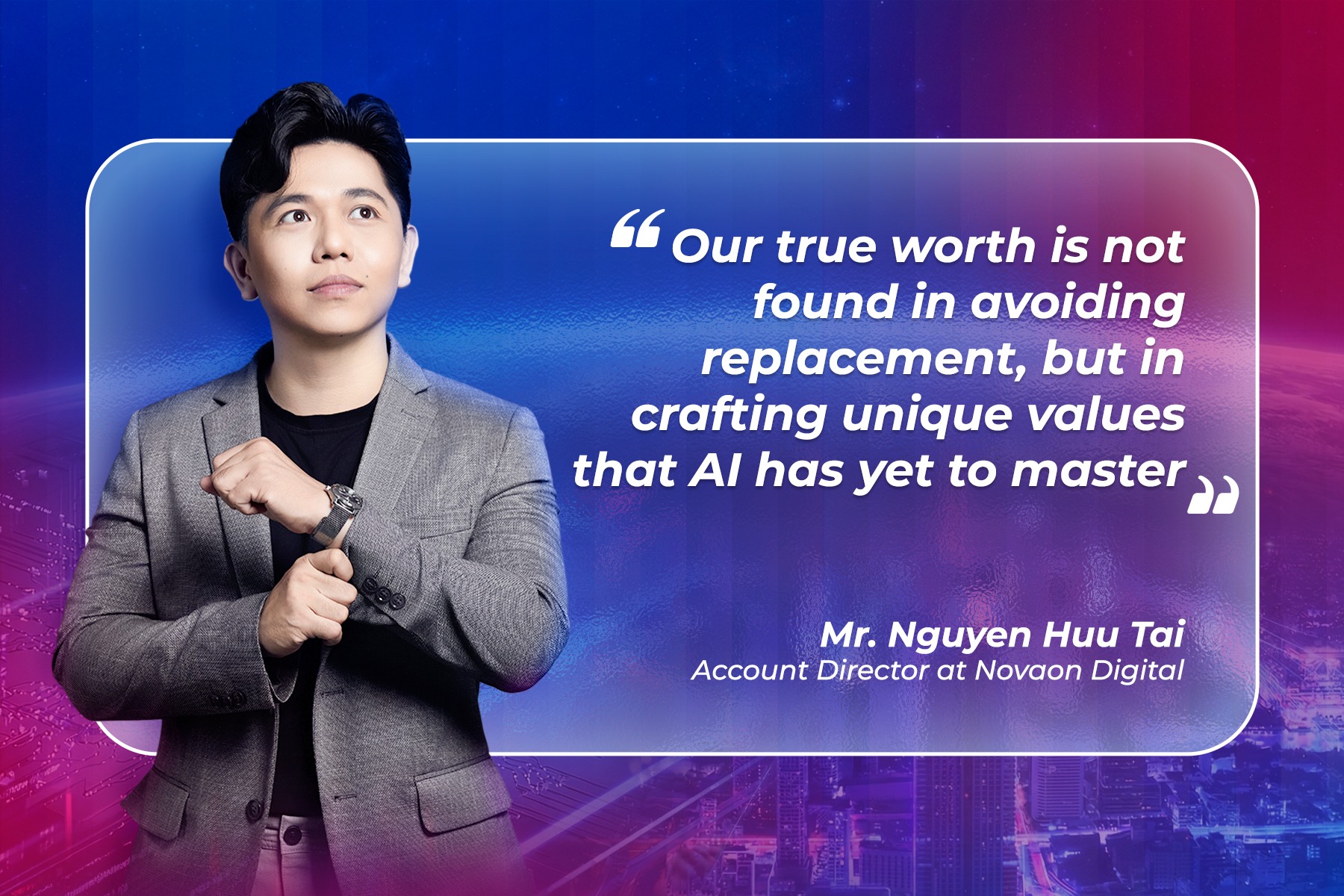
I think this question needs to be reframed slightly. It is not about “how to avoid being replaced” but “what value am I creating that AI cannot.”
After years of working directly with FMCG labels, I see a gap that requires a human touch regardless of how good the tools are.
First is the ability to interpret market context. Data tells you what consumers are doing, but it does not explain how they feel, what stories are unfolding in the market, or how buyer psychology is shifting. Those signals often come from hands-on experience rather than reports.
Core values that prevent Marketing experts from being replaced in the AI era.
Source: Novaon Digital
Second is maintaining brand consistency over time. AI can optimize exceptionally well for individual campaigns, but brands are built over years. Ensuring that every piece of content aligns with the long term positioning and emotional identity requires active human leadership.
Third, and perhaps most importantly, is the ability to recognize when not to follow AI. This is not because AI is technically wrong, but because there are moments when a message, despite being optimized for metrics, is inappropriate for the external reality. For example, a beverage campaign with the message “Chill out – Unlimited Party” might have high predicted metrics, but it would be tone-deaf if the community is currently focused on natural disaster relief or sensitive social events. That judgment call is not found in any algorithm; it remains a human strength.
Question 7: Given the unstoppable wave of AI development, could you share some advice for FMCG CMOs looking to invest in AI to enhance brand experience?
Answer:
I observe a common pattern in many FMCG organizations: AI budgets are rising rapidly, but results are not proportional. The cause usually isn’t the tool, but the investment priority.
My first advice: build the data foundation before buying the tool. AI is only as smart as the data it operates on. If your data is fragmented across channels, even the best tool will just optimize the wrong things faster.
Simultaneously, invest in people before technology. Don’t just train them on tools; build an AI-first mindset where creative teams understand data and data teams understand brand emotion. The boundary between creative and analytics is blurring, and the teams that cross that boundary will have a more sustainable advantage than any tool.
Finally, I think brands should start viewing marketing as a continuous learning system rather than a series of isolated campaigns. In the AI era, effective marketing is the ability to capture market signals, adjust content in real time, and accumulate insights through every cycle. That is Adaptive Marketing, and it is the direction for leading FMCG brands.
Thank you for these insights!