Financial behaviors are becoming increasingly digitalized, but customer journeys are not only taking place on screens. Consumers may encounter brands through OOH, interact with DOOH, participate in Activation experiences, and then continue their journey through Mobile Banking, Social platforms, or other digital channels. As financial products and services become increasingly similar, differentiation no longer comes only from product features, but also from how brands create seamless experiences throughout the customer journey. Brand Experience Marketing 2026 raises the challenge of connecting OOH, DOOH, Activation, and Digital into a unified journey, guiding customers from awareness to engagement and action.
I. INTRODUCTION
1. Brief Overview
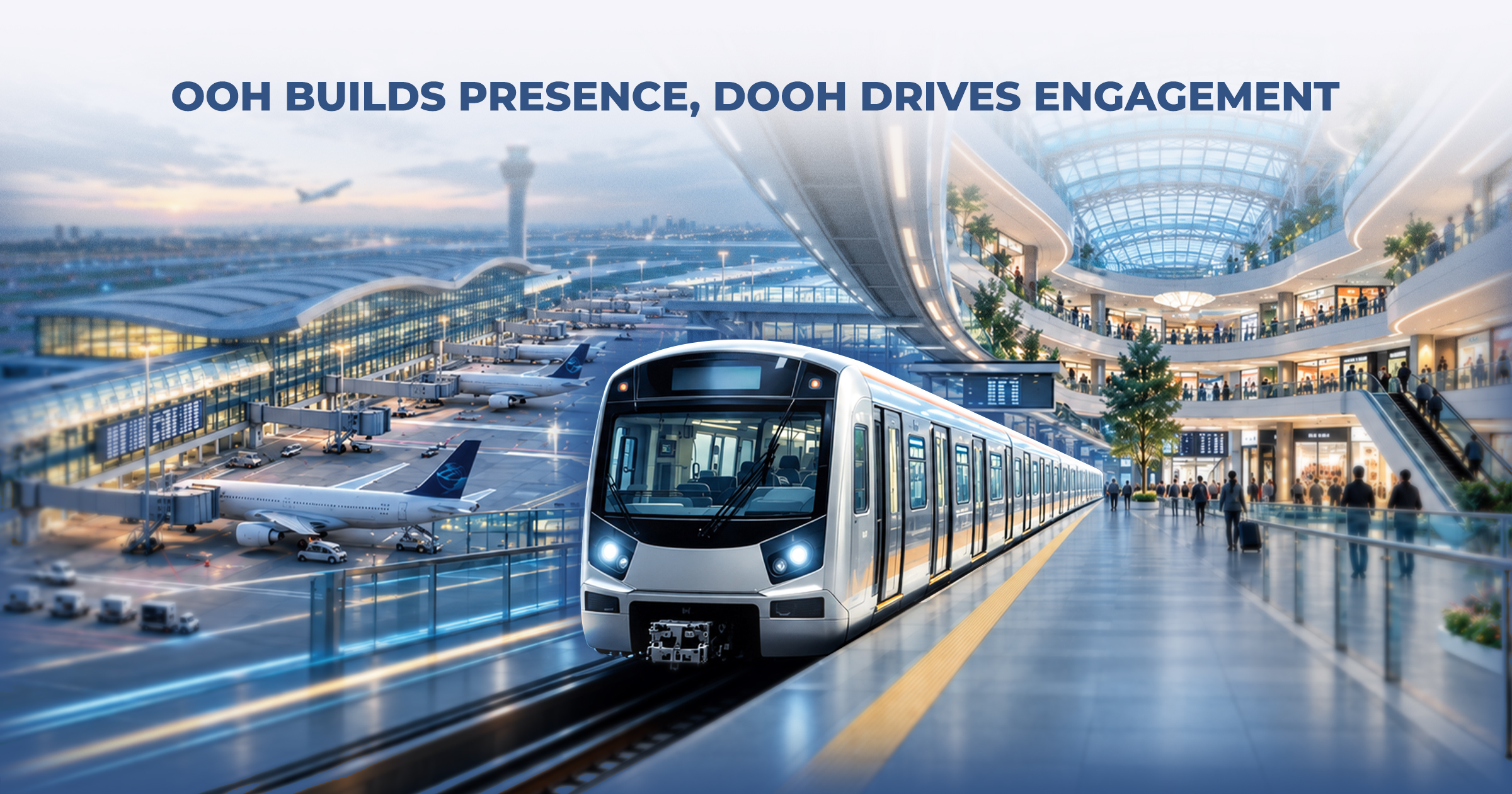
OOh builds presence, DOOH drives engagement
In an increasingly digitalized media ecosystem, OOH still maintains an advantage that Digital channels cannot completely replace: the ability to bring brands into real-world spaces and customers’ daily movement flows.
Metro systems, airports, shopping malls, office buildings, and high-traffic areas allow brands to reach customers in specific contexts, rather than simply waiting for them to actively open a Digital platform. In particular, the development of DOOH is significantly expanding this role. While traditional OOH primarily relies on static content and fixed scheduling, DOOH enables brands to use dynamic content, adjust messages based on time, location, or context, while also opening opportunities to connect with Mobile through QR codes and interactive formats. This shift is clearly reflected in industry investment levels. In 2025, OOH spending among the Consumer Banking sector in the US increased by 34%, indicating that Outdoor is becoming a notable component in financial brands’ customer reach strategies.
Research from OAAA and Harris Poll shows that 76% of people who have been exposed to DOOH advertising took an action afterward. Among Mobile users, 74% stated that they had taken an action on their phones after seeing DOOH, including actions such as searching for brand information, visiting websites, or accessing Social Media. These figures demonstrate an important shift in the way Outdoor is perceived: a physical touchpoint can completely trigger subsequent Digital behavior. A DOOH screen can spark customers’ curiosity and encourage them to search for a brand. A QR code on OOH can directly lead them to a Landing Page or App. Content placed in the right context can help customers recognize a need that they had not previously actively searched for.
For Bank Finance, this represents a significant advantage because many financial products have relatively long Customer Journeys. Customers may begin by seeing a message, then researching, comparing, considering, and finally registering.
2. Market Context and User Behavior
The digitalization process is fundamentally changing how users access financial services. Mobile Banking, QR Payment, eKYC, Digital Account, and cashless payment are no longer unfamiliar concepts. They are gradually becoming common actions in everyday life.
In Vietnam, during the first nine months of 2025, the number of non-cash payment transactions increased by 43.32% compared to the same period. Notably, QR transactions increased by 61.63% in volume and 150.67% in value. Transactions through mobile devices also increased by 37.37% in volume.
These changes show that Mobile is becoming one of the central elements in personal financial journeys. Customers can open accounts, transfer money, make payments, manage cards, save money, or access investment products without necessarily visiting a branch. Continuous investment by banks in Digital Banking is also narrowing the gap in terms of features. Online account opening, eKYC, money transfers, QR payments, card management, or savings through Apps are no longer highly differentiated experiences. Users can find similar options across multiple banks.
This creates a shift in competitive criteria. A fast and convenient application can help customers complete transactions. However, brand experience is shaped by many other factors: how the bank understands their needs, how the brand appears in their daily lives, how products are explained, how trust is built, and how interaction continues after transactions.
3. Consumer Behavior
Having become familiar with fast and seamless Digital experiences, customers no longer expect banks to provide only convenient services. They also expect brands to understand their individual needs. This is particularly evident in Bank Finance because the motivation for using the same product can vary significantly among different customer groups.
The Accenture Banking Consumer Study 2025 shows that 72% of customers stated that personalization influences their choice of bank, but only 3% actually use personalization tools provided by their primary bank. This gap highlights a notable challenge: customers have higher expectations for personalized experiences, while the ability to transform data into truly relevant experiences remains insufficient. Although financial journeys take place on Digital platforms, the nature of the industry remains unchanged: customers are giving brands access to their money, data, and decisions that directly impact their lives.
4. The Challenge: OOH Is No Longer Simply a Broad-Reach Media Channel
Accenture states that 73% of customers are using additional services from banks other than their primary bank, while 58% have purchased a financial product from a new provider within the past 12 months. These figures reflect the increasingly flexible nature of customer choices: they do not necessarily remain loyal to a single bank for all financial needs.
This creates a clear challenge for brands: how to create enough differentiation for customers to remember, trust, and continue choosing them? OOH can help brands reach customers in physical spaces. DOOH can make messages more flexible. Digital can help customers research and register. However, if each touchpoint only performs its own individual role, the overall journey can still become fragmented.
II. MARKETING COMBINING OOH, DOOH AND ACTIVATION
1. The Combination of OOH/DOOH and Activation
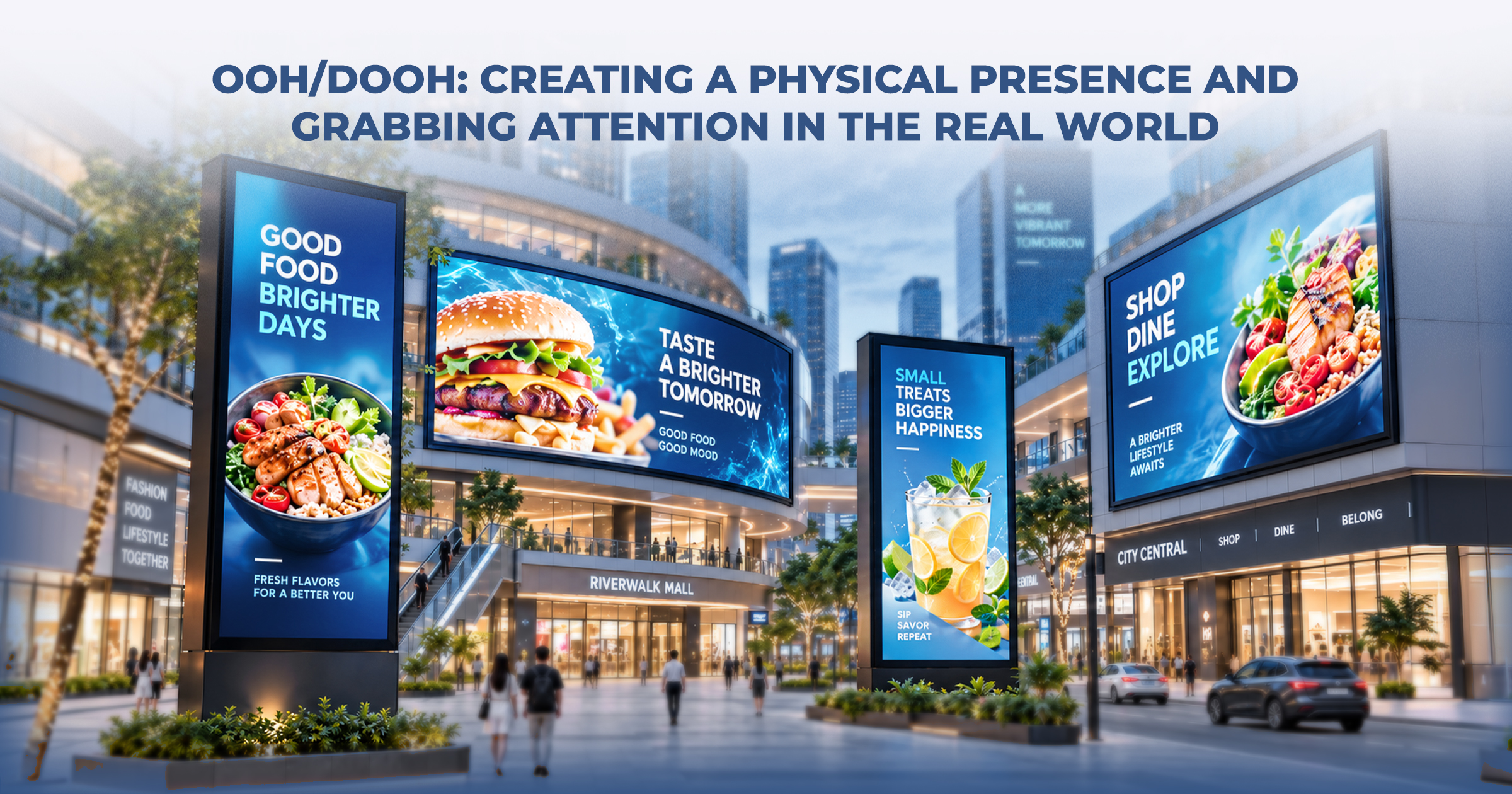
OOH/DOOH: Creating a physical presence and grabbing attention in the real world
OOH/DOOH: Creating Presence and Capturing Attention in Physical Spaces
OOH helps brands appear in specific contexts where customers live and move, such as Metro, Airport, Shopping Mall, Office Building, University, or event areas. This is an important advantage for Bank Finance, as brands can select spaces that are suitable for different customer groups and financial needs.
DOOH expands the capabilities of OOH through dynamic content, allowing messages to change based on time, location, data, or context. As a result, the same campaign can deliver different content depending on where customers are exposed to it.
More importantly, OOH/DOOH can create subsequent actions rather than simply stopping at being seen. According to research from OAAA and Harris Poll, 76% of people who have been exposed to DOOH stated that they took an action afterward; among Mobile users, 74% took an action on their phones. Common actions include searching for information, accessing Websites, and Social Media.
Activation: Adding Layers of Experience and Trust
Activation takes the attention generated by communication and transforms customers from observers into direct participants. This is particularly meaningful for Bank Finance. Products such as investment, wealth management, security, or financial solutions are often difficult to fully communicate through a single advertising message. Direct experiences allow brands to explain products, interact with customers, answer specific concerns, and create a sense of trust before customers make decisions. Therefore, Activation should not necessarily be understood as a large-scale event. It can be an interactive experience, a consultation area, a product trial activity, or an experience format designed to suit each customer group.
Digital: Continuing the Experience in the Personal Environment
After customers interact with OOH/DOOH or Activation, Digital becomes the natural continuation layer of the journey. Landing Pages, Apps, Social, or registration platforms help customers continue exploring and take specific actions such as registering for products, receiving offers, or completing eKYC. At the same time, Digital helps brands capture signals from customers. A QR Scan, a Website visit, or a Lead generated after Activation can all become data points to continue personalizing content and customer engagement.
Social: Extending the Experience Beyond Physical Spaces
If Activation creates experiences for people who directly participate, Social allows those experiences to continue reaching people who are not present at the location. UGC, Creator Content, Social Conversation, or content generated during Activation can become materials for brands to continue the story on Social. Therefore, a physical experience is no longer limited by the number of people present at the location, but can be amplified through online communities. As a result, OOH/DOOH, Activation, Digital, and Social are no longer activities implemented in parallel. Each touchpoint performs a different role but works toward a unified Customer Journey.
2. Key Trends in 2026 for the Bank Finance Industry
The combination of OOH, DOOH, and Activation is expanding in multiple directions, especially as Data, AI, and technology are increasingly integrated into experience design. For the Bank Finance industry, the following six trends demonstrate how brands can transform communication touchpoints into experiences with stronger interaction and greater continuity.
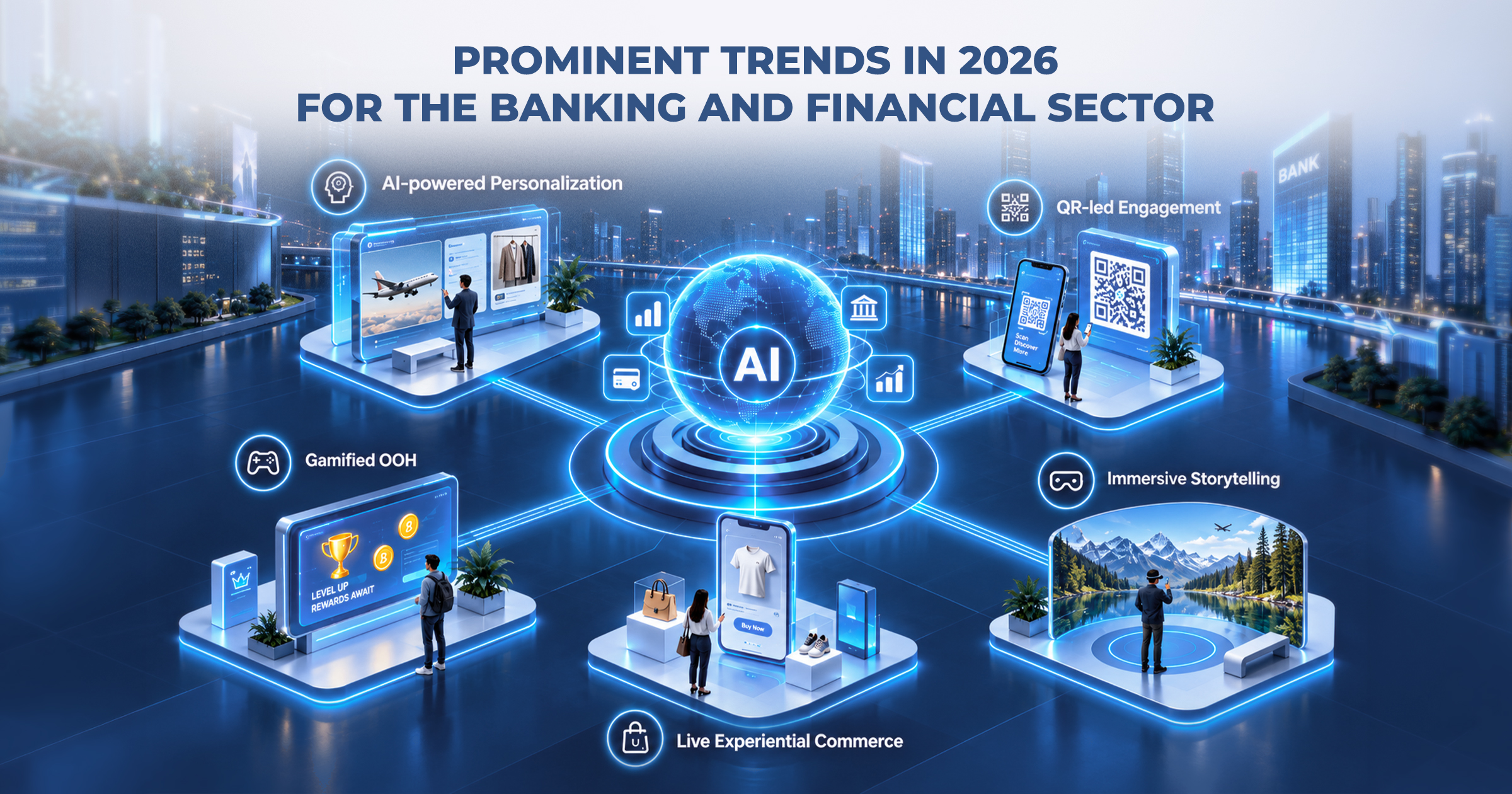
Prominent trends in 2026 for the Banking and Financial sector
2.1. AI-powered Personalization
AI and Data are helping brands shift from general messages to experiences that are more relevant to each customer group and each context.
In OOH/DOOH, content can be adjusted based on location, time, or Audience groups. A screen at an Airport can prioritize Travel Card messages, while an Office Building area can focus on Saving or Investment. This personalization can then continue on Digital platforms. Based on customer behaviors and needs, brands can provide more relevant Offers or product content instead of continuing to use a general message.
For Bank Finance, this approach can be applied to various product groups such as Travel Card, Saving, Investment, Digital Account, or Premium Banking. The key value of AI-powered Personalization does not lie in creating more advertising variations, but in delivering the right message to the right person in the right context.
2.2. QR-led Engagement
QR is becoming one of the simplest bridges between OOH/DOOH and smartphones. However, the value of QR should not stop at directing customers to a Website. After scanning, brands can open opportunities for a Quiz, Game, Personalized Offer, consultation tools, product registration, or direct experiences on the App.
This is particularly suitable for Bank Finance because QR scanning behavior has become familiar in digital payments in Vietnam. During the first nine months of 2025, QR transactions increased by 61.63% in volume and 150.67% in value compared to the same period. Therefore, QR on OOH/DOOH can become a transition point between mass experiences and personal experiences.
2.3. Gamified OOH
Gamification introduces game elements into OOH/DOOH to increase customers’ active participation.
For Bank Finance, this is a notable approach because content such as savings, investment, payments, or financial knowledge is often rational in nature and difficult to attract attention when communicated only through advertising messages.
Gamification can make these topics more accessible. A brand can build a Game around saving goals, a Quiz about spending habits, or a simulation experience showing how financial choices can influence future outcomes.
2.4. Social-first Activation
Activation is increasingly being designed with the goal of creating Social content from the beginning, rather than simply organizing an event and only considering communication afterward.
Formats such as Personalized Content, AI Photo, Video, Creator Experience, Challenge, or Social Wall can transform participants into part of the content. This creates an important shift in how Activation is evaluated. The scale of an experience is no longer measured only by the number of people directly present at the location. Participants can share the experience with their own communities. A Creator can bring content from Activation to thousands or millions of followers. Suitable UGC can continue generating discussions even after the event ends.
For Bank Finance, Social-first Activation therefore creates a connection between direct experiences and community-driven reach, helping brands maintain presence even after Activation has ended.
2.5. Live Experiential Commerce
Activation is moving closer to business actions rather than stopping only at Engagement.
For Bank Finance, customers can experience the brand, receive consultation, and continue completing registration steps directly at the Activation point. Actions such as eKYC, account opening, card registration, information submission, or receiving offers can be directly integrated into the experience. Instead of allowing customers to recall the experience after leaving the event and then continue searching for products on Digital, brands can bring the next step directly into the experience.
2.6. Immersive Storytelling
Immersive Storytelling uses 3D DOOH, AR, Interactive Installation, or Immersive Space to help brands communicate financial stories in a more visual way.
This approach is suitable for intangible values in Bank Finance such as security, asset growth, future planning, or financial benefits. Instead of only talking about a Benefit, brands can create experiences that allow customers to directly explore that Benefit.
For example, an Interactive experience can simulate how assets grow over time. An AR Experience can help customers explore card benefits. A 3D DOOH can transform messages about security or technology into more visual and memorable content.
Section Summary
Overall, the six trends above demonstrate a shift in how Bank Finance brands build experiences. OOH and DOOH are increasingly capable of moving beyond awareness creation and becoming the starting point of interaction. Activation adds a layer of direct experience, helping customers understand products and build trust. Digital continues the journey in a personal environment, where customers can explore, register, and use products. Social helps experiences taking place in physical spaces continue to be shared and amplified.
The common point among these trends does not lie in how many technologies brands use or how many channels they add. More importantly, each touchpoint must create conditions for customers to continue their journey instead of ending the experience immediately at that point. This is also the difference between Multi-channel and Connected Experience. Multi-channel focuses on brands being present in multiple places; Connected Experience focuses on how those places connect with each other within the same customer journey.
III. CASE STUDY
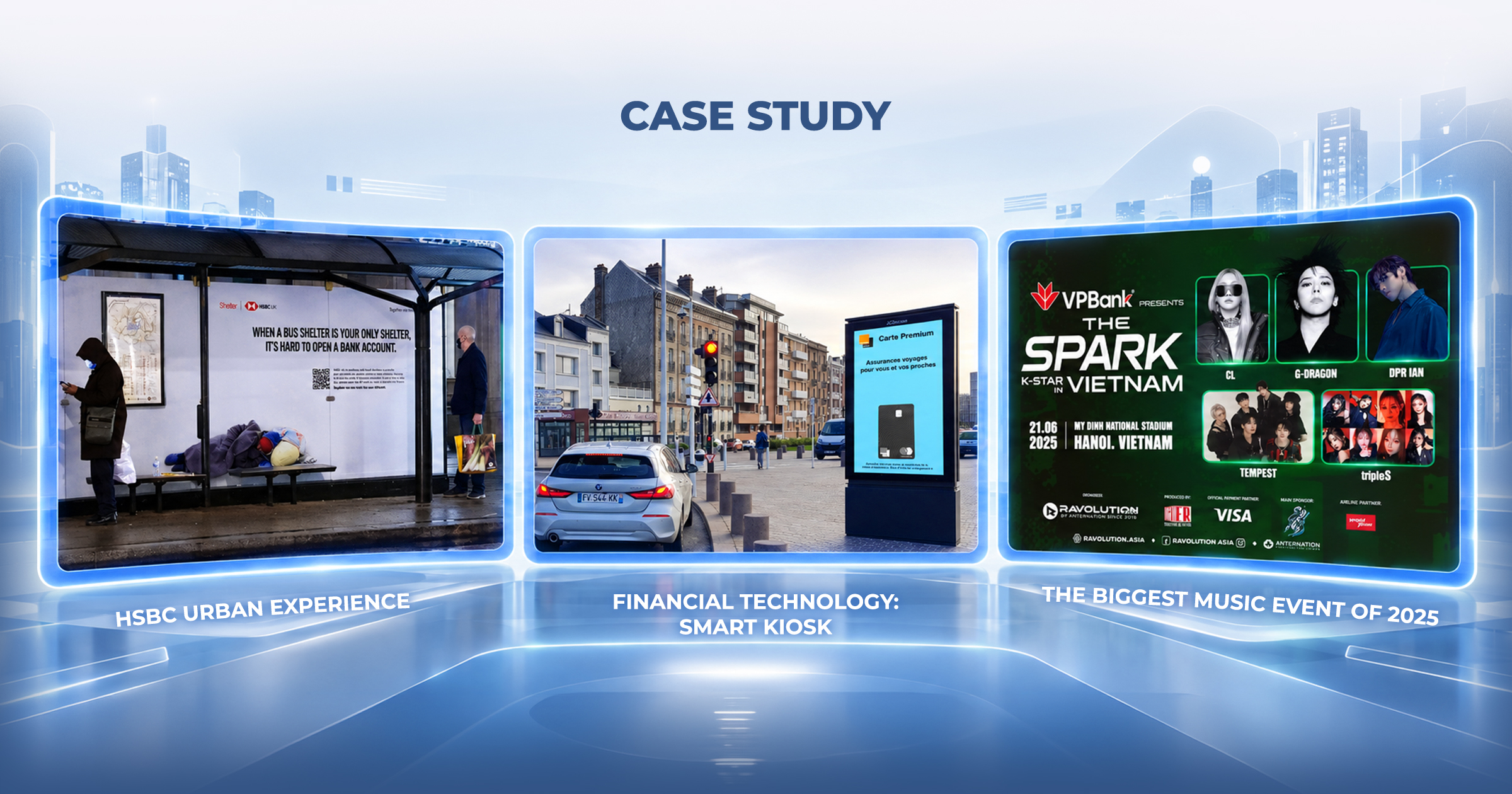
Case study: HSBC urban experience, Financial technology: smart kiosk, VP Bank music event in 2025
Case 1. OOH/DOOH Leading Customer Experience
HSBC UK – The Homeless Bank Account
Background and Challenge: For people without a fixed address, accessing traditional banking services can become a significant barrier. Without a permanent address, they may face difficulties opening a bank account, while the lack of access to banking services can further limit their ability to receive salaries, access benefits, and participate in the financial system. HSBC UK, in partnership with Shelter, developed the No Fixed Address service, enabling people without a permanent address to access banking services with support from participating organizations. Therefore, the challenge of the campaign was not simply to communicate a new service, but to deliver information about the solution to the people who needed it most.
Insight and Idea: Instead of maximizing reach among a broad audience, HSBC identified areas with high concentrations of homeless individuals and locations near HSBC branches that could provide support. OOH was therefore selected based on the real-life context of the target audience. The media placement was not only a communication channel, but also became part of the solution itself. The core idea was to bring information about the service directly to locations where the need existed.
Execution: HSBC deployed OOH advertising across locations relevant to the target audience, providing information about the No Fixed Address service. The campaign also integrated QR codes, allowing interested individuals to continue learning about the program and the support provided by Shelter. As a result, the advertisement was not simply a brand message. It became a pathway that enabled people to discover and access a practical financial solution.
Touchpoint Integration: OOH created awareness in the right physical context. QR codes created a bridge between the offline environment and digital information. Supporting organizations and HSBC branches continued the customer journey at the next stage. The key point was that advertising was not designed as the final touchpoint. Instead, it became part of the process of connecting people with the right support and solution.
Results:Within two weeks of the OOH campaign launch, the number of No Fixed Address accounts opened increased by 52%. The donations generated through QR interactions also helped Shelter support more than 100 people experiencing homelessness, while one in five people who scanned the QR code became regular supporters.
Key Learnings for Banking & Finance: The HSBC case demonstrates that OOH should not only be evaluated through reach and exposure metrics. When Audience, Location, Message, and Action are strategically connected, Outdoor Media can become an integral part of the solution a brand aims to deliver. For Banking & Finance brands, this creates a new perspective: instead of only asking “Where can we place advertising to maximize visibility?”, brands should consider “Who needs this message, where are they located, and what action can they take after seeing it?”
Case 2. DOOH Combined with Data and Technology
Orange Bank – Programmatic DOOH
Background and Challenge: DOOH provides brands with strong visibility and large-scale reach. However, brands still face an important challenge: how to leverage Outdoor Media with capabilities that have become common in Digital Media, including targeting, contextual delivery, optimization, and measurement. Orange Bank used Programmatic DOOH to promote its Premium Card and related offers in France, demonstrating how Data and Technology can transform the way Outdoor campaigns are planned, delivered, and measured.
Insight and Idea: Instead of viewing Outdoor Media as a fixed system with predetermined content and schedules, Programmatic DOOH brings Digital Media capabilities into physical environments. Content can be distributed more flexibly based on location, timing, and contextual factors, allowing brands to reach audiences at more relevant moments.
Execution: The campaign was deployed across 1,383 screens at 1,241 locations, focusing on cities where Orange Bank had physical presence and operating between 9 AM and 9 PM. Content was dynamically rotated instead of relying on a single creative format throughout the campaign, enabling messages to become more relevant based on campaign conditions. The key difference between traditional OOH and Programmatic DOOH lies in the ability to use data and technology throughout the distribution process, allowing screens to become more than static advertising placements.
Touchpoint Integration: Data was used to optimize content distribution and campaign delivery. Campaign effectiveness was then evaluated not only through impressions but also through Brand Lift measurements. Orange Bank conducted a Mobile Programmatic survey with 655 participants to evaluate the impact on Brand Awareness and Consideration. This approach brought Outdoor Media closer to Digital measurement thinking, where campaign effectiveness is assessed through changes in consumer perception and intent.
Results: The campaign generated approximately 8 million impressions, while achieving a 24-point increase in Brand Awareness and a 46% increase in Consideration, according to Displayce’s case study. A VIOOH case study also reported that 49% of consumers exposed to the campaign showed positive intent to learn more about Orange Bank’s offer.
Key Learnings for Banking & Finance: The Orange Bank case demonstrates that Data and Technology do not replace the fundamental role of OOH. Instead, they expand its capabilities. DOOH maintains the strength of physical visibility while gaining additional capabilities in content optimization, audience relevance, and campaign measurement. For Banking & Finance brands, this approach is particularly valuable for campaigns that need to communicate different products, offers, or messages to different customer segments.
Case 3. Activation Connecting Digital and Social
VPBank – K Star Spark in Vietnam 2025
Background and Challenge: As banking products become increasingly similar, brands need to find new approaches to become closer and more relevant to customers, especially younger audiences. Instead of only communicating product features and benefits, VPBank chose Culture and Music as the foundation to create a large-scale brand experience through K Star Spark in Vietnam 2025.
Insight and Idea: For younger audiences, Music and Pop Culture can create natural motivations for them to actively participate. Instead of starting the conversation with banking products, VPBank built the experience around artists and content that the target audience was genuinely interested in, including G-Dragon and CL. The important point is that Activation did not operate independently. The experience was connected with VPBank’s Digital ecosystem and product-related programs.
Execution: K Star Spark was developed into a large-scale experience featuring Concert activities, interactive experiences, and mechanisms connected with VPBank’s ecosystem. Some ticket benefits and promotional programs were linked with VPBank NEO and product usage conditions. According to YouNet Media, VPBank’s communication activities for Super Sinh Lời also connected benefits with actions such as account opening and fund deposits. Through this approach, Culture and Music created the reason for customers to engage, Activation created the experience, while Digital connected the experience with products.
Touchpoint Integration: The event experience generated content and conversations on Social platforms. Social continued to amplify the event to audiences who were not directly present. At the same time, Digital mechanisms helped customers move from interest to specific actions related to products.
Results: According to VPBank, K Star Spark in Vietnam attracted more than 40,000 attendees, generated over 128 million impressions, and achieved more than 30 million Social engagements. From a business perspective, VPBank recorded a 45% increase in new credit cards, more than 51% growth in card spending, nearly 30,000 Super Sinh Lời accounts opened, and more than VND 4,000 billion increase in CASA deposits during the reported period. YouNet Media also recorded VPBank as the leading banking brand on Social Media in May 2025, with discussions increasing by 178.9% and participants increasing by 367.5% compared to the previous month.
Lessons for the Bank Finance Industry: The key learning from K Star Spark does not only lie in the scale of a Concert. More importantly, it is the way the brand uses Culture to generate interest, Activation to create experiences, Digital to connect with products, and Social to extend the experience. For Bank Finance, this is an approach that allows brands to move beyond communication focused only on product features and benefits. When brands can appear in areas that customers genuinely care about, experiences have the opportunity to become more natural and create more reasons for customers to actively interact.
IV. NOVAON SOLUTIONS FOR BANK FINANCE BRAND EXPERIENCE
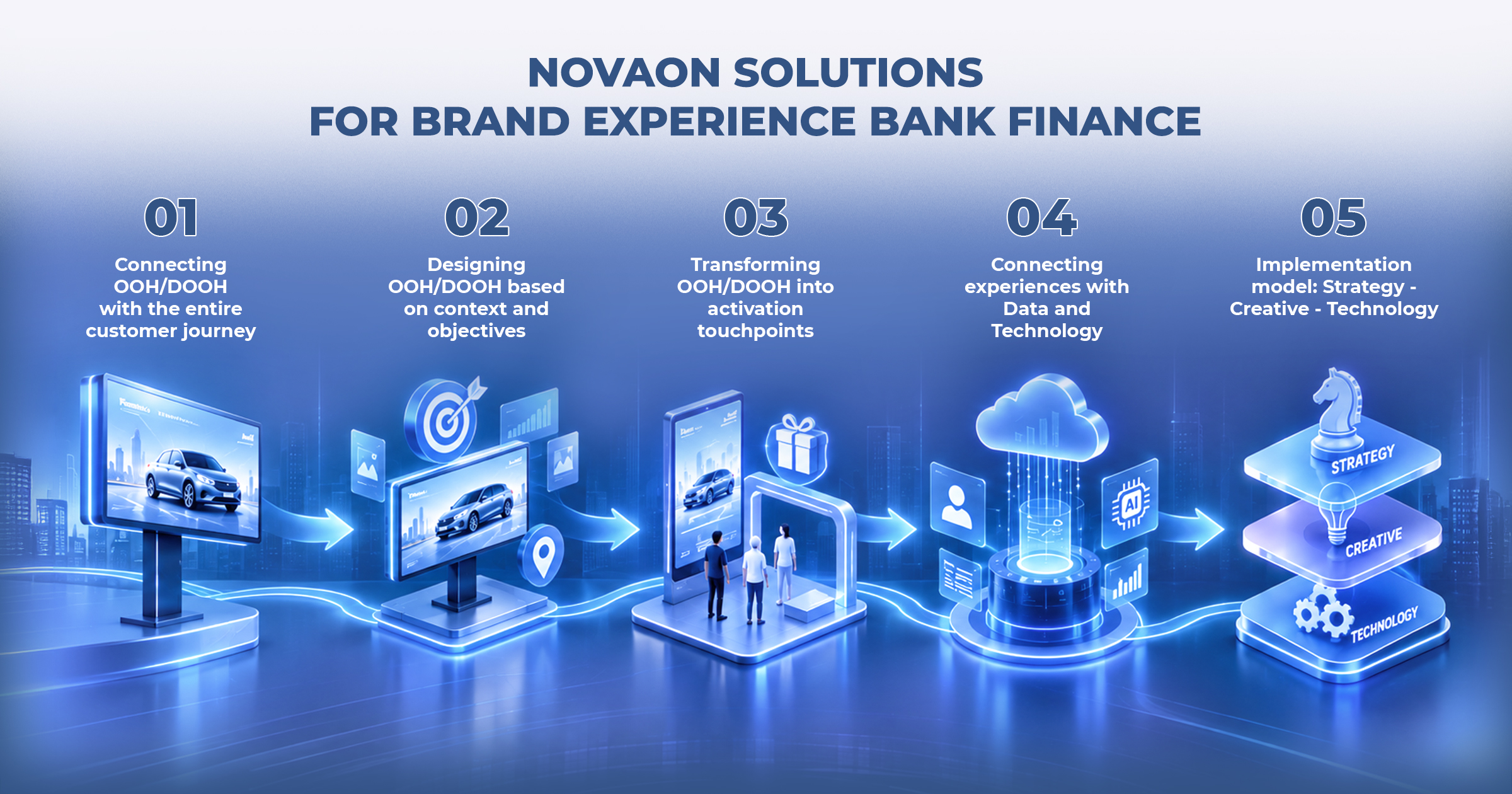
Novaon solutions for brand experience bank finance
1. Connecting OOH/DOOH with the Entire Customer Journey
Instead of implementing OOH/DOOH as an independent Media activity, Novaon can position Outdoor within an overall Customer Journey, clearly defining the role of each touchpoint from Awareness to Engagement and Conversion.
OOH creates presence in spaces capable of reaching the right customer groups. DOOH increases content flexibility through context, time, and interactive technology. Activation receives that attention and transforms it into direct experiences, while Digital continues the journey through Landing Pages, Apps, Lead Forms, or registration platforms.
This approach aligns with Novaon Digital’s Brand Experience direction, where Strategy, Technology, and Creativity are used to build connected experiences rather than optimizing each individual touchpoint separately.
2. Designing OOH/DOOH Based on Context and Objectives
OOH/DOOH should not be selected based only on Reach. For Bank Finance, location, audience, and needs at each specific moment need to be incorporated from the strategy development stage.
Novaon can develop a touchpoint system based on different contexts:
- Airport: Travel Card, international payments, travel insurance.
- Office Building: Saving, Investment, Wealth Management.
- Shopping Mall: Credit Card, Digital Banking, Loyalty.
- Metro and transportation areas: Digital Account, Payment, and products with frequent usage needs.
DOOH can then be used to adjust content according to each context, allowing the same campaign to deliver different messages to different customer groups. The objective is to transform Location from simply an advertising placement into a part of the experience strategy.
3. Transforming OOH/DOOH into Activation Touchpoints
One of the biggest gaps of OOH is that customers may see the brand but may not necessarily have a reason to continue interacting.
Novaon can design OOH/DOOH from the beginning with a clear Next Action. QR, Interactive Content, Mini Game, or Digital mechanisms can be integrated so customers can continue the experience on their Smartphones.
At suitable locations, Outdoor touchpoints can be directly connected with Activation. Customers see the message, interact, and are guided toward an experience space, consultation area, or registration process.
4. Connecting Experience with Data and Technology
When customers interact with QR, Landing Page, Activation, or Lead Form, these behaviors create valuable signals for brands.
Novaon Digital can connect Digital touchpoints and data to continue segmenting, nurturing, and personalizing customer experiences. Novaon’s website currently identifies Technology as one of the three core capabilities for transforming Brand Experience, alongside Strategy and Creativity.
For Bank Finance, the system can be designed to continue the journey after Activation: customers who have interacted are recorded, categorized based on their needs, and continue receiving suitable content or Offers on Digital platforms.
5. Implementation Model: Strategy – Creative – Technology
This is the model Novaon Digital is currently applying in its Brand Experience approach, where Strategy focuses on Insight and the journey, Creative creates differentiated experiences, and Technology helps connect and enhance the effectiveness of those experiences.
- Strategy defines the Customer Journey, Audience, the role of each touchpoint, and the KPI system throughout the campaign.
- Creative builds a Big Idea and a consistent experience system from OOH/DOOH to Activation, Digital, and Social.
- Technology connects touchpoints, data, and customer actions, from QR, Landing Pages, Lead Forms to suitable Digital and CRM systems.
CONCLUSION
The Bank Finance industry is becoming increasingly digitalized, but this does not mean that customer experiences only take place in the Digital environment. Customers still interact with brands in physical spaces, starting from an OOH/DOOH advertisement, continuing their exploration on Digital platforms, participating in direct experiences, and finally taking actions on digital platforms. As financial products and services become increasingly similar, the connection between these touchpoints becomes an important factor for brands to create differentiation.
In this context, OOH and DOOH are expanding from roles focused on creating reach into touchpoints capable of stimulating interaction and driving action. Therefore, Brand Experience Marketing 2026 is no longer centered on how many channels a brand appears on. The value lies in how OOH/DOOH creates attention, Activation creates experiences, Digital continues the journey, and Social amplifies those experiences. When touchpoints are designed to complement one another, brands can create a more unified journey, from awareness, interaction, and trust building to action.
Cre: Brands Vietnam