
In the automotive industry, customers are truly searching for peace of mind through a vehicle that is safe, durable, and capable of being a long term companion. However, communicating these core yet invisible values is difficult, especially when consumers are overwhelmed by information and increasingly skeptical of traditional advertising. Faced with this challenge, Subaru has chosen a distinct approach by centering safety as the core material to build a Brand Experience. This strategy allows customers to directly feel and verify the brand values rather than just hearing about them. To understand this strategy better, we spoke with Ms. Nguyen Bao Phuong, the Marketing Director at Subaru Vietnam.
Part 1: Market Context and Positioning Shifts. When Safety is the Source of All Desires
Amidst the explosion of technology, modern users are experiencing a state of information overload. According to statistics from Red Crow Marketing, an average person today may be exposed to between 4,000 and 10,000 advertisements daily. This massive volume of data forces them to create a mental filter to easily bypass superficial media campaigns and protect their limited attention.
For high end family customers, this filter is even more stringent. Their ultimate desire when purchasing a vehicle is absolute peace of mind to protect their families. According to behavioral psychology research from The Decision Lab and automotive industry surveys by MINI and Cox Automotive, there is a significant gap between technical data and customer perception. Focusing too heavily on dry specifications not only worsens information overload but also makes it harder for brands to reach the emotions of the user. This discrepancy creates a Cognitive Gap where customers crave safety but find it difficult to visualize or verify through one way advertising. The biggest challenge is how to penetrate that filter to transform mechanical commitments into authentic trust.
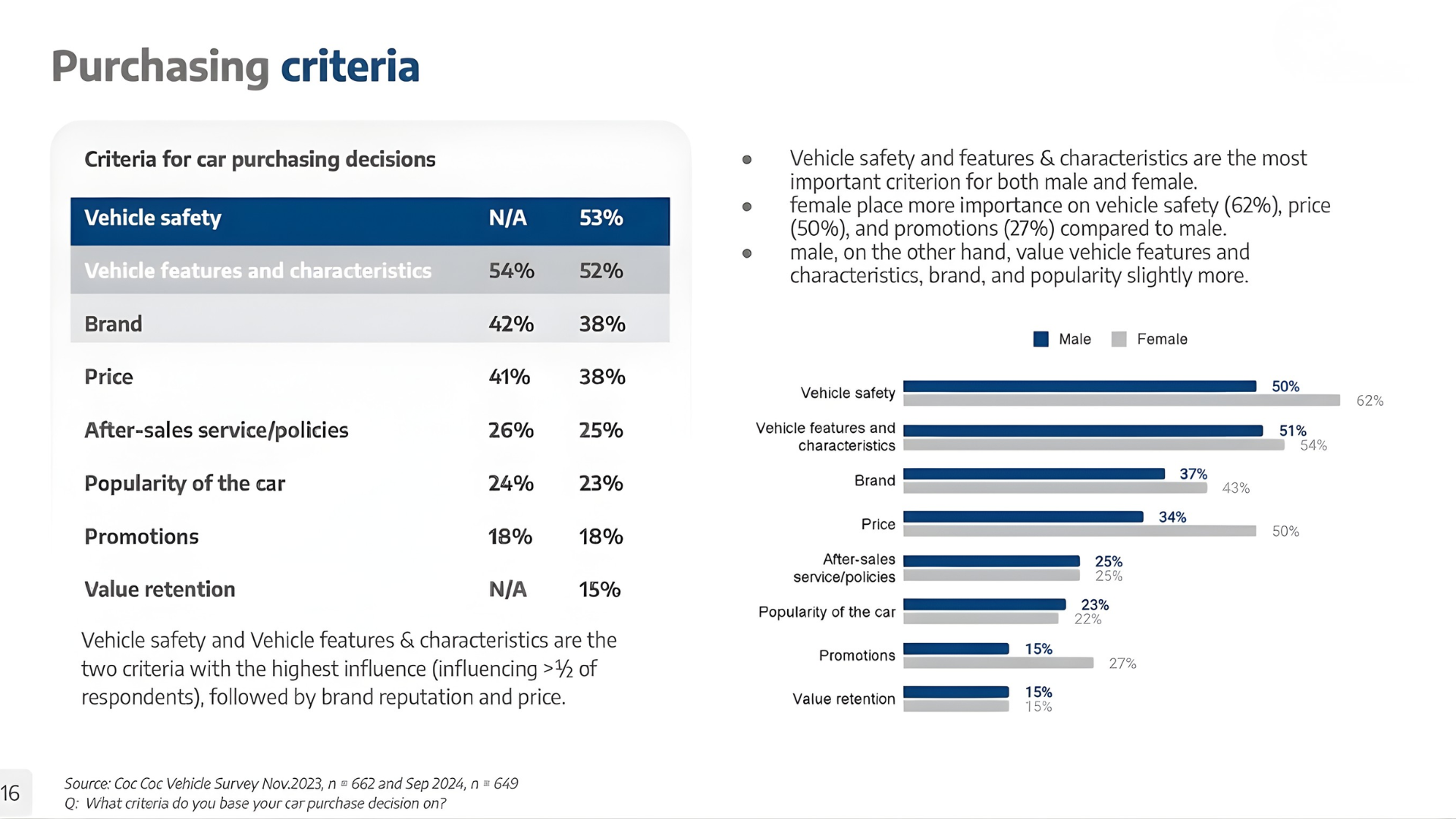
Safety is the leading factor for Vietnamese consumers when purchasing a car
Source: Coc Coc Ad Platform
In a context where customers demand evidence over promises, Brand Experience has emerged as a breakthrough strategy to address this urgent need. Instead of merely talking about safety, Brand Experience acts as a translator by creating interactive spaces where customers can directly feel and understand the product. When a brand proactively creates these empirical touchpoints where experts explain the chassis system or core safety features through relatable stories, the barrier of technical intimidation is immediately removed.
The combination of original mechanical quality and deep interactive experiences not only allows the brand to prove its capabilities but also builds a powerful emotional bond. As a result, the car is no longer just a machine but becomes a reliable companion for the family.
In the following section, Ms. Nguyen Bao Phuong, Marketing Director at Subaru Vietnam, will share how this marketing mindset is applied to create a core competitive advantage for the brand in the market.
Question 1: From the perspective of a brand that places safety at its core like Subaru, how do you believe the combination of product positioning and Brand Experience should be approached to attract your specific customer base?
Answer: In my opinion, the first and most important principle of this combination is that core product quality must be the absolute foundation for an excellent Brand Experience strategy. We cannot deliver a sense of peace of mind if the vehicle is not truly safe and robust from within.
Once a standard mechanical and technological foundation is established, Brand Experience steps in as the most persuasive practical evidence to validate the brand’s safety positioning. Customers may be reluctant to read dry technical specifications, but they are always convinced by what they experience personally. Instead of forcing them to understand the rigidity of steel or complex algorithms, we design practical experience spaces where they can see, hear, and directly feel the protective performance of the vehicle.

Quality is considered the key factor shaping Brand Experience strategy
Source: Novaon Digital
Using real life experience as a translator for technical specifications has successfully eliminated the barrier of dry data. Consequently, the positioning of life safety is no longer just a line in an advertisement but is truly transformed into solid trust. This realizes the philosophy of One life, one Subaru, a companion that fully protects every family journey.
Question 2: How can you communicate messages about product features and core values without making customers feel confused or bored?
Answer: The secret lies in translating technical language into the language of daily life. Customers, especially family breadwinners, do not need and do not want to become automotive engineers to make a buying decision.
Therefore, when communicating our core mechanical foundations—such as the enduring performance of a premium Japanese import or a sophisticated chassis designed similarly to luxury sports cars like Porsche—we strictly avoid overloading them with specifications. Instead, we place these foundations into real world scenarios. How will that chassis become a protective shield for the user in the split second of a collision?
To make this most accessible, no method is more effective than Brand Experience. When experts visually decode these features, complex mechanical functions automatically become relatable and easy to understand. Customers will clearly see the true value they are investing in. Those empathetic experiences create an invaluable asset of trust, ensuring the car is not just a machine but a choice made with pride for the family’s complete safety.
Part 2: Brand Experience as a Strategic Touchpoint for Positioning Safety and Durability in the Automotive Industry
Brand Experience in the automotive industry must be approached as an intentional strategic system rather than a series of fragmented activation activities. The focus is not on increasing the number of touchpoints but on designing touchpoints capable of converting core values like safety and durability into verifiable experiences, thereby directly impacting customer perception and trust.
However, in practical implementation, we sometimes fail to leverage the strategic role of Brand Experience, leading to three common bottlenecks. First is the bias toward form, where experiences are implemented as a communication layer to attract attention but lack the depth to reflect core values. Second is the lack of strategic alignment, where experiential activities are disjointed and not designed as a continuous journey, causing the message to be fragmented and less effective. Third is the failure to convert product value, where safety and durability features are still only spoken about rather than becoming something customers can truly feel and verify.
This raises a strategic question: How can Brand Experience truly become a mechanism for proving value, where every touchpoint not only communicates but also helps customers directly feel and believe in the brand’s positioning? More importantly, how can we break these execution bottlenecks to create an experience system deep and consistent enough to generate long term differentiation?
Question 3: To break these three execution bottlenecks, what do you believe is the overall Brand Experience strategy that helps a brand create substantive touchpoints and achieve a breakthrough?
Answer: An effective Brand Experience strategy must be built around a core principle: every touchpoint must prove the positioning, not just communicate it. To break the three execution bottlenecks, we need a synchronized system of solutions.
First, we must shift from superficial forms to empirical experiences. To overcome the bottleneck of shallowness, brands must move away from stereotypical formats such as static car displays. Instead, we need to design spaces and situations where customers can directly verify the sturdiness of the chassis and the responsiveness of safety features. The mechanical value must be realized by the customers themselves rather than existing only in flashy advertisements.
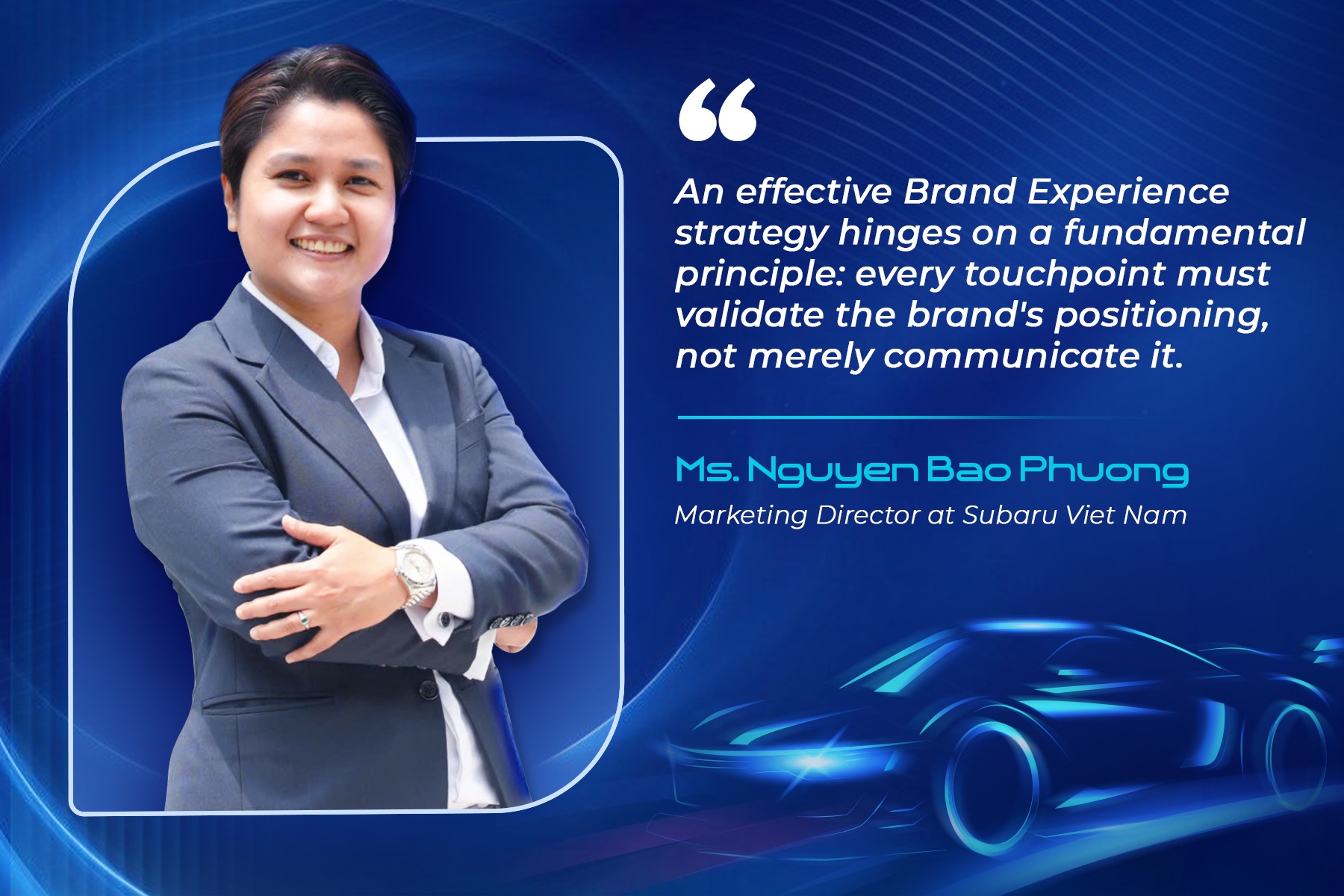
Core principles for building an effective Brand Experience strategy in the Automotive industry
Source: Novaon Digital
Second, creating a Seamless Journey. To resolve the bottleneck of fragmentation, Brand Experience must be designed as a continuous flow. The emotions and knowledge customers acquire in the digital space (Online) must be fully and consistently continued through in-depth consultation when they step into the showroom (Offline). Every touchpoint must resonate to reinforce a single message, avoiding any fragmentation of customer trust.
Third, transforming specifications into practical privileges. To clear the final bottleneck, do not ask customers to imagine durability or safety in the abstract. Instead, translate them into immediate, tangible benefits they can feel right away. Nowadays, every car is equipped with safety features, but what sets Subaru apart is the integrity, reliability, and responsive performance of those features in emergency situations. This is the value of true durability and, above all, the privilege of complete life protection for the entire family throughout years of companionship.
When these three solutions are synchronized, Brand Experience becomes the most powerful tool to transform core commitments into practical experiences, deeply embedding them in perception and creating long-term differentiation for the brand.
[Editorial Perspective – Empirical Case Study from Subaru]
In the journey of creating Brand Experience, Subaru does not follow a broad, scattered communication path but focuses on touchpoints that convey product capability. Partnering with Subaru in this strategy, Novaon Digital plays a supporting role in translating technical language and creating a seamless Online-to-Offline (O2O) experience flow:
- At digital touchpoints: Novaon Digital and Subaru implement in-depth Livestream sessions. Instead of one-way advertising, experts directly “decode” the product through empirical evidence, turning complex mechanical terms like the Boxer Engine or S-AWD (Symmetrical All-Wheel Drive) into everyday language that is easy to understand and trustworthy for users.
- At physical touchpoints: To perfectly complement the digital experience, the SATD (Subaru Advanced Technology Drive) specialized terrain test-drive series is organized with close coordination. Here, customers do not just observe; they directly take the wheel through simulated difficult terrains. This allows them to personally realize the life-saving value of the chassis and safety technologies that Subaru and Novaon Digital previously communicated on digital platforms.
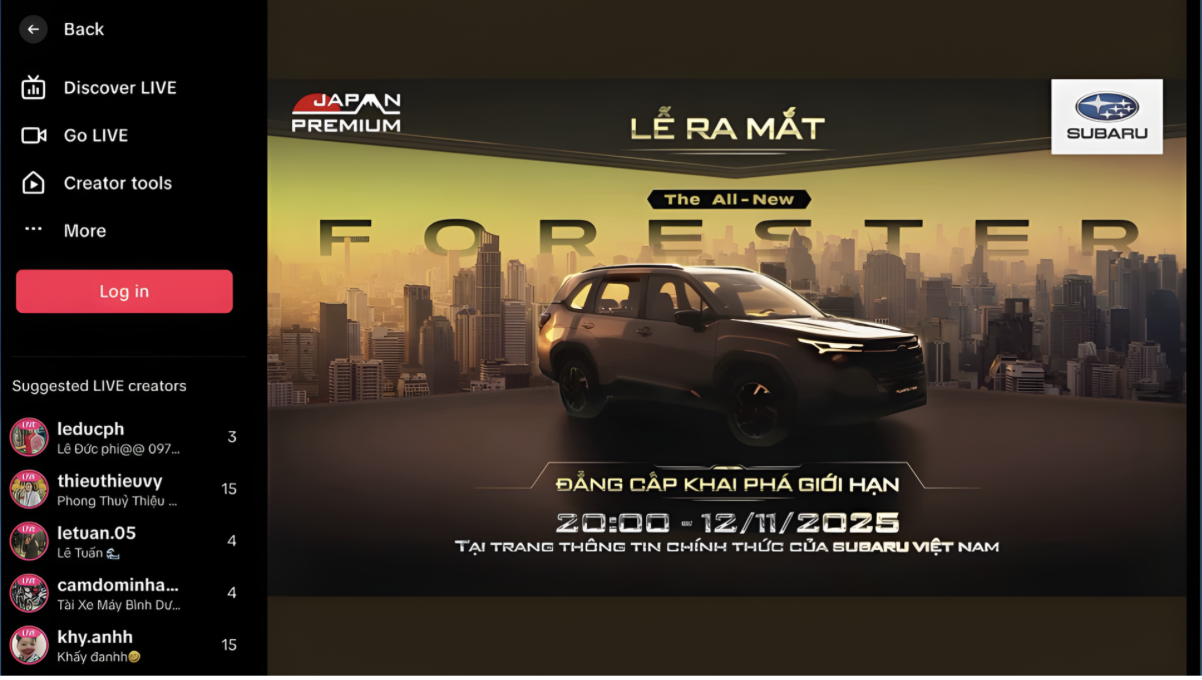
A technology decoding Livestream session conducted by Subaru in collaboration with Novaon Digital
Source: Novaon Digital
The close synergy between Subaru’s product mindset and Novaon Digital’s creative execution has ensured that safety and durability positioning are no longer just dry figures, but have become a solid foundation of trust deeply embedded in the minds of Vietnamese consumers.
Question 4: From your practical management experience, what blind spots or execution risks do you advise your team to avoid to prevent breaking the Brand Experience flow?
Answer: From a management perspective, I see three common execution blind spots when implementing Brand Experience with technical positioning.
First is the imposition of dry language. If a brand does not understand consumer insights to translate mechanical specifications for each target audience, cramming in technical terms will feel forced and immediately lose the emotional connection.
Second is the experience fracture between Online and Offline. The sense of peace of mind sparked in the digital space, such as through a Livestream, will completely collapse if the physical experience at the showroom—from consultation to test drives—does not maintain a corresponding level of expertise and consistency.
Third is proving values at the wrong time. Showcasing safety features or pushing technical specs at the wrong stage of the buyer journey makes the message annoying rather than useful.
Therefore, instead of chasing superficial creativity, we always approach Brand Experience as a journey management challenge. Every touchpoint must be designed with intent to serve a single goal: being a guarantee for the commitment to life safety.
Part 3: The Future of Automotive Communication. AI as a Lever for Core Product Positioning
Moving into 2026, communication in the automotive industry faces not only competitive pressure but also a phase of “trust filtration.” Customers are becoming increasingly demanding, especially regarding brands positioned around safety and human protection, where every commitment requires near-absolute authenticity.
In this context, Artificial Intelligence (AI) has emerged as a strategic lever helping brands deeply understand consumer behavior, with a predicted 30% growth in performance by 2030. Specifically, AI has helped brands increase leads by 20% to 25% through personalized services and advertising. Furthermore, up to 85% of automotive brands will continue to maintain and increase their investment in AI technology over the next three years. This figure indicates not just growth, but the powerful potential of AI within the automotive industry.
However, this power brings the risk of “message virtualization.” As AI can generate simulations of driving situations or safety performance with near-perfect realism, the line between real experience and rendered products becomes blurred. Therefore, the challenge is not whether to use AI, but how brands balance technology with authenticity. This ensures that every safety commitment is not only visually persuasive but also trusted and upheld through real experience and verification.
Question 5: Given the current wave of technology, how do you believe AI application should be approached to keep brand positioning relatable to customers?
Answer: In my view, the philosophy of applying AI must be encapsulated in one core principle: AI is an assistant for distributing the truth, absolutely not a creator of truth. To balance technological power and authenticity, at Subaru, we choose to approach this in two directions:
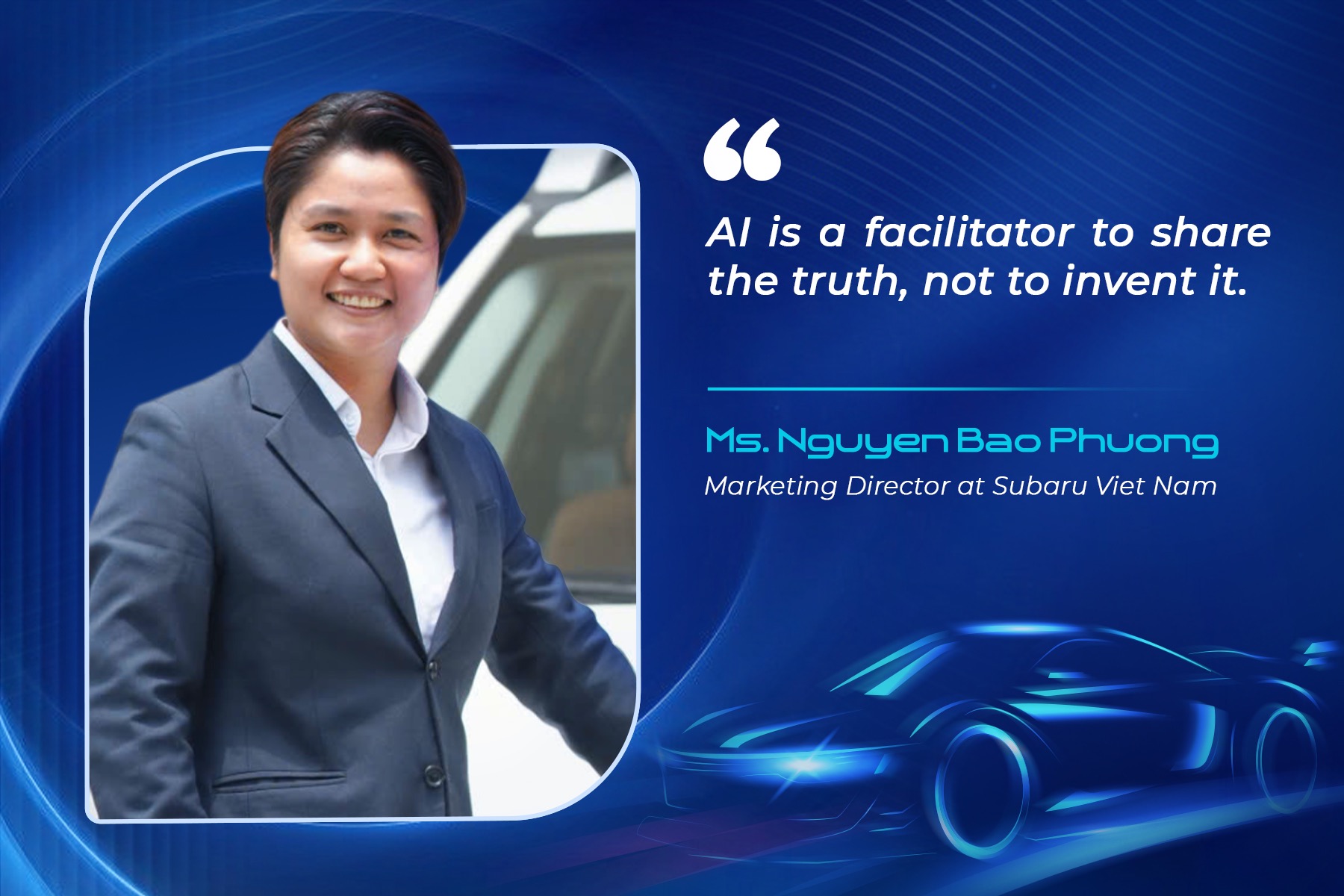
The role of AI in Automotive communications
Source: Novaon Digital
First, using AI to optimize touchpoints through a data-driven approach. The true power of AI lies in its ability to analyze big data. We use AI to decode insights, allowing us to personalize and distribute the right safety stories to the families who need them at the most opportune moments. This is an incredible lever to increase reach and efficiency without losing authenticity.
Second, using physical experience as an anchor of trust. For products with a mission to protect lives, the greatest risk is the virtualization of the message. If AI is overused to simulate flawless safety footage while the actual mechanical foundation falls short, customer trust will suffer a severe fracture. Therefore, AI should only serve as a guide. The ultimate touchpoints must remain empirical experiences where customers take the wheel themselves and feel the sturdiness of the chassis or the responsiveness of the original safety technology.
In short, technology helps us connect with customers faster and smarter, but the honesty of the mechanical system is what truly makes them stay.
Question 6: To conclude, could you share three lessons for Automotive CMOs on creating a Brand Experience that helps a brand maintain its identity in the AI era?
Answer: To stand firm in a market saturated with information and constant technological fluctuations, I believe marketers need to adhere to these three ultimate principles:
First, positioning must originate from an excellent mechanical core. Communicating safety or durability only carries weight when built upon an empirical product foundation. Do not promise peace of mind if the vehicle does not meet the most stringent standards for chassis rigidity and user protection. Real value is always the most powerful marketing material.
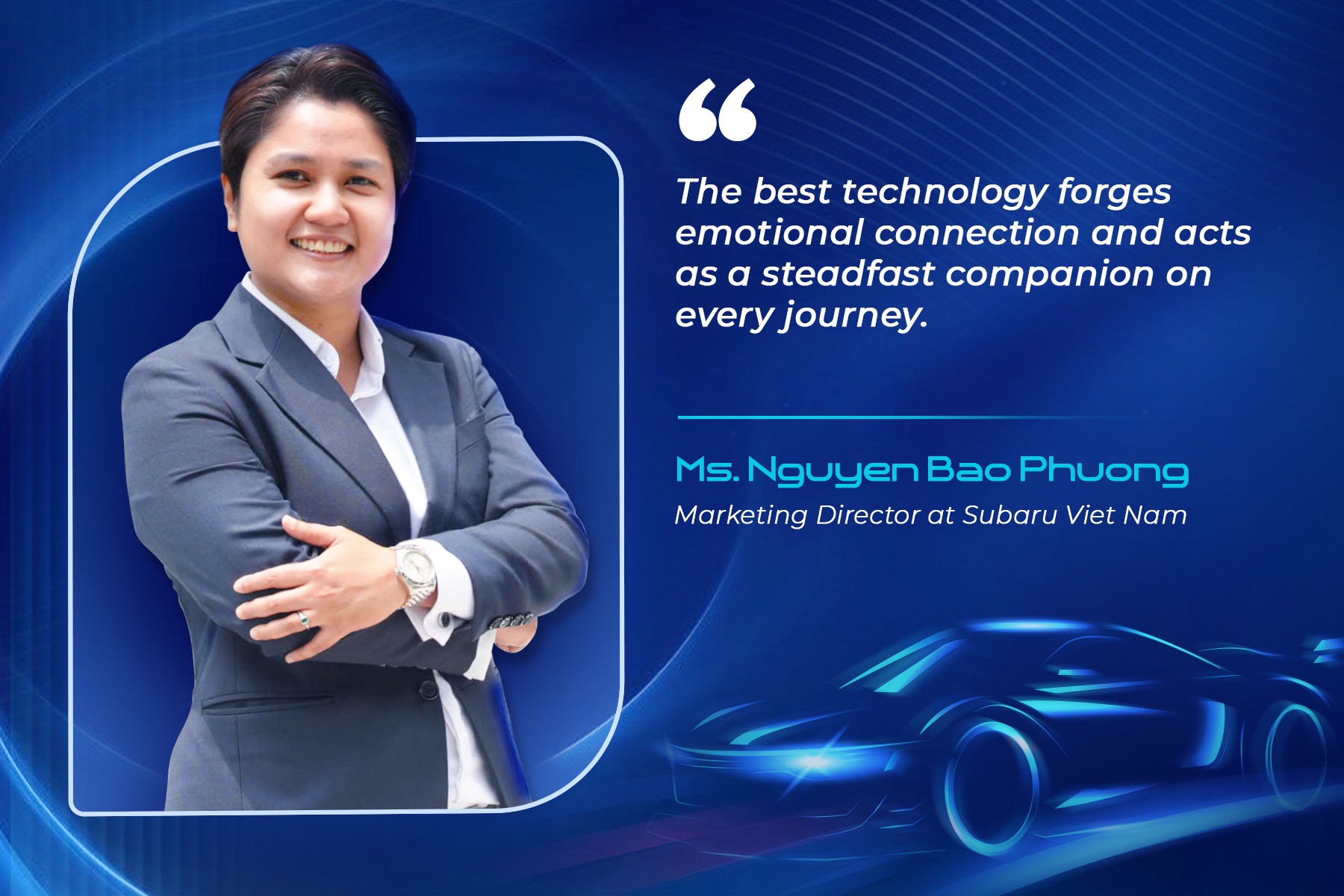
The secret to making technology a companion for Automotive brands
Source: Novaon Digital
Second, design experiences to prove, not just to tell. Today’s customers place their trust in what they can verify themselves, not in what a brand proclaims. Be consistent in investing in deep interactive touchpoints where technical language is visually decoded, allowing customers to realize the value for themselves instead of being force-fed one-way specifications.
Third, apply technology with empathy and discipline. AI and data are created to amplify the truth, not to mask product flaws. Use technology as an insightful assistant to personalize the customer journey, bringing safety messages to the exact families who desire them.
Ultimately, the highest form of technology is the one that connects human emotions and realizes the mission of becoming a steadfast companion on every journey.
Thank you for sharing these insights!