The report provides an in depth analysis of the market landscape, consumer behavior, five key shopping moments, and case studies from Hữu Nghị, Bảo Ngọc, Cung Đình Foods, Nutriboost, and Juchi. In doing so, it raises a new strategic question for FMCG brands: Beyond selling more within the existing category, in what other real-life contexts can the product become a natural consumer choice?
1. Festive Season 2026: From a Single Shopping Peak to an Extended Sequence of Demand
Vietnam’s consumer market continued to expand in 2026, but the positive headline figures also reflected a more cautious spending environment. During the first eight months of the year, total retail sales of goods and consumer service revenues reached approximately VND 5,235.5 trillion, up 13.3% year on year. However, after adjusting for price effects, real growth was only 7.6%, while average CPI increased by 4.45%. For FMCG brands, this means consumers are becoming more deliberate when weighing brand choice, price, pack size, and promotional offers.
At the same time, e-commerce and social commerce continued to expand. According to Metric data cited in the report, sales across Shopee, Lazada, Tiki, and TikTok Shop increased by 46.6% in Q1 2026 compared with the same period in 2025. TikTok Shop also reported a 66% increase in GMV in Vietnam in 2025, with the Grocery category growing by 71%. Nevertheless, traditional retail remained the preferred channel for 84% of shoppers during Tet, indicating that the purchase journey is increasingly distributed across both digital platforms and physical retail environments.
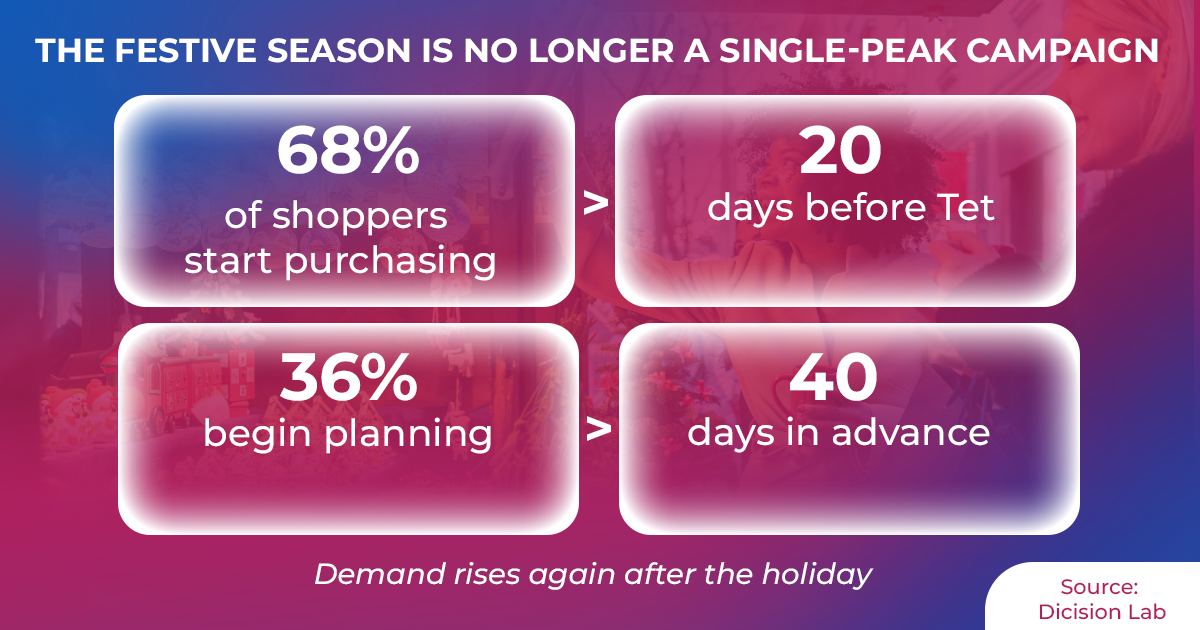
The festive season is therefore no longer defined by a single peak. The sequence of 9.9, 10.10, 11.11, 12.12, Christmas, New Year, and Tet extends the shopping period and creates multiple waves of demand. Research by Decision Lab and Meta cited in the report shows that 68% of shoppers begin purchasing more than 20 days before Tet, while 36% start planning more than 40 days in advance. Demand may also rise again after the holiday period.
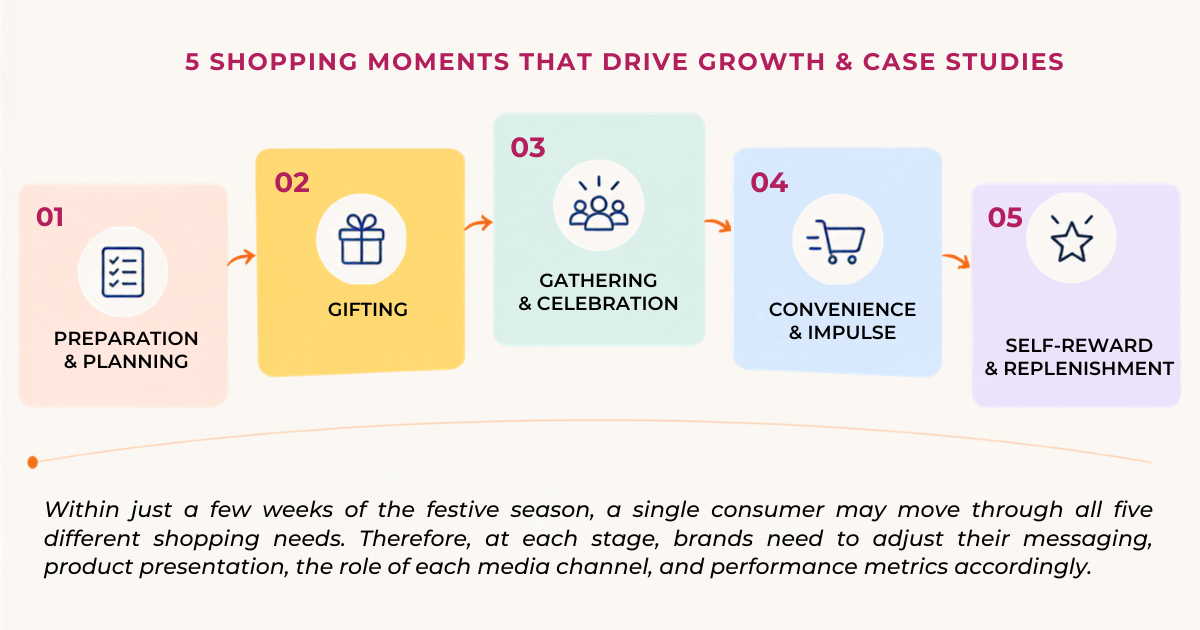
This suggests that brands can no longer concentrate resources solely around one major sales peak. Instead, the festive season should be understood as a sequence of interconnected demand states: preparation – gifting – gathering – impulse purchase – replenishment, each characterized by different consumer behaviors and purchase motivations.
2. FMCG Report 2026: From Category Growth to Occasion-Led Growth
Traditionally, FMCG businesses are managed by product categories such as beverages, confectionery, dairy, snacks, and personal care. This structure remains useful for market-share tracking and competitive analysis, but consumers do not begin their purchase journeys by thinking in terms of categories. They begin with a specific situation: guests are coming over, a gift is needed for a colleague, a family trip is being planned, snacks are needed for a movie night, or healthier eating habits are being resumed after Tet.
As a result, the same product can serve different roles depending on the context. A beverage may be consumed during a family meal, at a party, while travelling, or during a work break. Snacks may be associated with movies, gaming, social gatherings, or travel. A box of cakes may move beyond everyday consumption to become a gift. The product remains the same, but the reason for purchase changes with the occasion.
From this perspective, the Brand Report proposes shifting the strategic question from “How can we sell more within the current category?” to “What other contexts exist in which the brand could become a natural choice but remain underdeveloped?” A usage occasion becomes commercially meaningful only when three elements intersect: a genuine consumer need, a relevant product benefit, and a credible reason for the brand to be present.
Building on this framework, the report identifies five key shopping moments during the festive season. Preparation & Planning represents the period when brands can influence selection criteria before purchase decisions are fully formed. Gifting creates opportunities to increase perceived value through emotional meaning, packaging, presentation, and personalization. Gathering & Celebration enables brands to expand group consumption and create additional usage occasions. Convenience & Impulse requires brands to minimize the distance between the emergence of a need and the act of purchase. Self-Reward & Replenishment focuses on converting seasonal buyers into more regular customers by creating reasons to return after the festive period.
Each moment is supported by a specific case study. Hữu Nghị demonstrates the importance of engaging consumers before purchase decisions are fully formed. Bảo Ngọc illustrates how emotional value can enhance gifting behavior. Cung Đình Foods shows how a broad occasion such as Tet can be broken down into multiple smaller usage situations. Nutriboost demonstrates how brands can shorten the path from promotional exposure to in-store purchase. Juchi, meanwhile, illustrates how small but frequently recurring consumption occasions can help establish repeat-purchase habits.
Beyond current opportunities, the Brand Report also examines the future direction of FMCG marketing. As AI and customer data capabilities continue to advance, brands may move from responding to existing demand to anticipating emerging demand, while personalizing communication according to context and optimizing performance across the entire customer journey rather than evaluating individual channels in isolation.
3. Conclusion
The 2026 festive season calls for a new strategic approach to FMCG marketing. Rather than treating Tet or year-end as one major campaign built around a single message, brands need to understand the context consumers are in, the need that is emerging, and the most relevant role the product can play at that particular moment.
When communications, points of sale, data, and customer relationship activities are connected, each moment can become an opportunity to create additional reasons to purchase, expand usage occasions, and extend customer value beyond the first transaction. This is the central perspective behind Novaon Digital’s Brand Report “FMCG Festive-Season Marketing 2026”, developed to help brands identify new sources of growth in an increasingly fragmented and context-driven consumer landscape.